
The important battles in Indian history are turning points that decided who ruled the subcontinent. This chronological guide to important battles in Indian history lists each battle with its year, the sides involved and the result — the exact details SSC, Railway and State exams ask. Learn them era by era rather than as one long list.
Table of Contents
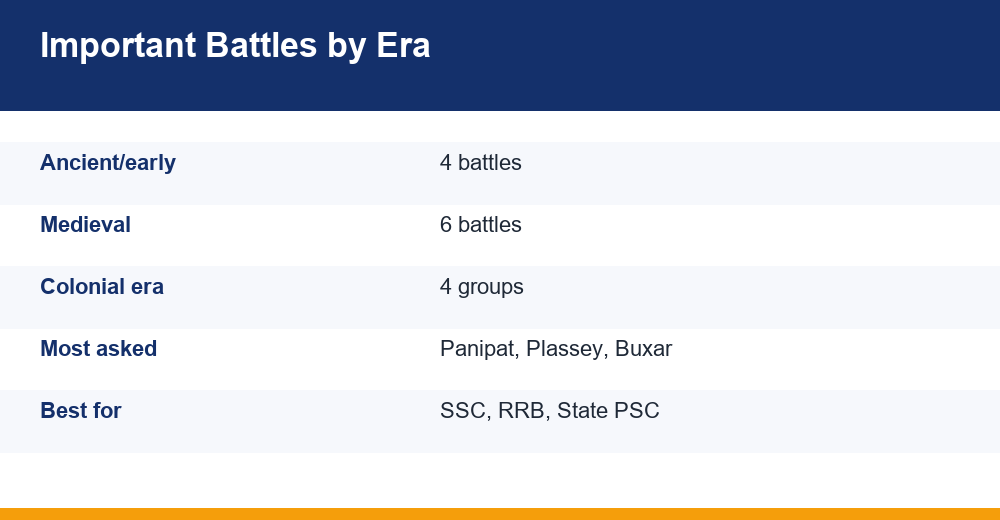
Ancient & early medieval battles
These early battles set the pattern of invasions from the northwest and the responses to them.
| Battle | Year | Fought between | Result |
|---|---|---|---|
| Battle of Hydaspes | 326 BCE | Alexander vs King Porus | Alexander won; Porus reinstated |
| Kalinga War | 261 BCE | Ashoka vs Kalinga | Ashoka won; turned to Buddhism |
| First Battle of Tarain | 1191 | Prithviraj Chauhan vs Muhammad Ghori | Prithviraj won |
| Second Battle of Tarain | 1192 | Muhammad Ghori vs Prithviraj Chauhan | Ghori won; Delhi Sultanate set in motion |
Medieval battles
The medieval period is dominated by the three Battles of Panipat and the rise of the Mughals. Note how the same battlefield (Panipat) decided the fate of India three times.
| Battle | Year | Fought between | Result |
|---|---|---|---|
| First Battle of Panipat | 1526 | Babur vs Ibrahim Lodi | Babur won; Mughal Empire founded |
| Battle of Khanwa | 1527 | Babur vs Rana Sanga | Babur won |
| Second Battle of Panipat | 1556 | Akbar (Bairam Khan) vs Hemu | Mughal victory |
| Battle of Talikota | 1565 | Deccan Sultanates vs Vijayanagara | Fall of Vijayanagara Empire |
| Battle of Haldighati | 1576 | Maharana Pratap vs Akbar’s forces | Mughal advantage; Pratap resisted |
| Third Battle of Panipat | 1761 | Marathas vs Ahmad Shah Abdali | Abdali won; Maratha losses |
Two more medieval clashes are worth adding, because examiners use them to test the transition between dynasties:
| Battle | Year | Fought between | Result |
|---|---|---|---|
| Battle of Chausa | 1539 | Sher Shah Suri vs Humayun | Sher Shah won; Humayun forced to flee |
| Battle of Kannauj (Bilgram) | 1540 | Sher Shah Suri vs Humayun | Sher Shah won; founded the Sur Empire |
| Battle of Karnal | 1739 | Nadir Shah vs Mughals (Muhammad Shah) | Nadir Shah won; sacked Delhi, took the Peacock Throne |
The Sur interregnum matters because Sher Shah Suri’s administrative reforms — the rupee, the Grand Trunk Road improvements and an efficient revenue system — were later absorbed by the Mughals. The Battle of Karnal (1739) is often overlooked but heavily asked: Nadir Shah’s invasion drained the Mughal treasury and exposed how weak the empire had become, accelerating its decline.
Colonial-era battles
These battles mark the rise of British power. Plassey and Buxar together are the most-asked pair, because they explain how a trading company became a ruling power. For the leaders of the resistance that followed, see our freedom fighters of India.
| Battle | Year | Fought between | Result |
|---|---|---|---|
| Battle of Plassey | 1757 | British (Robert Clive) vs Siraj-ud-Daula | British victory; foothold in Bengal |
| Battle of Wandiwash | 1760 | British vs French | British victory in the Carnatic |
| Battle of Buxar | 1764 | British vs Mir Qasim, Shuja-ud-Daula & Shah Alam II | British victory; consolidation of power |
| Anglo-Mysore Wars | 1767-1799 | British vs Mysore (Hyder Ali, Tipu Sultan) | British prevailed by 1799 |
The story did not end with Buxar. Through the late eighteenth and early nineteenth centuries the British fought a series of regional wars to consolidate control: the four Anglo-Mysore Wars against Hyder Ali and Tipu Sultan (ending with Tipu’s death at Seringapatam in 1799), the three Anglo-Maratha Wars (with the decisive Battle of Assaye in 1803), and finally the two Anglo-Sikh Wars (1845-1849) that led to the annexation of Punjab. Together these campaigns explain how, within roughly a century of Plassey, almost the entire subcontinent had come under British control either directly or through subsidiary alliances.
| War / Battle | Period | Outcome |
|---|---|---|
| Anglo-Mysore Wars | 1767-1799 | British defeat Mysore; Tipu Sultan killed in 1799 |
| Anglo-Maratha Wars | 1775-1818 | British break Maratha power; Battle of Assaye (1803) key |
| Anglo-Sikh Wars | 1845-1849 | Annexation of Punjab by the British |
Key turning points explained
A handful of these battles explain the entire sweep of medieval and colonial Indian history, and knowing the story makes the dates permanent. The First Battle of Panipat (1526) saw Babur, with a smaller army but with field artillery and the tulughma tactic, defeat the much larger force of Ibrahim Lodi, the last Sultan of Delhi. It ended the Delhi Sultanate and founded the Mughal Empire, which would dominate India for over three centuries.
The Battle of Talikota (1565) was fought between the combined Deccan Sultanates and the Vijayanagara Empire. The defeat and the sack of the capital, Hampi, ended one of the greatest empires of South India — a reminder that not every decisive battle involved the Mughals or the British.
The Battle of Plassey (1757) is often called the battle that won India for the British, though it was as much a conspiracy as a fight: Robert Clive defeated Siraj-ud-Daula, the Nawab of Bengal, after securing the betrayal of the Nawab’s commander Mir Jafar. It gave the East India Company control of Bengal’s wealth. Seven years later, the Battle of Buxar (1764) was a genuine military victory in which the British defeated the combined forces of Mir Qasim, the Nawab of Awadh and the Mughal Emperor Shah Alam II. Buxar confirmed and extended what Plassey had begun, giving the Company the Diwani (revenue rights) of Bengal, Bihar and Odisha.
Finally, the Third Battle of Panipat (1761) saw the Marathas suffer a catastrophic defeat against Ahmad Shah Abdali. The loss shattered Maratha power in the north at precisely the moment the British were expanding — an accident of timing that helped clear Britain’s path to dominance.
Why these battles matter
Each battle is a cause-and-effect hinge: Panipat 1526 began Mughal rule, Talikota ended Vijayanagara, Plassey and Buxar built British dominance, and the Third Battle of Panipat weakened the Marathas just as the British were rising. Understanding the consequence makes the date stick, and lets you answer analytical questions rather than only factual ones. Examiners increasingly prefer these “what was the result” and “what changed” questions over plain date recall, so always pair a battle with its outcome. You can verify dates and context against standard references such as the National Portal of India.
Recurring themes in Indian military history
Reading these battles together reveals patterns that make them easier to remember and to reason about. First, Panipat was decisive three times because it sat on the natural invasion route to Delhi from the northwest — whoever controlled Panipat controlled the capital. Second, superior tactics and technology repeatedly beat larger armies: Babur’s artillery at Panipat, the British discipline and alliances at Plassey and Buxar. Third, internal betrayal decided as many battles as fighting did — Mir Jafar at Plassey being the most famous example.
A fourth theme is timing: the British rose precisely as the two great Indian powers of the eighteenth century — the Mughals and the Marathas — were being weakened, the Mughals by Nadir Shah’s invasion (1739) and the Marathas by the Third Battle of Panipat (1761). When you can explain these themes, you can answer not just “when” a battle happened but “why it mattered”, which is exactly the higher-order question examiners now favour.
For a broader chronology, connect these battles with the leaders of the later freedom struggle in our freedom fighters of India guide, and with the constitutional history in our Indian polity notes.
Quick-recall: battles and their winners
Just before an exam, a rapid winner-focused recap is invaluable. Fix these outcomes in memory:
| Battle | Winner |
|---|---|
| First Battle of Panipat (1526) | Babur |
| Second Battle of Panipat (1556) | Akbar’s forces (Bairam Khan) |
| Third Battle of Panipat (1761) | Ahmad Shah Abdali |
| Battle of Plassey (1757) | British (Robert Clive) |
| Battle of Buxar (1764) | British |
| Battle of Talikota (1565) | Deccan Sultanates |
| Battle of Karnal (1739) | Nadir Shah |
If you can reproduce this small table from memory, you can answer the majority of direct battle questions. The trickiest for most candidates are the three Panipat outcomes and the Plassey-vs-Buxar distinction, so drill those two clusters until they are automatic.
How to remember important battles in Indian history
- Group by era (ancient, medieval, colonial) as above.
- For repeated battlefields like Panipat, memorise all three years together with their winners.
- Link each battle to its consequence — the “what changed” is often the real question.
- Revise with a blank table: write the year and result from memory, then check.
Master this compact set and you cover the large majority of battle-based history questions across SSC, Railway and State examinations.
Frequently Asked Questions
Which battle founded the Mughal Empire in India?
The First Battle of Panipat (1526), in which Babur defeated Ibrahim Lodi, founded the Mughal Empire.
What was the result of the Battle of Plassey?
The British East India Company under Robert Clive defeated Siraj-ud-Daula in 1757, giving the British a decisive foothold in Bengal.
How many battles of Panipat were fought?
Three battles of Panipat were fought — in 1526, 1556 and 1761 — each with a different outcome and significance.
Why are battles important in history for exams?
Battles mark turning points that explain how power changed hands, so examiners use them to test both dates and cause-and-effect understanding.