These Indian polity notes condense the most-tested parts of the Constitution into one revision-friendly page. Covering the making of the Constitution, its borrowed features, important articles, major amendments and constitutional bodies, these Indian polity notes are built for SSC, Railway and State PSC aspirants who want the high-yield facts without the bulk.
Table of Contents
Making of the Constitution
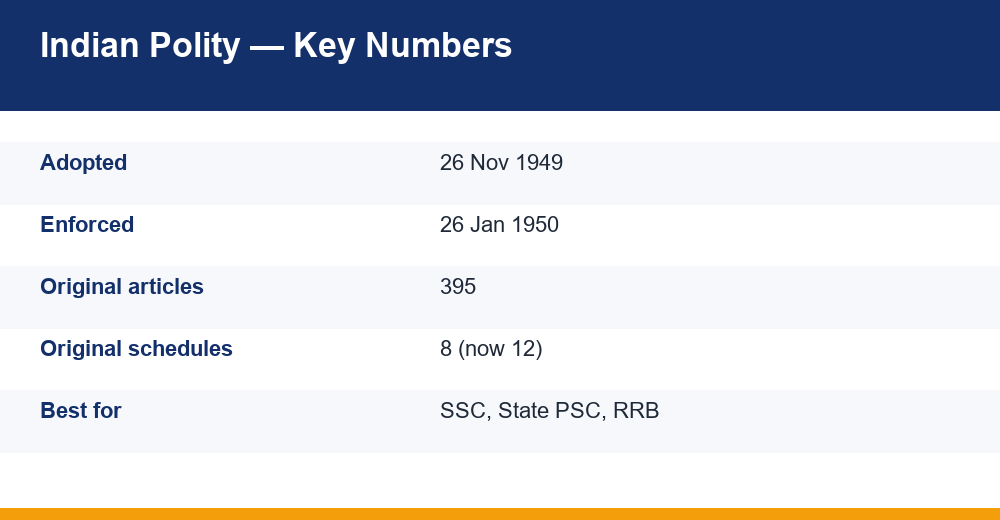
The Constituent Assembly was formed in 1946 to frame the Constitution. Dr. Rajendra Prasad was its President, and Dr. B. R. Ambedkar chaired the Drafting Committee, which is why he is called the chief architect of the Constitution. The Assembly took about two years, eleven months and eighteen days. The Constitution was adopted on 26 November 1949 (celebrated as Constitution Day) and came into force on 26 January 1950.
Salient features of the Constitution
A few defining features of the Indian Constitution are asked repeatedly. It is the longest written constitution of any sovereign country. It establishes a sovereign, socialist, secular, democratic republic (the words “socialist” and “secular” were added by the 42nd Amendment). It blends federal and unitary features — a federation with a strong Centre — and provides for a parliamentary form of government at both the Union and state levels. It is neither perfectly rigid nor perfectly flexible: some provisions can be amended by a simple majority, others need a special majority, and a few need ratification by the states as well. It also guarantees an independent judiciary with the power of judicial review, and a single citizenship for the whole country.
Borrowed features of the Constitution
The framers studied constitutions around the world and adapted the features that suited India. Knowing which feature came from where is one of the most reliably asked polity questions:
| Feature | Borrowed from |
|---|---|
| Parliamentary system, rule of law | United Kingdom |
| Fundamental Rights, judicial review, Preamble | United States |
| Directive Principles of State Policy | Ireland |
| Federal system with a strong Centre | Canada |
| Concurrent List, trade & commerce | Australia |
| Fundamental Duties | Erstwhile USSR |
| Emergency provisions | Germany (Weimar) |
A memory tip: the “rights and remedies” side (Fundamental Rights, judicial review, the Preamble) comes largely from the United States, the “duties and goals” side (Fundamental Duties from the USSR, Directive Principles from Ireland) reflects a socialist influence, and the day-to-day machinery of government (parliamentary system, rule of law) is British.
Parts & schedules
The Constitution is organised into Parts (covering themes like Fundamental Rights, DPSP and the Union) and Schedules (lists and tables). It originally had 395 articles and 8 schedules; today there are 12 schedules. Key parts to remember: Part III (Fundamental Rights), Part IV (Directive Principles), Part IVA (Fundamental Duties) and Part V (the Union). For a deeper look at Part III, see our detailed notes on the Fundamental Rights.
Important articles to remember
A compact set of articles accounts for most polity questions:
| Article | Deals with |
|---|---|
| Article 14 | Equality before law |
| Article 19 | Six freedoms (speech, assembly, etc.) |
| Article 21 | Protection of life and personal liberty |
| Article 21A | Right to education (6-14 years) |
| Article 32 | Right to Constitutional Remedies |
| Article 44 | Uniform Civil Code (DPSP) |
| Article 50 | Separation of judiciary from executive (DPSP) |
| Article 356 | President’s Rule in states |
| Article 368 | Amendment of the Constitution |
The Preamble
The Preamble is the introduction to the Constitution and reflects its philosophy. It declares India to be a Sovereign, Socialist, Secular, Democratic Republic and promises to secure to all citizens justice, liberty, equality and fraternity. The words “Socialist”, “Secular” and “Integrity” were added by the 42nd Amendment in 1976. The Preamble is based on the Objectives Resolution moved by Jawaharlal Nehru, and the Supreme Court has held that it is part of the Constitution and can be amended, but its basic structure cannot be destroyed.
Fundamental Rights, DPSP and Duties
Part III guarantees six Fundamental Rights: the Right to Equality (Articles 14-18), the Right to Freedom (19-22), the Right against Exploitation (23-24), the Right to Freedom of Religion (25-28), Cultural and Educational Rights (29-30) and the Right to Constitutional Remedies (32). These are justiciable, meaning citizens can approach the courts directly to enforce them. For a full breakdown, see our detailed notes on the Fundamental Rights.
Part IV contains the Directive Principles of State Policy (DPSP) — guidelines for the government to build a just society. Unlike Fundamental Rights, they are not enforceable in court, but they are “fundamental in the governance of the country”. Part IVA lists the Fundamental Duties (originally ten, now eleven), added by the 42nd Amendment on the recommendation of the Swaran Singh Committee. A classic exam question contrasts Fundamental Rights (justiciable, from the USA) with DPSP (non-justiciable, from Ireland).
Union, State and Concurrent Lists
The Seventh Schedule divides powers between the Centre and the states into three lists. The Union List contains subjects of national importance (defence, foreign affairs, railways) on which only Parliament can legislate. The State List contains subjects of local importance (police, public health, agriculture) generally reserved for state legislatures. The Concurrent List contains subjects on which both can legislate (education, forests, marriage); if there is a conflict, the central law prevails. Subjects not in any list fall under the residuary powers of the Centre.
Structure of Parliament
The Indian Parliament is bicameral, consisting of the President and two Houses. The Lok Sabha (House of the People) is directly elected and its members serve a five-year term; it is the more powerful House in money matters. The Rajya Sabha (Council of States) is a permanent body that is not subject to dissolution — one-third of its members retire every two years — and members serve six-year terms. Money Bills can be introduced only in the Lok Sabha, while the Rajya Sabha gives states a voice at the Union level. The Vice President is the ex-officio Chairman of the Rajya Sabha, and the Speaker presides over the Lok Sabha.
Key constitutional amendments
Amendments show how the Constitution has evolved. These five are asked most often:
| Amendment | Known for |
|---|---|
| 42nd (1976) | Added Fundamental Duties; ‘Socialist, Secular, Integrity’ in Preamble |
| 44th (1978) | Right to Property removed from Fundamental Rights |
| 61st (1989) | Voting age lowered from 21 to 18 |
| 73rd & 74th (1992) | Panchayati Raj and Municipalities |
| 101st (2016) | Goods and Services Tax (GST) |
The Union Executive: President, PM and Council of Ministers
The President is the constitutional head of state (Article 52) and exercises executive power on the aid and advice of the Council of Ministers. Elected indirectly by an electoral college for a five-year term, the President appoints the Prime Minister, other ministers, governors, judges and more, and enjoys legislative, executive, financial and judicial powers, including the power to grant pardons (Article 72). Real executive power, however, rests with the Prime Minister, the head of government, who leads the Council of Ministers and is collectively responsible to the Lok Sabha. The Council of Ministers has three ranks — Cabinet Ministers, Ministers of State and Deputy Ministers.
The Judiciary
India has an integrated and independent judiciary with the Supreme Court at its apex (Article 124), followed by the High Courts in the states and subordinate courts at the district level. The Supreme Court is the guardian of the Constitution and the ultimate interpreter of the law; through the power of judicial review it can strike down laws that violate the Constitution. The landmark Kesavananda Bharati case (1973) established the “basic structure” doctrine, holding that Parliament can amend the Constitution but cannot alter its basic structure. Judicial independence is protected through security of tenure, fixed service conditions and the separation of the judiciary from the executive (a Directive Principle under Article 50).
Emergency provisions
The Constitution provides for three kinds of emergency. A National Emergency (Article 352) can be declared on grounds of war, external aggression or armed rebellion. A State Emergency or President’s Rule (Article 356) is imposed when the constitutional machinery in a state fails. A Financial Emergency (Article 360) can be declared if the financial stability of India is threatened; it has never been used. During a National Emergency, the fundamental rights under Article 19 can be suspended, but the rights under Articles 20 and 21 can never be suspended — a protection strengthened after the experience of the 1975-77 Emergency.
Important constitutional bodies
Constitutional bodies derive their powers directly from the Constitution. The most-tested are the Election Commission (Article 324), the Union Public Service Commission (Article 315), the Comptroller and Auditor General (Article 148) and the Finance Commission (Article 280). Distinguish these from statutory bodies (created by law, such as the NHRC), because that distinction is a common question. You can read the full text of any article on the official National Portal of India.
Local government: Panchayati Raj & Municipalities
The 73rd and 74th Constitutional Amendments of 1992 gave constitutional status to local self-government — a favourite exam topic. The 73rd Amendment established a three-tier Panchayati Raj system (village, block and district levels) and added the Eleventh Schedule, which lists 29 subjects for panchayats. The 74th Amendment did the same for urban local bodies (Municipalities) and added the Twelfth Schedule, listing 18 subjects. Both amendments provide for regular elections every five years, reservation of seats for Scheduled Castes, Scheduled Tribes and women, and State Election Commissions to conduct local elections. These reforms are the constitutional basis of grassroots democracy in India.
Citizenship & the Union
Articles 5 to 11 deal with citizenship. India provides for single citizenship — unlike the United States, an Indian is a citizen of India alone, not of India and a state — which was designed to strengthen national unity. Parliament has the power to regulate citizenship by law, which it has done through the Citizenship Act. On the structure of the Union, Article 1 describes India as a “Union of States”, a phrase chosen deliberately to signal that the federation is indestructible: states can be reorganised by Parliament, but no state has a right to secede.
Constitutional vs statutory bodies
A recurring trap is the difference between constitutional and statutory bodies. Constitutional bodies derive their powers directly from the Constitution — the Election Commission (Article 324), UPSC (Article 315), CAG (Article 148), the Finance Commission (Article 280) and the Attorney General (Article 76). Statutory bodies are created by an ordinary Act of Parliament — the National Human Rights Commission, the Central Information Commission, the National Commission for Women and the erstwhile Planning Commission (now replaced by NITI Aayog, an executive body). Knowing which is which, and the article or Act behind each, answers a whole class of questions.
How polity questions are asked
In SSC, Railway and State exams, polity questions cluster around a predictable set: the article associated with a right or provision, the country a feature was borrowed from, the amendment behind a change, the difference between two bodies, and the roles and powers of constitutional posts. Because the syllabus is finite and stable, polity offers some of the most dependable marks in the General Awareness section — which is exactly why these Indian polity notes reward repeated, structured revision over last-minute reading.
How to revise Indian polity notes
- Anchor the four dates: Assembly formed (1946), adopted (26 Nov 1949), enforced (26 Jan 1950), and key amendment years.
- Learn the borrowed-features table as a block — it is almost always asked.
- Memorise the compact article list; most questions come from it.
- Separate constitutional bodies from statutory bodies to avoid the classic trap.
Revised regularly, these Indian polity notes turn one of the most scoring sections of the General Awareness paper into reliable marks. Pair them with current affairs on governance for full coverage.
Frequently Asked Questions
When was the Indian Constitution adopted and enforced?
The Constitution was adopted on 26 November 1949 and came into force on 26 January 1950, celebrated as Republic Day.
From which country were the Directive Principles borrowed?
The Directive Principles of State Policy were borrowed from Ireland.
Which amendment added the Fundamental Duties?
The 42nd Amendment of 1976 added the Fundamental Duties to the Constitution.
How many schedules does the Constitution have now?
The Constitution originally had 8 schedules; it now has 12 after subsequent amendments.