
Coding decoding reasoning is one of the most common and scoring topics in the reasoning section of SSC, Railway and Banking exams. The questions look mysterious at first, but every one of them hides a simple rule, and once you find the rule the answer follows immediately. This guide to coding decoding reasoning explains the letter-position method that unlocks most questions, walks through every major type with solved examples, and shares the tricks that make you fast.
Table of Contents
What is coding-decoding
In coding-decoding, a word, number or message is written in a disguised or “coded” form using a specific rule. Your task is to discover that rule by studying the example given, and then apply it to encode or decode a new word. Because the rule is always logical — a shift of letters, a reversal, a substitution or an arithmetic operation on positions — the topic tests pattern recognition rather than knowledge. That is exactly why it is scoring: with practice, the patterns become instantly recognisable.
The letter-position method
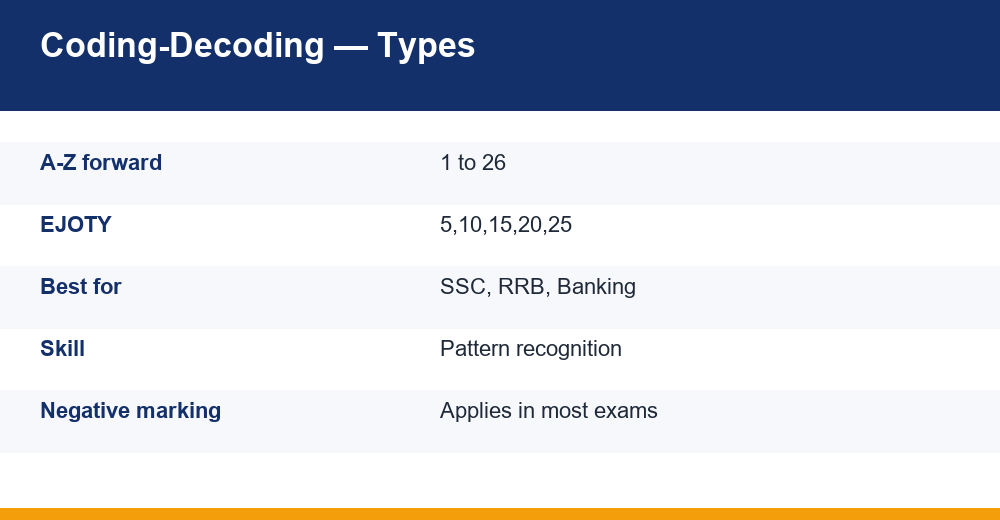
The single most useful skill for coding-decoding is knowing the position of every letter in the alphabet, both forward (A=1, B=2, up to Z=26) and backward (Z=1, Y=2, up to A=26). A helpful memory aid for the forward positions is EJOTY: E=5, J=10, O=15, T=20, Y=25. From these anchors you can quickly work out any nearby letter — for instance, if J is 10, then K is 11 and I is 9. Another useful fact is that a letter and its opposite always add up to 27 (A+Z = 1+26 = 27), which makes reverse-order questions fast.
With letter positions at your fingertips, most letter-coding questions reduce to simple arithmetic: compare the position of each letter in the code with the original, spot the constant shift, and apply it. This one skill solves the majority of coding-decoding questions you will meet.
Main types of coding decoding reasoning
Coding-decoding questions fall into a handful of recognisable types:
- Letter coding — letters are shifted forward or backward by a fixed number.
- Number/symbol coding — letters are replaced by numbers or symbols using a rule.
- Substitution coding — whole words are replaced by other words (e.g. “sky is called water”).
- Mixed-letter / message coding — groups of words are coded and you match words to codes.
- Conditional / new-pattern coding — coding based on rules and conditions, common in bank exams.
Solved coding-decoding examples
Example 1 (letter coding). If CAT is coded as DBU, how is DOG coded? Solution: each letter is shifted forward by 1 (C→D, A→B, T→U). Applying the same shift to DOG gives E, P, H — so the code is EPH.
Example 2 (letter coding, backward). If BAD is coded as YZW, find the rule. Solution: each letter is replaced by its opposite (B↔Y, A↔Z, D↔W), because opposite letters add up to 27. This is the reverse-alphabet rule.
Example 3 (number coding). If A=1, B=2 and so on, what is the code for the word “CAB”? Solution: C=3, A=1, B=2, so CAB = 312.
Example 4 (sum of positions). If the code of a word is the sum of its letter positions, what is the code for “ACE”? Solution: A=1, C=3, E=5, so the code is 1+3+5 = 9.
Example 5 (substitution). If “green” is called “blue”, “blue” is called “red” and “red” is called “white”, what is the colour of the clear daytime sky? Solution: the sky is blue, but blue is called “red”, so the answer is “red”.
Example 6 (message coding). If “pit dar na” means “you are good”, “dar toll ne” means “good and bad” and “ne jji pit” means “they are bad”, which word means “bad”? Solution: “good” is common to the first two phrases and codes to “dar”; “are/you” involves “pit”; comparing the second and third phrases, “bad” is common and codes to “ne”.
New-pattern coding-decoding
Banking and some SSC exams increasingly use “new-pattern” coding, where several sentences are coded and you must deduce the code for individual words by comparing the sentences, or where coding follows a set of conditions. These questions are more time-consuming but follow the same logic: find what is common between coded sentences to isolate the code for each word. The key is to be systematic — line up the sentences, mark the common words, and eliminate step by step rather than guessing. With practice, even these longer questions become manageable.
More solved examples
Example 7 (shift by position). If MONDAY is coded as NPOEBZ, what is the rule? Solution: each letter moves forward by one place (M→N, O→P, N→O, D→E, A→B, Y→Z), a +1 letter shift.
Example 8 (two-step rule). If a code reverses the word and then shifts each letter forward by 1, then WORD becomes DROW reversed and shifted: D→E, R→S, O→P, W→X = ESPX. Breaking a two-step rule into its steps is the key skill in harder questions.
Example 9 (number to letter). If 1 means A, 2 means B and so on, decode 8-5-12-12-15. Solution: 8=H, 5=E, 12=L, 12=L, 15=O, spelling HELLO.
Example 10 (product of positions). If the code of a word is the product of its letter positions, what is the code for BE? Solution: B=2, E=5, so the code is 2×5 = 10.
Common mistakes to avoid
The most frequent errors in coding decoding reasoning come from small slips rather than hard logic. Miscounting a letter’s position, especially near the middle of the alphabet, is the classic one, which is why memorising EJOTY and the opposite-letter rule matters. Another is spotting a partial pattern and applying it too quickly, when the real rule involves two steps such as a reversal followed by a shift. A third is confusing forward and backward counting in reverse-alphabet questions. The fix for all three is the same: verify your rule against every letter of the given example before applying it to the target word.
Tricks & practice
The fastest solvers all share two habits: they know letter positions cold, and they have seen enough question types that they recognise the pattern within seconds. Build the first by drilling the alphabet forward and backward until it is automatic, and the second by solving a variety of coding-decoding questions every day. Always identify the type first, then apply the matching method. For more reasoning practice, see our blood relations reasoning guide and our GK one-liner questions for overall revision, and confirm your exam reasoning syllabus on the official SSC website.
Because coding-decoding rewards pattern recognition over memory, it is one of the best return-on-effort topics in the reasoning section. A couple of weeks of daily practice is usually enough to make these questions near-automatic marks in the exam.
Frequently Asked Questions
What is coding-decoding in reasoning?
Coding-decoding is a reasoning topic where a word or message is written in a coded form using a rule, and you must find the rule to encode or decode another word.
What is the easiest way to solve coding-decoding questions?
Learn the position of each letter in the alphabet (A=1 to Z=26) and the reverse order. Most letter-coding questions are solved by comparing letter positions.
What is EJOTY in coding-decoding?
EJOTY is a memory aid for letter positions: E=5, J=10, O=15, T=20, Y=25. It helps you quickly find the position of any nearby letter.
Which exams ask coding-decoding questions?
Coding-decoding appears in almost all reasoning sections — SSC, Railway (RRB), Banking (IBPS, SBI) and State exams — making it a high-value topic.