The important articles of Indian Constitution are the most reliable scoring area in the polity section of SSC, Railway, Banking and TET papers. This guide sorts the 60 most-asked articles part by part, from Part I to Part XX, with a one-line meaning, an exam-weight tag and memory tricks, so you revise with priorities instead of scrolling through an unsorted list.
Table of Contents
How Many Articles Are in the Indian Constitution?
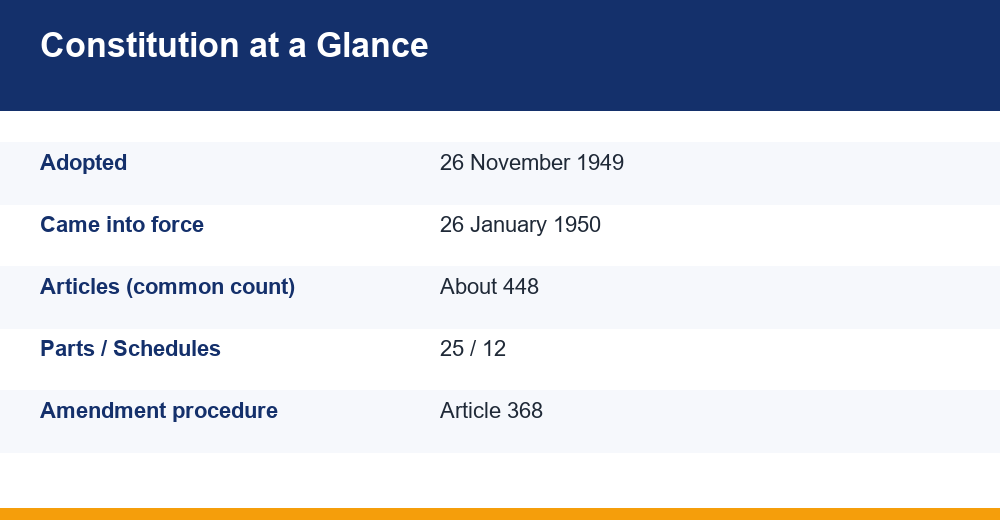
When the Constitution came into force on 26 January 1950, it had 395 articles in 22 parts and 8 schedules. The Constituent Assembly had adopted it two months earlier, on 26 November 1949, the day now observed as Constitution Day.
More than seven decades of amendments have added new provisions. The numbering, however, still ends at Article 395, because new articles are slotted in with letter suffixes such as 21A, 51A, 243A or 300A. That is why exam books quote a count of about 448 articles in 25 parts and 12 schedules, even though the last number you will see is 395.
Some articles have also been repealed or left blank, so the exact total depends on how a source counts them. For exams, remember the standard answer: about 448 articles, 25 parts and 12 schedules today, against 395 articles, 22 parts and 8 schedules originally.
| Feature | At commencement (1950) | Commonly cited today |
|---|---|---|
| Articles | 395 | About 448 |
| Parts | 22 | 25 |
| Schedules | 8 | 12 |
| Last article number | 395 | 395 (insertions use A, B, C) |
You do not need to memorise all of them. Around 60 provisions account for most of the questions asked, and those are the important articles of Indian Constitution covered below. If you are starting polity from scratch, pair this list with our broader Indian polity notes so each article sits inside a clear concept.
For the authoritative text of any article, refer to the website of the Legislative Department, Ministry of Law and Justice, which publishes the official, up-to-date edition of the Constitution of India along with regional-language versions.
Important Articles of Indian Constitution: Part-Wise Master Table
The table below arranges 60 articles in the order they appear in the Constitution. The exam-weight tag is our editorial judgement based on how often each article recurs in previous SSC CGL, CHSL, MTS, RRB NTPC and Group D papers: High means it turns up repeatedly, Medium means it appears now and then. Treat the tags as a revision guide, not a statistic.
| Article | Part | What it says (one line) | Weight |
|---|---|---|---|
| 1 | I | India, that is Bharat, shall be a Union of States | High |
| 3 | I | Formation of new States, change of areas, boundaries or names | High |
| 5 | II | Citizenship at the commencement of the Constitution | Medium |
| 11 | II | Parliament to regulate citizenship by law | Medium |
| 12 | III | Definition of ‘the State’ for Fundamental Rights | Medium |
| 14 | III | Equality before law and equal protection of laws | High |
| 15 | III | No discrimination on religion, race, caste, sex or place of birth | High |
| 16 | III | Equality of opportunity in public employment | High |
| 17 | III | Abolition of untouchability | High |
| 18 | III | Abolition of titles (except military and academic) | Medium |
| 19 | III | Six freedoms, including speech and expression | High |
| 21 | III | Protection of life and personal liberty | High |
| 21A | III | Free and compulsory education for children aged 6 to 14 | High |
| 22 | III | Protection against arrest and detention | Medium |
| 23 | III | Ban on human trafficking and forced labour | Medium |
| 24 | III | No child below 14 in factories, mines or hazardous work | High |
| 25 | III | Freedom of conscience and religion | Medium |
| 30 | III | Right of minorities to run educational institutions | Medium |
| 32 | III | Right to constitutional remedies (writs from Supreme Court) | High |
| 40 | IV | Organisation of village panchayats | High |
| 44 | IV | Uniform Civil Code for citizens | High |
| 45 | IV | Early childhood care and education below age 6 | Medium |
| 48A | IV | Protection of environment, forests and wildlife | Medium |
| 50 | IV | Separation of judiciary from executive | Medium |
| 51 | IV | Promotion of international peace and security | Medium |
| 51A | IVA | Fundamental Duties of citizens | High |
| 52 | V | There shall be a President of India | Medium |
| 54 | V | Election of the President | High |
| 61 | V | Impeachment of the President | High |
| 72 | V | President’s power to grant pardons | High |
| 74 | V | Council of Ministers to aid and advise the President | Medium |
| 76 | V | Attorney General for India | High |
| 79 | V | Constitution of Parliament | Medium |
| 80 | V | Composition of the Rajya Sabha | Medium |
| 110 | V | Definition of Money Bills | High |
| 112 | V | Annual Financial Statement (Union Budget) | High |
| 123 | V | President’s power to issue ordinances | High |
| 124 | V | Establishment of the Supreme Court | High |
| 143 | V | Advisory jurisdiction of the Supreme Court | Medium |
| 148 | V | Comptroller and Auditor General of India | High |
| 153 | VI | Governors of States | Medium |
| 155 | VI | Appointment of the Governor | Medium |
| 163 | VI | Council of Ministers to aid and advise the Governor | Medium |
| 213 | VI | Governor’s power to issue ordinances | Medium |
| 226 | VI | High Courts’ power to issue writs | High |
| 239AA | VIII | Special provisions for Delhi | Medium |
| 243B | IX | Constitution of Panchayats | Medium |
| 243Q | IXA | Constitution of Municipalities | Medium |
| 246 | XI | Subject-matter of laws made by Parliament and States | Medium |
| 265 | XII | No tax without authority of law | Medium |
| 280 | XII | Finance Commission | High |
| 300A | XII | Right to property as a legal (not fundamental) right | High |
| 315 | XIV | Public Service Commissions for Union and States | High |
| 324 | XV | Election Commission: superintendence of elections | High |
| 326 | XV | Elections on the basis of adult suffrage | High |
| 343 | XVII | Hindi in Devanagari as official language of the Union | High |
| 352 | XVIII | Proclamation of National Emergency | High |
| 356 | XVIII | President’s Rule in States | High |
| 360 | XVIII | Financial Emergency | High |
| 368 | XX | Power of Parliament to amend the Constitution | High |
Notice the pattern: just over half of the High-weight entries sit in Parts III and V. If your preparation time is short, cover those two parts first, then Part XVIII (Emergency) and the independent bodies such as the CAG, the Finance Commission and the Election Commission.
Fundamental Rights, Directive Principles and Duties
Part III (Articles 12 to 35) holds more of the important articles of Indian Constitution than any other part, and it is the most heavily tested block in every government exam. Group the rights into six heads and the articles fall into place: equality (14 to 18), freedom (19 to 22), against exploitation (23 and 24), religion (25 to 28), cultural and educational (29 and 30) and constitutional remedies (32).
Article 21A was added by the 86th Amendment in 2002, and the right to property was moved out of Part III by the 44th Amendment in 1978, surviving as Article 300A. Both facts are favourite one-liners. For a detailed walkthrough of each right with case examples, read our guide to fundamental rights in the Indian Constitution.
Which article is called the heart and soul of the Constitution?
Article 32, the right to constitutional remedies. In the Constituent Assembly, Dr B.R. Ambedkar described it as the very soul and heart of the Constitution, because without it every other fundamental right would be unenforceable. It lets a citizen approach the Supreme Court directly for enforcement.
The Supreme Court can issue five writs under Article 32, and High Courts can issue the same writs under Article 226, which is wider because it also covers ordinary legal rights:
- Habeas corpus: produce a detained person before the court
- Mandamus: command a public authority to perform its duty
- Prohibition: stop a lower court from exceeding its jurisdiction
- Certiorari: quash an order already passed by a lower court
- Quo warranto: ask by what authority a person holds a public office
Directive Principles and Fundamental Duties
Part IV (Articles 36 to 51) contains the Directive Principles of State Policy. They are not enforceable in court, but they guide law-making. Articles 40 (village panchayats), 44 (Uniform Civil Code), 48A (environment) and 50 (separation of judiciary) are the ones examiners prefer.
Fundamental Duties sit in Article 51A under Part IVA, inserted by the 42nd Amendment in 1976 on the recommendation of the Swaran Singh Committee. There were originally ten duties; the eleventh, on parents or guardians providing education to children aged 6 to 14, came with the 86th Amendment in 2002.
Union Executive, Parliament and Judiciary
Part V (Articles 52 to 151) covers the Union government. It produces the largest number of article-to-office matching questions, so learn it as a sequence rather than as isolated numbers.
- 52 to 62: the President, including election (54), oath (60) and impeachment (61)
- 63 to 71: the Vice-President, who is ex officio Chairman of the Rajya Sabha (64)
- 72: pardoning power of the President
- 74 and 75: Council of Ministers and the Prime Minister
- 76: Attorney General, the highest law officer of the Union
- 79 to 122: Parliament, with Money Bills under 110 and the Budget under 112
- 123: ordinances when Parliament is not in session
- 124 to 147: the Supreme Court
- 148 to 151: the Comptroller and Auditor General
Two pairs confuse candidates every year. Article 110 defines a Money Bill, while Article 112 calls the Budget the Annual Financial Statement; the word ‘Budget’ itself does not appear there. Likewise, Article 123 gives ordinance power to the President and its mirror, Article 213, gives it to the Governor.
A joint sitting of both Houses to resolve a deadlock on an ordinary bill falls under Article 108. It does not apply to Money Bills or constitutional amendment bills, a distinction that appears regularly in statement-type questions.
States, Delhi and Local Bodies
Part VI (Articles 152 to 237) largely mirrors Part V for the States. If you know the Union article, you can often guess the State article’s role: Governor (153 to 162), State Council of Ministers (163 and 164), Advocate General (165), State legislature (168 onwards) and High Courts (214 onwards).
Article 239AA, inserted by the 69th Amendment in 1991, gives Delhi its Legislative Assembly and special status as the National Capital Territory. It comes up often in Delhi-focused recruitment papers such as DSSSB.
Panchayats and Municipalities
Local self-government gained constitutional status through two 1992 amendments. The 73rd Amendment added Part IX (Articles 243 to 243O) and the Eleventh Schedule for panchayats. The 74th Amendment added Part IXA (Articles 243P to 243ZG) and the Twelfth Schedule for municipalities.
| Topic | Panchayats (Part IX) | Municipalities (Part IXA) |
|---|---|---|
| Amendment | 73rd (1992) | 74th (1992) |
| Article range | 243 to 243O | 243P to 243ZG |
| Schedule | Eleventh (29 subjects) | Twelfth (18 subjects) |
| Constitution of body | Article 243B | Article 243Q |
| Women’s reservation | At least one-third of seats | At least one-third of seats |
Do not mix these with Article 40, the Directive Principle that first asked the State to organise village panchayats. The constitutional machinery for elected local bodies came only in 1992.
Election Commission, Emergency and Article 368
Which article deals with the Election Commission?
Article 324 vests the superintendence, direction and control of elections to Parliament, State legislatures and the offices of President and Vice-President in the Election Commission. The Commission was set up on 25 January 1950, which is why that date is celebrated as National Voters’ Day.
- Article 325: a single general electoral roll, with no exclusion on religion, race, caste or sex
- Article 326: elections on adult suffrage; the voting age was lowered from 21 to 18 by the 61st Amendment (1988)
- Article 329: bar on courts interfering in electoral matters, except through election petitions
- Articles 330A, 332A and 334A: one-third reservation for women in the Lok Sabha and State Assemblies, added by the 106th Amendment (2023) and linked to delimitation after the next census
The three emergency articles
Among all the important articles of Indian Constitution, the emergency provisions in Part XVIII (Articles 352 to 360) are a near-certain source of at least one question. Learn the trio together:
| Article | Type | Ground | Use so far |
|---|---|---|---|
| 352 | National Emergency | War, external aggression or armed rebellion | Three times (1962, 1971, 1975) |
| 356 | President’s Rule | Failure of constitutional machinery in a State | Imposed many times across States |
| 360 | Financial Emergency | Threat to financial stability or credit of India | Never imposed |
The 44th Amendment (1978) replaced ‘internal disturbance’ with ‘armed rebellion’ in Article 352 and required the President to act only on the written advice of the Union Cabinet.
What is Article 368 of the Indian Constitution?
Article 368 in Part XX gives Parliament the power to amend the Constitution and lays down the procedure. Most amendments need a special majority in each House: a majority of the total membership and two-thirds of members present and voting. Amendments touching federal features, such as representation of States in Parliament, also need ratification by at least half of the State legislatures.
The power is not unlimited. In Kesavananda Bharati v. State of Kerala (1973), the Supreme Court held that Parliament cannot alter the basic structure of the Constitution. Note also that some changes, such as creating a new State under Article 3, are made by simple majority; Article 4 expressly says such laws are not amendments for the purposes of Article 368.
What Are the Most Important Articles for SSC Exams?
SSC and RRB papers ask short, direct questions: ‘Which article deals with…?’ or ‘Article X is related to…?’. They rarely test sub-clauses. Based on recurring patterns in past papers, these 20 deserve first priority among the important articles of Indian Constitution:
- Article 1: Union of States
- Article 3: new States
- Article 14: equality before law
- Article 17: abolition of untouchability
- Article 19: six freedoms
- Article 21: life and personal liberty
- Article 21A: right to education
- Article 32: constitutional remedies
- Article 44: Uniform Civil Code
- Article 51A: Fundamental Duties
- Article 72: pardoning power
- Article 76: Attorney General
- Article 110: Money Bill
- Article 123: ordinances
- Article 148: CAG
- Article 280: Finance Commission
- Article 324: Election Commission
- Article 343: official language
- Article 352: National Emergency
- Article 368: amendment
Banking exams such as IBPS and SBI lean towards finance-related provisions: 110, 112, 265, 280 and 360. TET papers often ask about Article 21A, Article 45 and the eleventh Fundamental Duty because they connect directly to school education.
A useful habit is to practise in both directions: read the article and recall the subject, then read the subject and recall the article. Examiners use both formats, and many candidates who know that 21A means education still stumble when asked which article guarantees free schooling to children.
How to Remember Constitution Articles Easily
Rote learning 60 numbers rarely survives a week. These techniques work better because they attach each number to something you already know.
- Learn ranges, not numbers: Fundamental Rights 12 to 35, Directive Principles 36 to 51, President 52 to 62, Emergency 352 to 360. Once you know the range, most wrong options in an MCQ eliminate themselves.
- Use mirror pairs: 32 and 226 (writs), 123 and 213 (ordinances), 74 and 163 (aid and advice), 76 and 165 (Attorney General and Advocate General).
- Letter hooks: 21A, where ‘A’ stands for alphabet, is the right to education; 51A, the duties article, follows the last Directive Principle (51) just as duties follow rights.
- The step-of-four trick: the emergency articles 352, 356 and 360 rise in steps of four, from national to State to financial emergency.
- Amendment links: tie articles to landmark amendments, such as the 42nd (51A, 48A), 44th (300A), 73rd and 74th (243 series) and 86th (21A, 45).
History helps too. The idea of listing citizens’ rights did not begin in 1950; the Congress adopted a resolution on Fundamental Rights and Economic Policy at its 1931 Karachi session. Revising Indian National Congress sessions alongside Part III gives you two connected facts for the price of one.
Finally, revise in short, spaced cycles. Go through the master table on day 1, day 3, day 7 and day 15, covering the article column and testing yourself each time. Mark the ones you miss and repeat only those. Within a month, the important articles of Indian Constitution will feel as familiar as your roll number, and polity will become one of the quickest sections of your paper.
Frequently Asked Questions
How many articles are there in the Indian Constitution?
The original Constitution of 1950 had 395 articles in 22 parts and 8 schedules. After many amendments, exam books commonly cite about 448 articles in 25 parts and 12 schedules. The numbering still ends at 395 because new articles are inserted with letter suffixes, such as 21A, 51A and 300A.
Which article is called the heart and soul of the Constitution?
Article 32, the right to constitutional remedies, is called the heart and soul of the Constitution. Dr B.R. Ambedkar used this description in the Constituent Assembly because Article 32 lets citizens go directly to the Supreme Court to enforce their Fundamental Rights through writs such as habeas corpus and mandamus.
Which article deals with the Election Commission?
Article 324 deals with the Election Commission. It gives the Commission superintendence, direction and control of elections to Parliament, State legislatures and the offices of President and Vice-President. Related provisions include Article 325 on a common electoral roll and Article 326 on adult suffrage at 18 years.
What is Article 368 of the Indian Constitution?
Article 368 gives Parliament the power to amend the Constitution and sets out the procedure. Most amendments need a special majority in both Houses, and some federal provisions also need ratification by half the States. Under the Kesavananda Bharati judgment of 1973, amendments cannot destroy the Constitution’s basic structure.