The important dams in India are a reliable geography topic in SSC, Railway and State exams, usually asked as “which dam is on which river or in which state”. This list of important dams in India pairs each dam with its river and state, and highlights the record-holders examiners love to test.
Table of Contents
List of important dams in India
Learn each dam with both its river and its state, since questions can pin any of the three:
| Dam | River | State |
|---|---|---|
| Tehri Dam | Bhagirathi | Uttarakhand |
| Bhakra Nangal Dam | Sutlej | Himachal Pradesh / Punjab |
| Sardar Sarovar Dam | Narmada | Gujarat |
| Hirakud Dam | Mahanadi | Odisha |
| Nagarjuna Sagar Dam | Krishna | Telangana |
| Indira Sagar Dam | Narmada | Madhya Pradesh |
| Mettur Dam | Kaveri | Tamil Nadu |
| Krishnaraja Sagar (KRS) Dam | Kaveri | Karnataka |
| Rihand Dam | Rihand | Uttar Pradesh |
| Idukki Dam | Periyar | Kerala |
| Koyna Dam | Koyna | Maharashtra |
| Mullaperiyar Dam | Periyar | Kerala (operated by Tamil Nadu) |
| Farakka Barrage | Ganga | West Bengal |
| Maithon Dam | Barakar (Damodar Valley) | Jharkhand |
| Tungabhadra Dam | Tungabhadra | Karnataka |
A second set of dams appears regularly in state-level and railway papers and is worth adding to your revision:
| Dam | River | State |
|---|---|---|
| Srisailam Dam | Krishna | Andhra Pradesh / Telangana |
| Almatti Dam | Krishna | Karnataka |
| Gandhi Sagar Dam | Chambal | Madhya Pradesh |
| Rana Pratap Sagar Dam | Chambal | Rajasthan |
| Pong Dam | Beas | Himachal Pradesh |
| Baglihar Dam | Chenab | Jammu & Kashmir |
| Ukai Dam | Tapi | Gujarat |
| Nizam Sagar Dam | Manjira | Telangana |
| Tilaiya Dam | Barakar | Jharkhand |
| Panchet Dam | Damodar | Jharkhand |
Dams and hydroelectric power
Many of these dams are also major sources of hydroelectric power, which makes them doubly useful for exams that combine geography with the economy. Bhakra Nangal, Tehri, Sardar Sarovar, Nagarjuna Sagar, Koyna and the Chambal-valley dams all generate significant electricity alongside providing irrigation. Hydroelectricity is renewable and forms an important part of India’s energy mix, so questions sometimes ask which dam or project is associated with power generation. The Koyna Dam in Maharashtra, for instance, is one of the largest hydroelectric projects in the country.
Record-holding dams
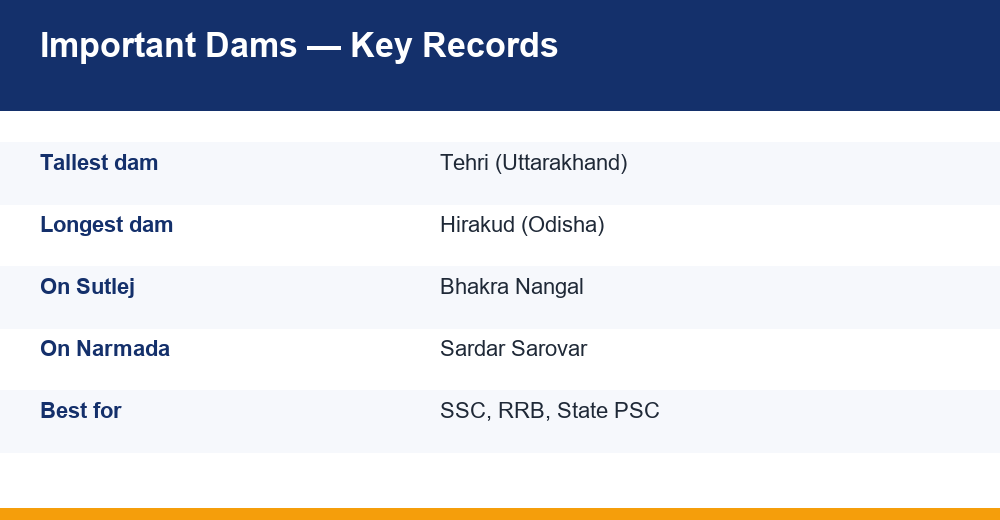
The record-holders are asked most often, so fix these first. The Tehri Dam is the tallest dam in India (and among the tallest in the world), built on the Bhagirathi in Uttarakhand. The Hirakud Dam on the Mahanadi in Odisha is the longest dam in India. The Bhakra Nangal Dam on the Sutlej is one of the highest gravity dams and a symbol of post-independence engineering; Jawaharlal Nehru famously called such projects the “temples of modern India”. The Sardar Sarovar Dam on the Narmada is central to a major multi-state irrigation and power project.
Dams grouped by river
Grouping dams by river makes recall easier and answers “which dams are on this river” questions. The Narmada hosts the Sardar Sarovar and Indira Sagar dams; the Kaveri hosts the Mettur and Krishnaraja Sagar dams; the Krishna hosts the Nagarjuna Sagar; the Periyar hosts the Idukki and Mullaperiyar dams; and the Sutlej hosts the Bhakra Nangal. For a refresher on the rivers themselves, see our guide to the major rivers of India.
Types of dams
Exams sometimes test the type of a dam, so it helps to know the basic categories. A gravity dam (like Bhakra Nangal) resists the water’s push through its own massive weight, usually built of concrete or masonry. An embankment dam (like Tehri) is made of compacted earth and rock and is the most common type for very large reservoirs. An arch dam is curved upstream so that it transfers water pressure to the canyon walls, suited to narrow gorges. A barrage (like the Farakka Barrage) is a low structure with gates used to divert or regulate water rather than to store a large reservoir. Knowing these categories helps you answer both definition questions and “which type is this dam” questions.
Multipurpose river-valley projects
Many important dams are part of larger multipurpose river-valley projects that combine irrigation, hydroelectric power, flood control and drinking-water supply. The Bhakra Nangal Project on the Sutlej was one of independent India’s earliest and most celebrated. The Damodar Valley Corporation (DVC), modelled on the American Tennessee Valley Authority, manages a chain of dams (including Maithon and Panchet) on the Damodar to control the river once called the “Sorrow of Bengal”. The Nagarjuna Sagar Project on the Krishna and the Sardar Sarovar Project on the Narmada are among the largest irrigation projects in the country. These projects are frequent current-affairs and geography crossover questions.
Dams and inter-state water disputes
Because rivers cross state boundaries, some dams sit at the centre of long-running inter-state water disputes — a favourite current-affairs topic. The Cauvery dispute between Karnataka and Tamil Nadu involves dams such as Krishnaraja Sagar and Mettur. The Mullaperiyar dispute concerns the safety and control of the Mullaperiyar Dam, operated by Tamil Nadu but located in Kerala. The Krishna and Narmada waters have also seen tribunals allocate shares among states. Understanding which dams and states are involved lets you answer questions that link geography with governance.
Why dams matter in exams
Dams connect geography, economy and current affairs: they provide irrigation, hydroelectric power, flood control and drinking water, and they frequently feature in questions on river-valley projects and inter-state water disputes. Knowing the river and state of each major dam lets you answer both plain factual questions and the map-based questions that increasingly appear. You can cross-check details on the National Portal of India.
Quick facts about important dams in India
A few standout facts about dams are asked so often they are worth memorising on their own. The Tehri Dam is not only the tallest dam in India but also among the tallest in the world. The Hirakud Dam is one of the longest earthen dams anywhere. The Bhakra Nangal reservoir, Gobind Sagar, is named after Guru Gobind Singh. The Nagarjuna Sagar Dam was, at the time of its construction, one of the world’s largest masonry dams. The Farakka Barrage was built to flush silt from the Kolkata port by diverting Ganga water into the Hooghly. Linking each dam to a memorable fact like these makes recall much faster under exam pressure.
How to remember important dams in India
- Learn each dam as a trio: dam → river → state.
- Memorise the two records first: Tehri (tallest) and Hirakud (longest).
- Group dams by river to answer “which dams on this river” questions.
- Link famous dams to their projects (Bhakra Nangal, Sardar Sarovar) for current-affairs crossover.
Revised as river-and-state trios, the important dams in India become quick, dependable marks in the geography portion of any competitive exam.
Frequently Asked Questions
Which is the tallest dam in India?
The Tehri Dam on the Bhagirathi River in Uttarakhand is the tallest dam in India.
Which is the longest dam in India?
The Hirakud Dam on the Mahanadi River in Odisha is the longest dam in India.
On which river is the Sardar Sarovar Dam built?
The Sardar Sarovar Dam is built on the Narmada River, primarily in Gujarat.
Which dam is built on the Sutlej River?
The Bhakra Nangal Dam is built on the Sutlej River, on the border of Himachal Pradesh and Punjab.