
Percentage questions appear in almost every competitive exam, and the topic is the foundation for profit and loss, interest, and data interpretation. This guide to percentage questions covers the core concept, the must-know formulas, a fraction-to-percentage table, time-saving tricks and a set of fully solved examples. Master percentages and a large part of the quantitative aptitude section becomes easier, because so many other topics build on this single idea.
Table of Contents
Percentage basics
The word “percent” means “per hundred”, so a percentage is simply a fraction with a denominator of 100. Writing 25% is the same as writing 25/100 or 0.25. The basic formula is: Percentage = (Value / Total) × 100. To find x% of a number, you calculate (x/100) × number. For example, 20% of 350 is (20/100) × 350 = 70. This single idea — moving between the “part”, the “whole” and the “percentage” — is behind every percentage question, however complex it looks.
A second core idea is percentage change. When a quantity changes from an old value to a new value, the percentage change is (change / original value) × 100. Whether the question is about population growth, price rise, or a fall in production, this is the formula that applies. Keeping the “original value” in the denominator is the detail that trips up many candidates, so always ask “change compared to what?”.
Important percentage formulas
- x% of N = (x/100) × N
- Percentage change = (Change / Original) × 100
- If A is x% more than B, then B is [x/(100+x)] × 100% less than A
- If A is x% less than B, then B is [x/(100-x)] × 100% more than A
- Successive change of a% and b% = a + b + (ab/100)
- Population/CI growth after n years at r% = P(1 + r/100)n
These formulas are worth memorising, but understand the logic behind each rather than learning them blindly — understanding lets you adapt when a question is phrased in an unfamiliar way.
Fraction to percentage conversion table
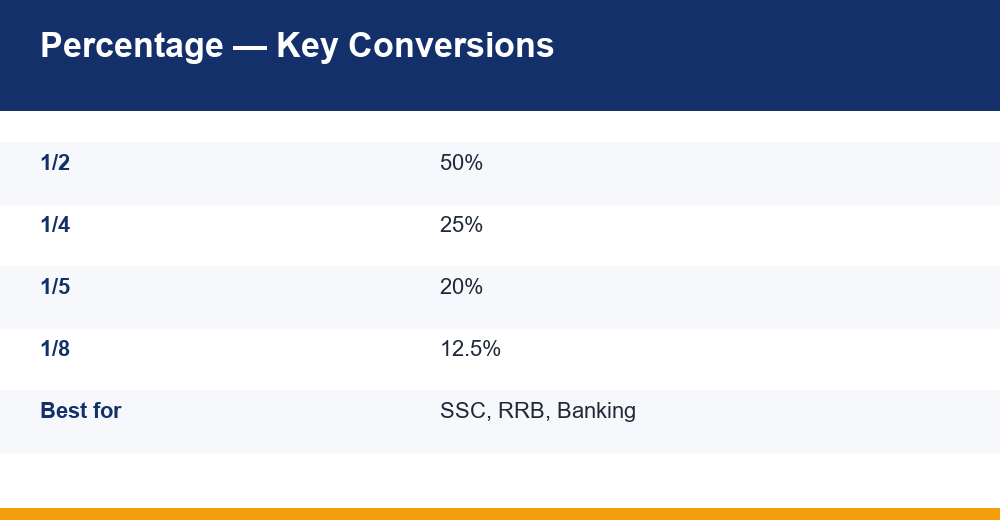
The single biggest time-saver in percentage questions is knowing common fraction equivalents by heart. When you see “12.5% of 800”, recognising 12.5% as 1/8 turns it into 800/8 = 100 instantly.
| Fraction | Percentage | Fraction | Percentage |
|---|---|---|---|
| 1/2 | 50% | 1/8 | 12.5% |
| 1/3 | 33.33% | 1/9 | 11.11% |
| 1/4 | 25% | 1/10 | 10% |
| 1/5 | 20% | 1/11 | 9.09% |
| 1/6 | 16.67% | 1/12 | 8.33% |
| 1/7 | 14.28% | 1/16 | 6.25% |
Time-saving tricks
Trick 1 — use fractions: convert awkward percentages to fractions. 37.5% is 3/8, so 37.5% of 240 is 3 × 240/8 = 90. Trick 2 — the reversal rule: x% of y always equals y% of x, so 16% of 25 is the same as 25% of 16 = 4, which is far easier. Trick 3 — net change: for a price that rises 10% then falls 10%, the net change is 10 – 10 – (10×10/100) = -1%, a 1% decrease, not zero. Trick 4 — percentage points vs percentage: a rise from 20% to 25% is a 5 percentage-point rise but a 25% increase, and exams deliberately test this difference.
Solved percentage questions
Example 1. If 40% of a number is 160, what is the number? Solution: 40% of N = 160, so N = 160 × 100/40 = 400.
Example 2. A student scored 450 out of 600. What is the percentage? Solution: (450/600) × 100 = 75%.
Example 3. The price of an item increases from 250 to 300. Find the percentage increase. Solution: change = 50; percentage increase = (50/250) × 100 = 20%.
Example 4. A salary is increased by 20% and then decreased by 20%. What is the net change? Solution: net change = 20 – 20 – (20×20/100) = -4%, i.e. a 4% decrease.
Example 5. In an election between two candidates, the winner got 60% of the votes and won by 800 votes. Find the total votes. Solution: the winner got 60% and the loser 40%, so the margin is 20% of the total = 800, giving total = 800 × 100/20 = 4000.
Example 6. If A’s income is 25% more than B’s, by what percent is B’s income less than A’s? Solution: using the formula, [25/(100+25)] × 100 = 25/125 × 100 = 20%.
Notice how each example reduces to the same basic relationship between part, whole and percentage. Once you see that structure, even wordy problems become routine.
Example 7. The population of a town rises 10% in the first year and 20% in the second. If it is now 13,200, what was it two years ago? Solution: it became 1.1 × 1.2 = 1.32 times the original, so original = 13,200 / 1.32 = 10,000.
Example 8. A shopkeeper offers two successive discounts of 20% and 10%. What single discount is equivalent? Solution: net = 20 + 10 – (20×10/100) = 28%.
Example 9. If the price of sugar rises 25%, by what percent must consumption fall to keep expenditure unchanged? Solution: [25/(100+25)] × 100 = 20%.
Example 10. A number increased by 25% becomes 500. Find the original. Solution: 1.25 × N = 500, so N = 400.
Where percentage is used
Percentage is the engine behind several other topics, which is why mastering it lifts your whole quantitative score. Profit and loss is a percentage of the cost price. Simple and compound interest are percentages of the principal. Data interpretation constantly asks for percentage share, change and growth. Even discount and marked price problems are percentage problems in disguise. When you handle percentages fluently, all of these become easier because you can focus on the specific twist each topic adds rather than the underlying arithmetic.
Practice & tips
Percentage rewards practice more than memory. Solve a mix of direct questions and word problems every day, always writing the “compared to what” quantity clearly. Because percentage underpins profit and loss, simple and compound interest and data interpretation, every hour spent here pays off across the whole quantitative section. For more static-GK and aptitude revision, see our GK one-liner questions, and combine this with timed practice so speed improves alongside accuracy. You can check the quantitative-aptitude syllabus for your exam on the official SSC website.
The goal is to reach a point where common conversions and simple percentage questions are done mentally, freeing time for the harder problems. That fluency, built through daily practice, is what turns percentage into one of the most reliable scoring topics in any exam.
Frequently Asked Questions
What is the basic formula for percentage?
Percentage = (Value / Total) x 100. To find x% of a number, multiply the number by x and divide by 100.
How do I quickly convert a fraction to a percentage?
Multiply the fraction by 100. Memorising common fractions (1/2 = 50%, 1/4 = 25%, 1/8 = 12.5%) lets you solve many percentage questions mentally.
What is the successive percentage change formula?
For two successive changes of a% and b%, the net change is a + b + (ab/100), using positive values for increase and negative for decrease.
Why are percentage questions important for exams?
Percentage is the base for many other topics — profit and loss, interest, data interpretation — so mastering it improves your whole quantitative aptitude score.