Samas in Hindi grammar is the process of joining two or more meaningful words into one shorter word, dropping the case markers and connectors that sat between them. It turns राजा का कुमार into राजकुमार and माता और पिता into माता-पिता. This guide covers all six types, how to write the samas vigrah, and the two confusions that cost students the most marks in TET and other Hindi-language papers.
Table of Contents
What Is Samas in Hindi Grammar?
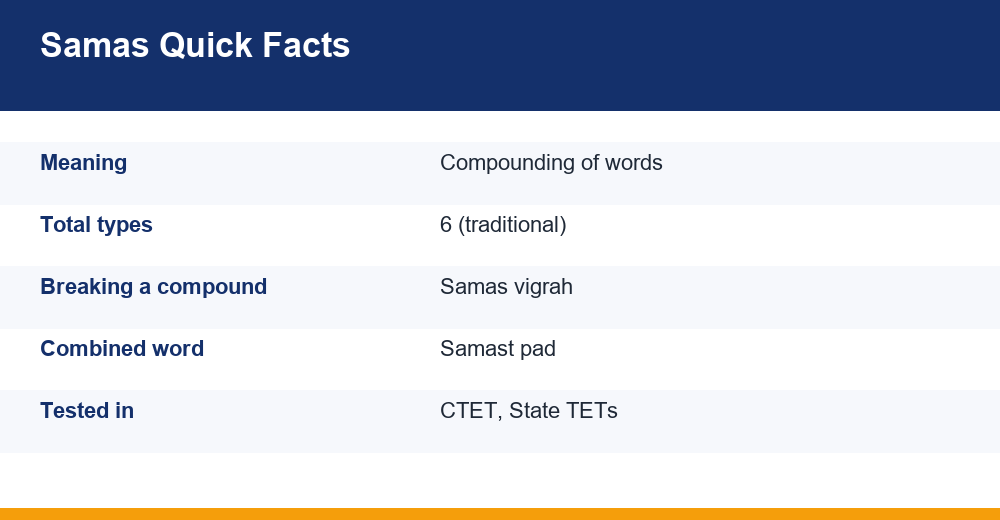
The word समास literally means ‘संक्षेप’ or brevity. When two or more words come together and the words linking them (like का, के लिए, से, में, और) disappear, the new word is called a समस्त पद (samast pad), also known as सामासिक शब्द.
Every compound has two parts. The first word is the पूर्व पद (purva pad) and the second is the उत्तर पद (uttar pad). In रसोईघर, रसोई is the purva pad and घर is the uttar pad; the hidden connector is ‘के लिए’.
Writing the compound back out in full, with the hidden connectors restored, is called समास विग्रह. रसोईघर becomes ‘रसोई के लिए घर’. Almost every exam question on this topic is really a vigrah question in disguise: if you can expand the compound correctly, you can name its type.
Compounding is everywhere in everyday Hindi, not just in textbooks. Words such as प्रधानमंत्री, जलवायु, देशभक्ति and रेलगाड़ी are all compounds, which is why examiners can draw on an almost endless supply of examples. Learning the underlying logic is far more efficient than memorising lists.
Key terms you must know
- समास – the process of compounding
- समस्त पद / सामासिक पद – the compound word produced
- पूर्व पद – the first member of the compound
- उत्तर पद – the second member of the compound
- समास विग्रह – breaking the compound back into its full phrase
The Six Types of Samas at a Glance
The six traditional types of samas in Hindi grammar are तत्पुरुष, कर्मधारय, द्विगु, द्वंद्व, अव्ययीभाव and बहुव्रीहि. The quickest way to classify them is to ask one question: which part of the compound is प्रधान (dominant)?
| Samas | Dominant part | Identifying sign | Example (vigrah) |
|---|---|---|---|
| अव्ययीभाव | पूर्व पद (first) | First word is an avyay; whole word acts as avyay | यथाशक्ति (शक्ति के अनुसार) |
| तत्पुरुष | उत्तर पद (second) | Case marker (vibhakti) dropped | राजकुमार (राजा का कुमार) |
| कर्मधारय | उत्तर पद | Adjective-noun or comparison relation | नीलकमल (नीला है जो कमल) |
| द्विगु | उत्तर पद | First word is a number; denotes a group | चौराहा (चार राहों का समाहार) |
| द्वंद्व | दोनों पद (both) | और / या / अथवा dropped; often hyphenated | माता-पिता (माता और पिता) |
| बहुव्रीहि | अन्य पद (a third) | Points to someone not named in the compound | लंबोदर (लंबा है उदर जिसका – गणेश) |
Many grammar books treat कर्मधारय and द्विगु as sub-types of तत्पुरुष because in both the second word dominates. Exams still ask about them as separate types, so learn all six independently.
A simple memory aid: first word strong means अव्ययीभाव, second word strong means the तत्पुरुष family, both strong means द्वंद्व, and neither strong means बहुव्रीहि. Keep this four-way split in mind as you work through the detailed sections below.
Tatpurush, Karmadharaya and Dvigu Samas
1. Tatpurush Samas (तत्पुरुष समास)
In तत्पुरुष the uttar pad is dominant and a कारक चिह्न (case marker) between the two words is dropped. The type is named after whichever karak disappears. The kartā (ने) and sambodhan cases do not form tatpurush, which leaves six case-based forms.
| Sub-type | Dropped marker | Example | Vigrah |
|---|---|---|---|
| कर्म तत्पुरुष | को | गगनचुंबी | गगन को चूमने वाला |
| करण तत्पुरुष | से / के द्वारा | तुलसीकृत | तुलसी द्वारा कृत |
| सम्प्रदान तत्पुरुष | के लिए | रसोईघर | रसोई के लिए घर |
| अपादान तत्पुरुष | से (separation) | देशनिकाला | देश से निकाला |
| संबंध तत्पुरुष | का / के / की | राजकुमार | राजा का कुमार |
| अधिकरण तत्पुरुष | में / पर | वनवास | वन में वास |
Note that ‘से’ appears twice. In करण तत्पुरुष it means ‘by means of’ (हाथ से लिखा), while in अपादान तत्पुरुष it signals separation (देश से निकाला). Ask whether something is being used or something is being left behind.
There is also नञ् तत्पुरुष, where the first part is a negative prefix such as अ, अन् or न: असभ्य (न सभ्य), अनपढ़ (न पढ़ा), अनंत (न अंत).
2. Karmadharaya Samas (कर्मधारय समास)
Here the two words share a विशेषण-विशेष्य (adjective-noun) or उपमान-उपमेय (comparison) relationship. The vigrah usually contains ‘है जो’ or ‘के समान’.
- नीलकमल – नीला है जो कमल
- महात्मा – महान है जो आत्मा
- चंद्रमुख – चंद्र के समान मुख
- परमानंद – परम है जो आनंद
3. Dvigu Samas (द्विगु समास)
The purva pad is a संख्यावाचक विशेषण (number) and the whole compound names a group or collection. The vigrah ends with ‘का समूह’ or ‘का समाहार’.
- त्रिभुवन – तीन भुवनों का समाहार
- चौराहा – चार राहों का समाहार
- सप्ताह – सात दिनों का समूह
- पंचवटी – पाँच वटों का समाहार
- नवरत्न – नौ रत्नों का समूह
Dvandva, Avyayibhav and Bahuvrihi Samas
4. Dvandva Samas (द्वंद्व समास)
In द्वंद्व both words are equally important. The connector dropped is और, या, अथवा or एवं, and the compound is often written with a hyphen (योजक चिह्न).
- माता-पिता – माता और पिता
- दाल-रोटी – दाल और रोटी
- पाप-पुण्य – पाप और पुण्य
- सुख-दुख – सुख और दुख
- भला-बुरा – भला या बुरा
5. Avyayibhav Samas (अव्ययीभाव समास)
This is the only type where the first word dominates. The purva pad is usually an अव्यय (indeclinable) like यथा, प्रति, आ, भर, बे, and the finished compound behaves like an avyay itself, so it does not change with gender, number or tense. Repeated words such as घर-घर also fall here.
- यथाशक्ति – शक्ति के अनुसार
- प्रतिदिन – प्रत्येक दिन
- आजन्म – जन्म से लेकर
- भरपेट – पेट भरकर
- बेखटके – बिना खटके के
- घर-घर – हर घर / प्रत्येक घर
6. How Do You Identify Bahuvrihi Samas? (बहुव्रीहि समास)
In बहुव्रीहि neither word dominates. Together they point to a third person or thing that is not named in the compound. The vigrah almost always contains ‘जिसका’, ‘जिसकी’, ‘जिसके’ or ‘वह’.
| Compound | Vigrah | Refers to |
|---|---|---|
| लंबोदर | लंबा है उदर जिसका | गणेश |
| दशानन | दस हैं आनन जिसके | रावण |
| नीलकंठ | नीला है कंठ जिसका | शिव |
| चक्रपाणि | चक्र है पाणि (हाथ) में जिसके | विष्णु |
| पीतांबर | पीले हैं अंबर (वस्त्र) जिसके | श्रीकृष्ण |
| गजानन | गज के समान आनन है जिसका | गणेश |
To identify bahuvrihi samas, ask: ‘Does this word describe somebody else?’ If the answer names a deity, person or object outside the two words, it is bahuvrihi.
Karmadharaya vs Bahuvrihi: The Classic Trap
This is one of the most frequently tested confusions in TET papers. Words like नीलकंठ, पीतांबर and दशानन look like adjective-noun pairs, which tempts students to mark कर्मधारय. The deciding factor is the vigrah, not the shape of the word.
| Point | Karmadharaya | Bahuvrihi |
|---|---|---|
| Dominant part | उत्तर पद | अन्य (third) पद |
| Relation | Adjective-noun or comparison | Both words describe someone else |
| Vigrah signal | है जो / के समान | जिसका / जिसकी / जिसके |
| Meaning | Literal | Indirect, names a third entity |
| Example | नीलकंठ – नीला है जो कंठ | नीलकंठ – नीला है कंठ जिसका (शिव) |
Notice that the same word can belong to either type depending on the intended meaning. ‘नीला कंठ’ as a literal blue throat is कर्मधारय; ‘वह जिसका कंठ नीला है’, meaning Shiva, is बहुव्रीहि. The same logic applies to पीतांबर (yellow cloth vs Krishna) and कमलनयन (lotus-like eyes vs Vishnu).
A similar trap: dvigu vs bahuvrihi
Number words create the same problem. त्रिभुवन (तीन भुवनों का समाहार) is द्विगु because it names a group. But दशानन and त्रिलोचन (तीन हैं लोचन जिसके – शिव) are बहुव्रीहि because they point to a person. In exams, when the options include both and the question gives no vigrah, the expected answer is usually the one matching the popular meaning: दशानन is almost always marked बहुव्रीहि.
- Write the vigrah in full.
- If it uses ‘है जो’ or ‘के समान’, mark कर्मधारय.
- If it names a group with a number, mark द्विगु.
- If it uses ‘जिसका/जिसके’ and points to someone else, mark बहुव्रीहि.
Sandhi vs Samas: What Is the Difference?
Students often merge these two chapters because both produce joined words. The difference is about what gets joined: sandhi joins sounds (वर्ण), while samas joins words (पद). If you need a refresher on vowel and consonant joins, our guide to sandhi rules and types in Hindi covers them in detail.
| Basis | Sandhi (संधि) | Samas (समास) |
|---|---|---|
| What joins | Two sounds (varna) | Two or more words (pad) |
| Sound change | Sounds usually change at the join | Sounds may stay unchanged |
| Breaking it | संधि विच्छेद | समास विग्रह |
| Words dropped | Nothing is dropped | Vibhakti or connector is dropped |
| Typical words | Mostly tatsam (Sanskrit-origin) | Tatsam, tadbhav and others |
| Example | विद्या + आलय = विद्यालय | विद्यालय = विद्या के लिए आलय |
The विद्यालय example shows why examiners love this topic: one word can involve both processes. Sandhi viched gives विद्या + आलय (दीर्घ संधि), while samas vigrah gives ‘विद्या के लिए आलय’ (सम्प्रदान तत्पुरुष). Likewise हिमालय is हिम + आलय for sandhi and ‘हिम का आलय’ (संबंध तत्पुरुष) for samas.
So when a question asks for the ‘विग्रह’, expect a samas answer with a connector like का or के लिए. When it asks for ‘विच्छेद’, it wants the sound-level split. Reading that one word carefully is half the battle with samas in Hindi grammar.
Samas Vigrah with Examples: A Step-by-Step Method
Samas vigrah means expanding a compound into the phrase it came from. Done systematically, it lets you identify the type of nearly any compound you meet in practice sets.
- Split the word into purva pad and uttar pad (पाठशाला = पाठ + शाला).
- Test connectors one by one: का, के लिए, से, में, को, और, जो, जिसका.
- Pick the connector that gives a natural Hindi meaning (पाठ के लिए शाला).
- Name the type from the connector: के लिए means सम्प्रदान तत्पुरुष.
- Check for a third meaning before finalising, to rule out bahuvrihi.
Practice set with answers
| Compound | Vigrah | Type |
|---|---|---|
| हस्तलिखित | हाथ से लिखा | करण तत्पुरुष |
| पथभ्रष्ट | पथ से भ्रष्ट | अपादान तत्पुरुष |
| घुड़सवार | घोड़े पर सवार | अधिकरण तत्पुरुष |
| देशभक्ति | देश के लिए भक्ति | सम्प्रदान तत्पुरुष |
| नीलगाय | नीली है जो गाय | कर्मधारय |
| त्रिफला | तीन फलों का समूह | द्विगु |
| अन्न-जल | अन्न और जल | द्वंद्व |
| आजीवन | जीवन भर | अव्ययीभाव |
| गिरिधर | गिरि को धारण करने वाला (कृष्ण) | बहुव्रीहि |
Note on गिरिधर: some books list it as उपपद or कर्म तत्पुरुष when read literally. When the options include बहुव्रीहि and the context is Krishna, that is the expected answer. Always read the options before deciding.
A good habit is to write the vigrah for ten compounds daily from your textbook lessons. Within a couple of weeks, the connector pattern behind each type of samas in Hindi grammar starts to feel automatic.
Scoring Samas Questions in CTET, TET and SSC
In CTET, Hindi grammar appears inside the Language I and Language II sections, which carry 30 questions each in a paper of 150 multiple-choice questions. Samas items there usually ask you to identify the type from a given compound or pick the correct vigrah. The syllabus, pattern and current notices are published on the official CTET website, which you should check for every new cycle.
If you are building a full plan for the primary level, our CTET Paper 1 preparation guide shows where Hindi grammar fits alongside child development and pedagogy questions. State TETs such as UPTET, REET and MPTET follow a broadly similar pattern, and samas appears regularly in their Hindi sections.
What about SSC exams?
The objective language section of SSC CHSL is English, so samas is not a direct scoring topic there. If you are working through SSC CHSL preparation, treat this chapter as useful for state-level clerk exams and Hindi-medium papers. SSC GD Constable has offered candidates a choice of English or Hindi in its language section, so check the latest notice before you decide how much time to give samas.
Common question patterns
- ‘दशानन में कौन-सा समास है?’ – tests the bahuvrihi vs dvigu trap
- ‘नीलकमल का सही विग्रह क्या है?’ – tests karmadharaya vigrah
- ‘किस समास में पूर्व पद प्रधान होता है?’ – answer: अव्ययीभाव
- ‘किस समास में दोनों पद प्रधान होते हैं?’ – answer: द्वंद्व
- ‘विद्यालय’ with options mixing viched and vigrah – tests sandhi vs samas
Last-week revision for samas in Hindi grammar should be simple: the dominance table, the karmadharaya-bahuvrihi signal words and a set of 30 to 40 standard compounds. That covers most of what TET papers typically ask.
Frequently Asked Questions
What are the six types of samas in Hindi?
The six traditional types are तत्पुरुष, कर्मधारय, द्विगु, द्वंद्व, अव्ययीभाव and बहुव्रीहि. They are classified by which part dominates: the first word in avyayibhav, the second in tatpurush, karmadharaya and dvigu, both words in dvandva, and a third, unnamed entity in bahuvrihi. Many books treat karmadharaya and dvigu as sub-types of tatpurush.
What is the difference between sandhi and samas?
Sandhi joins two sounds (varna) and usually changes them at the join, while samas joins two or more words (pad) and drops the case marker or connector between them. Breaking sandhi is called viched; breaking samas is called vigrah. For example, विद्यालय is विद्या + आलय in sandhi, but विद्या के लिए आलय in samas.
How do you identify bahuvrihi samas?
Write the vigrah and see whether the compound points to someone or something not named in it. Bahuvrihi vigrah usually contains जिसका, जिसकी or जिसके. लंबोदर means ‘लंबा है उदर जिसका’, which refers to Ganesh, and दशानन means ‘दस हैं आनन जिसके’, which refers to Ravan. If a third meaning appears, it is bahuvrihi.
What is samas vigrah with examples?
Samas vigrah is expanding a compound back into its full phrase by restoring the dropped words. Examples: राजकुमार becomes राजा का कुमार, रसोईघर becomes रसोई के लिए घर, माता-पिता becomes माता और पिता, and चौराहा becomes चार राहों का समाहार. The connector you restore tells you the type of samas.