Questions on Indian National Congress sessions appear in almost every SSC, Railway and state PCS paper, yet most aspirants waste hours memorising lists that run past 60 entries. This guide trims the list to the 25 sessions examiners actually pick, from Bombay in 1885 to Meerut in 1946, with the venue, president and the single decision each one is remembered for. A firsts box and memory tricks at the end make revision quicker.
Table of Contents
Why Indian National Congress Sessions Matter in Exams
The Congress met once a year, usually in the last week of December, and every annual meeting had a president, a host city and a set of resolutions. That neat structure makes the topic perfect for one-liner questions: venue, year and president are easy to frame as MCQs.
Examiners rarely ask about obscure years. They return again and again to sessions linked with a turning point: a split, a reunion, a new goal or a famous first. If you learn the 25 sessions below with their one key decision, you cover most of the modern history questions on this theme in SSC CGL, CHSL, RRB NTPC, Group D and banking GA sections.
It also helps to know how a session worked. Delegates sent by provincial bodies gathered in a large pandal, a Subjects Committee drafted the resolutions, and the full house voted on them over two or three days. Special sessions were called in between when an urgent decision could not wait for December, which is why 1920 has two sessions in the list.
- Typical question 1: Who presided over the session where Purna Swaraj was adopted?
- Typical question 2: In which city was the first session held?
- Typical question 3: Match the session with its president (four pairs).
- Typical question 4: Which session was the only one presided over by Gandhi?
Modern history is only one part of the GA syllabus. If you are building notes from scratch, pair this topic with our ancient Indian history notes so that the chronology from the Harappans to 1947 stays connected in your head.
Where Was the First Session of the INC Held?
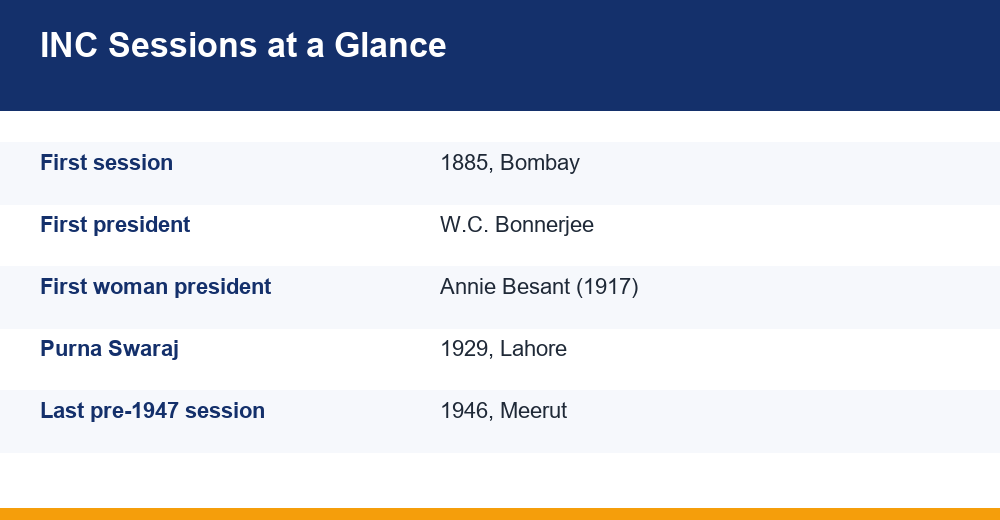
The first session was held at Gokuldas Tejpal Sanskrit College, Bombay, from 28 to 30 December 1885. It was presided over by Womesh Chandra Bonnerjee, a Calcutta barrister, and was attended by 72 delegates from different provinces.
The meeting was originally planned for Poona. An outbreak of cholera there forced the organisers to shift it to Bombay just before the session. Allan Octavian Hume, a retired British civil servant, played the central organising role and served as the first general secretary.
Key facts to remember about 1885
- Date: 28 to 30 December 1885
- Venue: Bombay (now Mumbai), shifted from Poona
- President: W.C. Bonnerjee
- Delegates: 72
- Founder figure: A.O. Hume
A common trap: some options list Poona as the venue of the first session. Poona was only the planned location. The correct answer is always Bombay.
1886 to 1906: Firsts, Songs and the Swaraj Demand
The first two decades belonged to the Moderates, who believed in petitions, speeches and constitutional pressure. Five sessions from this phase are asked regularly.
1886 Calcutta and 1887 Madras
Dadabhai Naoroji presided over the second session at Calcutta in 1886, where Surendranath Banerjee’s National Conference merged with the Congress. The 1887 Madras session was presided over by Badruddin Tyabji, the first Muslim president of the INC. A year later, at Allahabad in 1888, George Yule became the first English president.
1896 Calcutta: Vande Mataram
Under Rahimtullah M. Sayani, the 1896 Calcutta session became the first Congress meeting where Vande Mataram was sung, by Rabindranath Tagore. The song was written by Bankim Chandra Chattopadhyay and is today India’s national song, listed among the national symbols on the National Portal of India.
1905 Banaras and 1906 Calcutta
Gopal Krishna Gokhale presided at Banaras in 1905, the year Lord Curzon partitioned Bengal. The session supported the Swadeshi and boycott movement in Bengal.
At Calcutta in 1906, Dadabhai Naoroji presided for the third time. Here the word Swaraj was first used as the Congress goal, and four resolutions were passed: Swaraj, Swadeshi, Boycott and National Education.
Which Session Saw the Moderate-Extremist Split?
The split happened at the Surat session of 1907, presided over by Rash Behari Ghosh. Tensions had been building for years between the Moderates, led by Gokhale and Pherozeshah Mehta, and the Extremists, led by Bal Gangadhar Tilak, Lala Lajpat Rai and Bipin Chandra Pal.
The Extremists wanted Lajpat Rai or Tilak as president and feared the Moderates would dilute the four 1906 resolutions. The session broke up in chaos, and the two groups stayed apart for nine years.
| Point | Moderates | Extremists |
|---|---|---|
| Leaders | Gokhale, Pherozeshah Mehta, Naoroji | Tilak, Lajpat Rai, Bipin Chandra Pal |
| Method | Petitions, prayers, protest meetings | Boycott, Swadeshi, mass agitation |
| Goal | Self-government within the Empire | Swaraj |
| Reunited | Lucknow, 1916 | Lucknow, 1916 |
The Lal-Bal-Pal trio and other leaders of this phase are covered in more detail in our guide to freedom fighters of India.
One more early session is often asked: Calcutta 1911, under Bishan Narayan Dar, where Jana Gana Mana was sung for the first time on 27 December 1911.
1916 to 1928: Reunion, Non-Cooperation and Firsts
This is the most heavily tested block. It covers the return of Tilak, the arrival of Gandhi and two landmark firsts for women.
Lucknow 1916 and Calcutta 1917
Ambica Charan Mazumdar presided at Lucknow in 1916, where the Moderates and Extremists reunited and the Congress signed the Lucknow Pact with the Muslim League. The next year, at Calcutta in 1917, Annie Besant became the first woman president of the INC.
Who was the first woman president of the INC?
Annie Besant, an Irish-born theosophist and Home Rule League leader, was the first woman president (Calcutta, 1917). Sarojini Naidu was the first Indian woman president, at the Kanpur session of 1925. Exams test this distinction constantly, so learn both names together.
The non-cooperation years, 1920 to 1924
- Calcutta special session, September 1920 (Lala Lajpat Rai): non-cooperation resolution first passed.
- Nagpur, December 1920 (C. Vijayaraghavachariar): non-cooperation ratified; Provincial Congress Committees formed on linguistic lines.
- Gaya, 1922 (C.R. Das): council-entry proposal defeated, leading Das and Motilal Nehru to form the Swaraj Party.
- Delhi special session, 1923 (Maulana Abul Kalam Azad): youngest president of the INC; council entry permitted.
- Belgaum, 1924 (Mahatma Gandhi): the only session Gandhi presided over.
Madras 1927 and Calcutta 1928
M.A. Ansari presided at Madras in 1927, where the Congress decided to boycott the all-white Simon Commission and passed a resolution declaring complete independence as its goal. At Calcutta in 1928, Motilal Nehru presided and the Nehru Report was endorsed, with a one-year deadline for the British to grant dominion status.
Lahore 1929: Purna Swaraj and Who Presided
The Lahore session of December 1929 is the answer whenever a question asks where Purna Swaraj was declared. When the British let the 1928 deadline pass without granting dominion status, the Congress adopted the Purna Swaraj (complete independence) resolution here.
Who presided over the INC session of 1929?
Jawaharlal Nehru presided, aged 40. Gandhi had backed him for the post, and his election marked the rise of a younger, more radical leadership within the Congress.
On the midnight of 31 December 1929, Nehru hoisted the tricolour on the banks of the Ravi. The Congress then asked the nation to observe 26 January 1930 as Independence Day. That date was later chosen for the Constitution to come into force on 26 January 1950, which is why we celebrate Republic Day on it.
- President: Jawaharlal Nehru
- Main resolution: Purna Swaraj
- Also decided: launch civil disobedience; boycott the Round Table Conference
- Follow-up: Gandhi’s Dandi March began on 12 March 1930
Note that Motilal Nehru presided in 1928 and his son Jawaharlal took over in 1929. Questions sometimes offer both names as options to catch careless readers.
Karachi to Meerut: The Final Sessions Before 1947
Annual sessions were not held in 1930, 1935 and from 1941 to 1945, mainly because of mass movements and arrests. The sessions that did take place in the 1930s and 1940s each carry one strong exam fact.
Many aspirants mix up the later Indian National Congress sessions because Nehru, Bose and Azad each presided more than once. Tie every name to its venue and decision rather than to the year alone, and the confusion disappears.
Karachi 1931
Sardar Vallabhbhai Patel presided. The session endorsed the Gandhi-Irwin Pact and passed the resolution on Fundamental Rights and Economic Policy, an early blueprint for rights later written into the Constitution. Compare it with our list of important articles of the Indian Constitution to see how many ideas carried forward.
Faizpur 1936 and Haripura 1938
Faizpur, presided over by Jawaharlal Nehru, was the first session held in a village. Subhas Chandra Bose presided at Haripura in 1938, and during his presidency that year the National Planning Committee was set up with Nehru as its chairman.
Tripuri 1939, Ramgarh 1940 and Meerut 1946
At Tripuri, Bose was re-elected after defeating Gandhi’s candidate Pattabhi Sitaramayya, but resigned within weeks; Rajendra Prasad replaced him. Maulana Azad presided at Ramgarh in 1940, where the Congress opposed dragging India into the Second World War without consent. The Meerut session of 1946, under J.B. Kripalani, was the last before Independence.
Complete List of 25 Indian National Congress Sessions
Use this table for last-minute revision. Each row gives the year, venue, president and the one fact examiners link with that session.
| Year | Venue | President | Remembered for |
|---|---|---|---|
| 1885 | Bombay | W.C. Bonnerjee | First session, 72 delegates |
| 1886 | Calcutta | Dadabhai Naoroji | National Conference merged |
| 1887 | Madras | Badruddin Tyabji | First Muslim president |
| 1896 | Calcutta | Rahimtullah Sayani | Vande Mataram first sung |
| 1905 | Banaras | G.K. Gokhale | Backed Swadeshi and boycott |
| 1906 | Calcutta | Dadabhai Naoroji | Swaraj adopted as goal |
| 1907 | Surat | Rash Behari Ghosh | Moderate-Extremist split |
| 1911 | Calcutta | Bishan Narayan Dar | Jana Gana Mana first sung |
| 1916 | Lucknow | Ambica Charan Mazumdar | Reunion; Lucknow Pact |
| 1917 | Calcutta | Annie Besant | First woman president |
| 1920 (Sep, special) | Calcutta | Lala Lajpat Rai | Non-cooperation first passed |
| 1920 (Dec) | Nagpur | C. Vijayaraghavachariar | Non-cooperation ratified |
| 1922 | Gaya | C.R. Das | Led to Swaraj Party |
| 1923 (special) | Delhi | Abul Kalam Azad | Youngest president |
| 1924 | Belgaum | Mahatma Gandhi | Only session Gandhi presided |
| 1925 | Kanpur | Sarojini Naidu | First Indian woman president |
| 1927 | Madras | M.A. Ansari | Simon Commission boycott |
| 1928 | Calcutta | Motilal Nehru | Nehru Report endorsed |
| 1929 | Lahore | Jawaharlal Nehru | Purna Swaraj resolution |
| 1931 | Karachi | Vallabhbhai Patel | Fundamental Rights resolution |
| 1936 | Faizpur | Jawaharlal Nehru | First village session |
| 1938 | Haripura | Subhas Chandra Bose | National Planning Committee |
| 1939 | Tripuri | Subhas Chandra Bose | Bose re-elected, resigned |
| 1940 | Ramgarh | Abul Kalam Azad | Opposed war participation |
| 1946 | Meerut | J.B. Kripalani | Last session before 1947 |
Read the table once by rows and once by columns. Reading down the president column alone is a quick self-test before a mock.
Firsts Box and Quick Revision Tricks
A large share of questions on Indian National Congress sessions are really questions about firsts. Keep this box handy.
| First | Name | Session |
|---|---|---|
| First president | W.C. Bonnerjee | Bombay, 1885 |
| First Muslim president | Badruddin Tyabji | Madras, 1887 |
| First English president | George Yule | Allahabad, 1888 |
| First woman president | Annie Besant | Calcutta, 1917 |
| First Indian woman president | Sarojini Naidu | Kanpur, 1925 |
| Youngest president | Abul Kalam Azad | Delhi, 1923 |
| First village session | Jawaharlal Nehru | Faizpur, 1936 |
Memory tricks that work
- Songs by Calcutta: both Vande Mataram (1896) and Jana Gana Mana (1911) were first sung at Calcutta sessions.
- Women 17-25: Besant 1917, Naidu 1925; the foreign-born woman came first.
- Father then son: Motilal 1928 (Nehru Report), Jawaharlal 1929 (Purna Swaraj).
- S for Surat, S for Split: 1907.
- Gandhi only once: Belgaum 1924.
- Two Calcutta sessions in the 1920s: the special session of 1920 (Lajpat Rai) and 1928 (Motilal Nehru).
Finally, test yourself by covering the president column in the full table and naming each one. If you can get 20 out of 25 right, you are ready for any question on Indian National Congress sessions in SSC or Railway exams.
Revise the topic every two weeks until the exam. Short, repeated sessions of 10 minutes work far better than one long cramming night, especially for match-the-following questions where a single swapped pair costs you the mark.
Frequently Asked Questions
Where was the first session of Indian National Congress held?
The first session was held at Gokuldas Tejpal Sanskrit College in Bombay from 28 to 30 December 1885. Womesh Chandra Bonnerjee presided and 72 delegates attended. The meeting had been planned for Poona, but a cholera outbreak there forced organisers, led by A.O. Hume, to shift it to Bombay.
Who was the first woman president of the INC?
Annie Besant was the first woman president of the Indian National Congress, presiding over the Calcutta session of 1917. She was an Irish-born theosophist and Home Rule League leader. Sarojini Naidu became the first Indian woman president at the Kanpur session of 1925, a distinction exams frequently test.
Who presided over the INC session of 1929?
Jawaharlal Nehru presided over the Lahore session of December 1929, where the Purna Swaraj resolution was adopted. At midnight on 31 December he hoisted the tricolour on the banks of the Ravi, and the Congress called for 26 January 1930 to be observed as Independence Day across the country.
Which INC session saw the split between moderates and extremists?
The split took place at the Surat session of 1907, presided over by Rash Behari Ghosh. Disagreement over the presidency and the 1906 resolutions on Swaraj, Swadeshi and Boycott led to the break. The two groups reunited nine years later at the Lucknow session of 1916.