The RRB NTPC syllabus is the first thing every railway aspirant should master, because the exam rewards those who prepare exactly what is tested. This complete guide to the RRB NTPC syllabus covers the CBT 1 and CBT 2 exam pattern, the subject-wise topics for Mathematics, Reasoning and General Awareness, and a realistic preparation plan. Always confirm the latest details against the official RRB notification for your region.
Table of Contents
About RRB NTPC
The Non-Technical Popular Categories (NTPC) examination is conducted by the Railway Recruitment Boards to fill graduate and undergraduate posts such as Station Master, Goods Guard, Junior Clerk, Accounts Clerk, Commercial Apprentice and Traffic Assistant. It is one of India’s largest recruitment exams by number of applicants, and selection runs through multiple stages of computer-based tests followed by skill tests and document verification.
RRB NTPC exam pattern
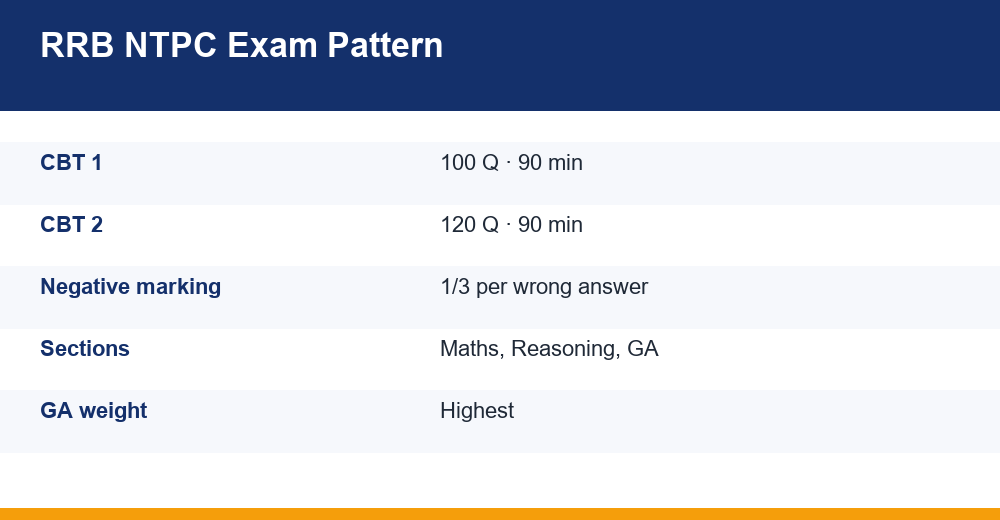
The written stage has two computer-based tests. CBT 1 is common to all posts and acts as a screening test; CBT 2 is post-group specific and its marks count towards the final merit.
| Stage | Questions | Duration | Negative marking |
|---|---|---|---|
| CBT 1 | 100 | 90 minutes | 1/3 mark |
| CBT 2 | 120 | 90 minutes | 1/3 mark |
For candidates with disabilities, the duration is extended as per the rules. A one-third negative marking means accuracy is critical — attempt a question only when you can eliminate the clearly wrong options.
RRB NTPC syllabus for CBT 1
CBT 1 has three sections. The section-wise distribution is:
| Subject | Questions | Marks |
|---|---|---|
| General Awareness | 40 | 40 |
| Mathematics | 30 | 30 |
| General Intelligence & Reasoning | 30 | 30 |
| Total | 100 | 100 |
General Awareness covers current affairs, Indian history, geography, polity, economy, general science, sports, art and culture. Mathematics covers number system, decimals, fractions, LCM and HCF, ratio and proportion, percentage, mensuration, time and work, time and distance, simple and compound interest, profit and loss, elementary algebra, geometry and trigonometry, and elementary statistics. Reasoning covers analogies, series, coding-decoding, mathematical operations, relationships, syllogism, Venn diagrams, data interpretation and sufficiency, and decision-making.
RRB NTPC syllabus for CBT 2
CBT 2 has the same three subjects but more questions and a higher difficulty level. The distribution is:
| Subject | Questions | Marks |
|---|---|---|
| General Awareness | 50 | 50 |
| Mathematics | 35 | 35 |
| General Intelligence & Reasoning | 35 | 35 |
| Total | 120 | 120 |
The topics are the same as CBT 1, so there is no separate syllabus to learn — the difference is depth and speed. Because GA carries 50 of 120 marks, a strong grip on static GK and current affairs is often what separates selected candidates from the rest. Our GK one-liner questions and Indian polity notes map directly onto this section.
Later stages: skill tests & verification
After CBT 2, shortlisted candidates take a post-specific test: a Typing Skill Test (for clerical and typing posts) or a Computer-Based Aptitude Test (for Station Master and Traffic Assistant). These are usually qualifying in nature. The final steps are document verification and a medical examination as per railway standards. Knowing which stage applies to your target post helps you prepare the right skill in advance rather than scrambling later.
RRB NTPC preparation strategy
Because the same syllabus runs through both CBTs, build a single strong foundation and then scale up speed and accuracy for CBT 2. Give General Awareness daily attention — it is the largest section and the slowest to build. Practise Mathematics and Reasoning with previous-year questions and timed sets, since both reward pattern recognition. Take full-length mocks in the exact CBT format to build stamina for 90-minute sittings, and analyse every mock to fix recurring errors.
- Cover the full GA range early and revise it in short, frequent sessions.
- Master Maths shortcuts (tables, squares, percentages) to save time.
- Drill Reasoning types until you can spot the pattern instantly.
- Take format-exact mocks and analyse mistakes by cause.
- Track current affairs of the last 6-12 months using our current affairs strategy.
You can confirm the official pattern, vacancies and syllabus on the Indian Railways recruitment portal at rrbcdg.gov.in before you begin.
Why railway jobs are worth the effort
Understanding what is at stake helps sustain months of preparation. A railway job through RRB NTPC offers rare stability, a structured pay scale with regular increments, comprehensive medical cover for the employee and family, travel-pass benefits, pension-linked retirement security under the applicable scheme, and a clear promotional ladder. Posts such as Station Master carry real operational responsibility and respect, while clerical and commercial posts offer steady, predictable careers. Indian Railways is also one of the largest employers in the world, so vacancy cycles are large — which means disciplined preparation genuinely converts into selection. Keeping this payoff in mind makes it easier to maintain the daily General Awareness habit that the exam rewards.
Subject-wise strategy in detail
General Awareness is the largest and most decisive section. Split it into static GK (history, polity, geography, general science) and current affairs of the last six to twelve months. Static GK is finite and repeats, so build it once and revise often; current affairs needs a running note updated daily. Because GA is quick to attempt in the exam but slow to build, starting early here is the single biggest advantage a candidate can give themselves.
Mathematics rewards fundamentals and speed. Master arithmetic first — percentage, ratio, average, profit and loss, time-speed-distance, time and work — because these topics appear most and are quickest to solve. Then cover mensuration, elementary algebra, geometry and trigonometry. Learn tables up to twenty, squares up to thirty and common fraction-to-percentage conversions so that routine calculations take seconds, not minutes.
General Intelligence & Reasoning is the most scoring section per minute of study. The recurring types — analogy, series, coding-decoding, classification, syllogism, Venn diagrams and puzzles — can be mastered with focused practice until you recognise each pattern instantly. Non-verbal reasoning is pure practice and should never be skipped, as it offers reliable marks under time pressure.
Posts & salary
RRB NTPC recruits for a range of graduate and undergraduate posts. Graduate-level posts include Station Master, Goods Guard, Senior Clerk-cum-Typist, Junior Account Assistant-cum-Typist and Commercial Apprentice; undergraduate-level posts include Junior Clerk-cum-Typist, Accounts Clerk-cum-Typist and Trains Clerk. Pay is set according to the 7th Pay Commission pay levels (broadly Level 2 to Level 6 depending on the post), with railway allowances added on top. Beyond pay, railway jobs offer strong job security, medical benefits, travel passes and clear promotion paths, which is why NTPC attracts millions of applicants each cycle.
How to attempt the exam
With 90 minutes for 100 questions in CBT 1, pace matters. A reliable approach is to clear General Awareness first (you either know a fact or you do not, so do not linger), then Reasoning for quick accurate marks, and finally Mathematics, which is the most time-consuming. Respect the one-third negative marking: attempt a question only when you can eliminate at least two options. Most successful candidates attempt around 85-90 questions with high accuracy rather than rushing all 100 and losing marks to negative marking.
Skill tests: CBAT & typing
The nature of the skill test depends on the post. For Station Master and Traffic Assistant, candidates take the Computer-Based Aptitude Test (CBAT), also called the psycho test, which measures attributes such as concentration, perceptual speed, memory and decision-making through a series of timed on-screen tests. There is no negative marking in the CBAT, but you must pass each of its constituent tests. For clerical and typing posts, a Typing Skill Test checks a minimum typing speed in English or Hindi on a computer. Because these tests are qualifying and format-specific, practising the exact test type in advance prevents unpleasant surprises at a late stage.
Recommended resources
You do not need many books — you need the right few, revised well. Use one General Awareness compilation plus a monthly current-affairs digest; one Quantitative Aptitude book with a large problem bank; and one Reasoning book covering verbal and non-verbal types. Above all, use previous-year RRB NTPC papers and full-length mock tests in the exact CBT format, which are the single highest-return resource because they train speed, accuracy and exam temperament together.
A 60-day revision plan
If you already know the basics, a focused two-month plan sharpens you for the exam:
| Phase | Days | Focus |
|---|---|---|
| Foundation | Day 1-25 | Revise full syllabus of all three sections with topic-wise practice |
| Speed | Day 26-45 | Previous-year questions and sectional tests against the clock |
| Test & revise | Day 46-60 | Full CBT-format mocks, error analysis, daily current affairs |
Common mistakes to avoid
- Underestimating General Awareness — it is the biggest section in both CBTs.
- Ignoring the negative marking and guessing blindly.
- Practising without the exact 90-minute CBT format, so stamina fails on exam day.
- Leaving current affairs to the last week instead of a daily habit.
- Skipping the CBAT or typing practice until it is too late.
Quick tips for the RRB NTPC syllabus
Treat General Awareness as your scoring engine, Mathematics and Reasoning as your speed engines, and mocks as your reality check. Candidates who respect the negative marking, revise GA daily and practise in the exact exam format consistently outperform those who simply study more hours. Prepare precisely what the RRB NTPC syllabus lists — no more, no less — and revise it until recall is automatic.
Frequently Asked Questions
What is the RRB NTPC exam pattern?
RRB NTPC has two computer-based tests. CBT 1 has 100 questions in 90 minutes (General Awareness 40, Mathematics 30, Reasoning 30). CBT 2 has 120 questions in 90 minutes (GA 50, Maths 35, Reasoning 35). Both have 1/3 negative marking.
Which section has the highest weight in RRB NTPC?
General Awareness carries the highest weight in both CBT 1 and CBT 2, so static GK and current affairs deserve the most revision time.
Is CBT 1 marks counted in the final merit?
No. CBT 1 is only a screening test; the marks that count towards final merit come from CBT 2 and the later stages.
What comes after CBT 2 in RRB NTPC?
Depending on the post, candidates take a Typing Skill Test or a Computer-Based Aptitude Test (CBAT), followed by document verification and a medical examination.