The SSC GD Constable examination is one of the largest recruitment drives in the country, filling constable (General Duty) posts in the Central Armed Police Forces and allied organisations. This complete guide explains the computer-based exam pattern, the syllabus, the all-important physical standards (PET and PST) and the medical test, along with a preparation plan. Because selection combines a written test with demanding physical requirements, candidates need to prepare on both fronts from the start. Confirm the latest standards in the official SSC notification.
Table of Contents
About SSC GD Constable
The exam is conducted by the Staff Selection Commission to recruit constables for the Border Security Force (BSF), Central Reserve Police Force (CRPF), Central Industrial Security Force (CISF), Indo-Tibetan Border Police (ITBP), Sashastra Seema Bal (SSB), Assam Rifles, the Secretariat Security Force (SSF) and the National Investigation Agency (NIA). It is open to candidates who have passed Class 10, which makes it one of the most accessible central government jobs and attracts millions of applicants each cycle. A career as a constable offers job security, a structured pay scale, allowances, and the pride of serving in a uniformed force, with opportunities for promotion over time.
Exam pattern
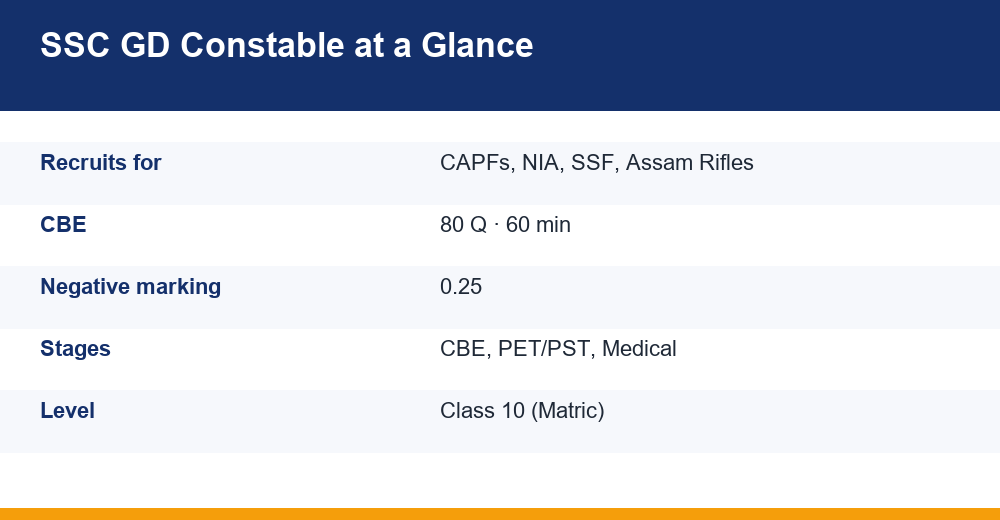
The Computer-Based Examination (CBE) is the first stage and screens candidates for the physical tests. It has 80 objective questions for 160 marks in 60 minutes, with each question carrying 2 marks and a negative marking of 0.5 marks per wrong answer. The four sections are equally weighted:
| Section | Questions | Marks |
|---|---|---|
| General Intelligence & Reasoning | 20 | 40 |
| General Knowledge & General Awareness | 20 | 40 |
| Elementary Mathematics | 20 | 40 |
| English / Hindi | 20 | 40 |
| Total | 80 | 160 |
The paper is set at the matriculation level, so the content is accessible, but the competition and the cut-offs are high because of the sheer number of applicants. Speed and accuracy in the CBE decide who moves on to the physical stage.
SSC GD Constable syllabus
General Intelligence & Reasoning covers analogies, similarities and differences, spatial visualisation, coding-decoding, series, arithmetical reasoning and non-verbal reasoning. General Knowledge & Awareness covers current affairs, history, geography, polity, economy, general science and sports — the same static-GK base tested across government exams. Elementary Mathematics covers number systems, whole numbers, decimals and fractions, percentage, ratio and proportion, average, interest, profit and loss, discount, mensuration, time and work, and time and distance. The English/Hindi section tests basic language comprehension and grammar in the language the candidate chooses.
For the General Awareness and mathematics portions, our GK one-liner questions and percentage tricks and questions map directly onto the syllabus and make efficient revision resources.
PET & PST physical standards
Candidates who clear the CBE are called for the Physical Efficiency Test (PET) and Physical Standard Test (PST) — the stage that makes SSC GD distinct from desk-job exams. The PET is a running test: male candidates are typically required to run 5 km in 24 minutes, and female candidates 1.6 km in 8.5 minutes, with relaxed timings for candidates from specified hill regions such as Ladakh. The PST measures physical standards:
| Standard | Male | Female |
|---|---|---|
| Height (general) | 170 cm | 157 cm |
| Chest (male, unexpanded/expanded) | 80 cm / 85 cm | Not applicable |
| Weight | As per height & age | As per height & age |
Relaxations in height and chest apply to candidates from certain categories and regions (such as Scheduled Tribes and hill areas). Because these physical tests are qualifying and non-negotiable, serious candidates begin running and fitness training months in advance rather than waiting for the CBE result. Consistent daily running, stamina building and attention to the exact standards for your category are essential.
Medical examination
The final stage is a detailed medical examination to ensure candidates meet the health standards required for active duty. This includes tests of vision (with specified minimum standards for each eye), hearing, and general physical fitness, and a check for conditions such as knock knees, flat feet, squint and varicose veins that can lead to disqualification. Candidates should be aware of these standards early, as some correctable issues can be addressed with time. Document verification is carried out alongside the medical stage.
SSC GD Constable preparation strategy
The winning approach is to prepare for the written and physical stages in parallel. For the CBE, build the four sections with daily practice, prioritising Reasoning and Mathematics for quick, accurate marks and giving General Awareness steady daily revision. Practise previous-year papers and full-length mocks in the exact 60-minute format, and respect the negative marking. At the same time, follow a running and fitness routine so that clearing the PET is never in doubt — many candidates clear the CBE but fail the physical stage simply because they started training too late.
- Prepare the CBE and the physical test together, from day one.
- Prioritise Reasoning and Elementary Mathematics for speed.
- Revise General Awareness daily; it overlaps with other exams.
- Run regularly and build stamina well before the PET.
- Know the exact PST and medical standards for your category.
- Take CBE-format mocks and respect the 0.5 negative marking.
You can confirm the pattern, standards and vacancies on the Staff Selection Commission website before applying.
Why this job is worth the effort
A constable post in a Central Armed Police Force is a stable, respected central government job open at the Class 10 level, which is rare. It offers a fixed pay scale with regular increments and allowances, ration and medical benefits, accommodation in many postings, and pension-linked retirement security under the applicable rules. There are clear promotion avenues — from constable to head constable and beyond — through departmental examinations and service. For millions of candidates, especially from rural and small-town backgrounds, this exam is a genuine route to a secure and honourable career, which is why disciplined preparation is worth it.
Common mistakes to avoid
The most common and costly mistake is preparing only for the written test and neglecting fitness until the results arrive; by then there is rarely enough time to build the stamina needed for the run, and many strong written performers are eliminated at the physical stage. A second mistake is ignoring the exact physical and medical standards for one’s own category and region, leading to avoidable disqualification. A third is treating General Awareness casually; because the paper is at matriculation level, cut-offs are high and every mark counts. A fourth is skipping full-length timed mocks and then mismanaging the 60-minute paper. Avoiding these four mistakes puts you ahead of a large share of applicants.
Final tips
Treat fitness as seriously as study — the selection is won by candidates who are strong in both. Clear the CBE with accurate, fast attempts, arrive at the PET already fit rather than hoping to catch up, and know your medical standards in advance. With balanced, early preparation on both fronts, this accessible Class-10-level exam becomes a realistic route into a respected uniformed career.
Frequently Asked Questions
What is the SSC GD Constable exam pattern?
The SSC GD Constable computer-based exam has 80 questions for 160 marks in 60 minutes across four sections — General Intelligence & Reasoning, General Knowledge & Awareness, Elementary Mathematics and English/Hindi — with 0.25 negative marking.
What are the stages of SSC GD Constable selection?
Selection has three stages: the Computer-Based Examination (CBE), the Physical Efficiency Test (PET) and Physical Standard Test (PST), and a detailed Medical Examination, followed by document verification.
What is the educational qualification for SSC GD Constable?
Candidates must have passed Class 10 (Matriculation) from a recognised board. There is no requirement for graduation.
What is the running requirement in the SSC GD PET?
The Physical Efficiency Test typically requires male candidates to run 5 km in 24 minutes and female candidates 1.6 km in 8.5 minutes, with relaxations for certain regions. Always check the current notification.