
Structured IBPS PO preparation is the key to becoming a Probationary Officer in a public-sector bank. This IBPS PO preparation guide walks through the Prelims and Mains exam pattern, the section-wise syllabus, a realistic study plan and a subject-wise strategy so you know exactly where to spend your time. Confirm the latest pattern in the official IBPS notification before you start.
Table of Contents
About IBPS PO
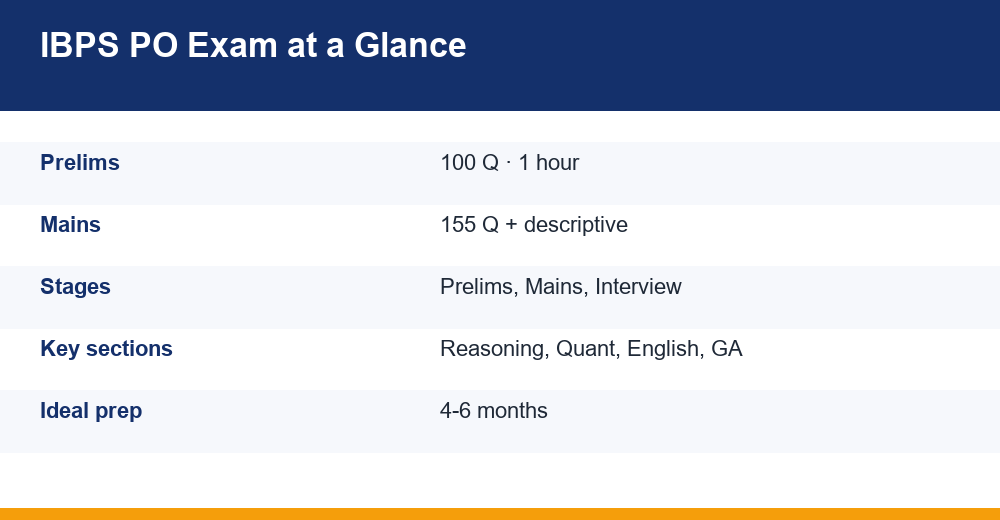
The Institute of Banking Personnel Selection (IBPS) conducts the Probationary Officer (PO) examination to recruit officers for participating public-sector banks. A PO is a scale-I officer who, after a probation period, handles branch operations, customer service, credit and administration, with strong prospects for promotion. Selection runs through three stages: Preliminary Examination, Main Examination and an Interview.
IBPS PO exam pattern
The Preliminary exam is a screening test; the Main exam and interview decide the final merit.
| Stage | Structure | Marks |
|---|---|---|
| Prelims | English, Quantitative Aptitude, Reasoning | 100 |
| Mains (objective) | Reasoning & Computer, GA, English, Data Analysis | 200 |
| Mains (descriptive) | Letter writing & essay | 25 |
| Interview | Personal interview | 100 (final: 80:20 Mains:Interview) |
Prelims lasts one hour with sectional timing; Mains runs about three hours for the objective part plus thirty minutes for the descriptive test. There is negative marking of 0.25 for each wrong objective answer.
IBPS PO Prelims syllabus
The Prelims has three sections with sectional time limits:
| Section | Questions | Marks |
|---|---|---|
| English Language | 30 | 30 |
| Quantitative Aptitude | 35 | 35 |
| Reasoning Ability | 35 | 35 |
| Total | 100 | 100 |
English covers reading comprehension, cloze test, error spotting, sentence rearrangement and fillers. Quantitative Aptitude covers simplification, number series, quadratic equations, data interpretation, and arithmetic (percentage, ratio, average, profit and loss, time and work, interest). Reasoning covers puzzles, seatingarrangement, syllogism, inequalities, coding-decoding, blood relations and direction sense.
IBPS PO Mains syllabus
The Mains is broader and deeper, adding General Awareness and Computer Aptitude, and replacing plain Quant with Data Analysis and Interpretation:
| Section | Questions | Marks |
|---|---|---|
| Reasoning & Computer Aptitude | 45 | 60 |
| General/Economy/Banking Awareness | 40 | 40 |
| English Language | 35 | 40 |
| Data Analysis & Interpretation | 35 | 60 |
| Total (objective) | 155 | 200 |
The descriptive paper tests letter writing and essay writing for 25 marks. General Awareness leans heavily on banking and economy current affairs, so build a running note of RBI announcements, banking terms, schemes and appointments alongside static GK.
IBPS PO preparation strategy
Clear the Prelims first by building speed and accuracy in the three core sections, then shift to the greater depth of Mains. Data Interpretation is the highest-value Mains skill, so invest in it early. For General Awareness, banking and economy awareness matter as much as static GK; a daily current-affairs habit is non-negotiable. Practise the descriptive paper too — a well-structured letter and essay are easy marks that many candidates neglect.
- Prelims: prioritise speed and accuracy; take sectional-timed mocks.
- Mains: master Data Interpretation and banking awareness.
- Maintain a daily current-affairs note focused on banking and economy.
- Practise letter and essay writing weekly for the descriptive paper.
- Prepare for the interview from the start by staying aware of banking developments.
You can verify the official pattern and notification on the IBPS website at ibps.in. For the general-awareness portion, our GK one-liner questions and current affairs preparation strategy map directly onto the banking-awareness section.
Banking & economy awareness topics
The General/Banking Awareness section is where bank exams differ most from other government exams, and it is highly scoring if prepared. Focus on the Reserve Bank of India and its functions; monetary-policy tools such as the repo rate, reverse repo rate, CRR and SLR; money-transfer systems like NEFT, RTGS, IMPS and UPI; types of banks and accounts; regulatory bodies such as SEBI, IRDAI and PFRDA; financial-inclusion schemes such as Jan Dhan Yojana, Mudra and the various insurance schemes; and terms like NPA, priority-sector lending, repo-linked lending rates and inflation. Add banking and economy current affairs of the last six months, since a large share of the section comes from recent developments.
Computer aptitude topics
Computer Aptitude in Mains is a quick-scoring area for most candidates. Cover the fundamentals: the generations and types of computers; hardware and software; memory (RAM, ROM, cache and storage devices); input and output devices; operating systems; the basics of MS Word, Excel and PowerPoint; networking concepts (LAN, WAN, internet); common shortcut keys; and internet security topics such as viruses, phishing and firewalls. Because these facts are finite and factual, a few focused revisions can secure almost the entire computer portion.
Section-wise strategy in detail
Quantitative Aptitude / Data Interpretation is the highest-value area across both stages. In Prelims, focus on simplification, number series, quadratic equations and arithmetic for speed. In Mains, Data Interpretation dominates — practise tables, bar and line graphs, pie charts, and caselet DI until you can read a set quickly and calculate accurately. Strong DI skills often decide the Mains outcome.
Reasoning Ability in banking exams is puzzle-heavy. Master seating arrangements (linear, circular), puzzles (floor, box, scheduling), syllogism, inequalities, coding-decoding and blood relations. In Mains, Reasoning is combined with Computer Aptitude, so revise computer basics — hardware, software, MS Office, networking and abbreviations — which are easy, scoring marks.
English Language rewards steady reading. Build reading comprehension, cloze tests, error spotting, sentence rearrangement and vocabulary. The descriptive paper — a letter and an essay — needs a clear structure and neat expression; practising a few each week turns it into guaranteed marks. General/Banking Awareness combines static GK with banking and economy current affairs: RBI policies, banking terms, financial schemes, appointments and recent developments.
Salary & career growth
An IBPS PO is appointed as a Scale-I officer. The role begins with a probation period and offers a competitive salary made up of basic pay plus dearness allowance, house rent allowance and other benefits, with the total in-hand amount varying by city. Career growth is a major draw: a PO can rise through the officer scales — from Scale I up to senior management and, in exceptional cases, the top executive positions of a bank — through a mix of departmental exams, performance and experience. This long-term trajectory is why banking remains one of the most sought-after career paths for graduates.
A study plan for IBPS PO
A four-to-six month plan works well: spend the first phase building concepts across all sections, the second phase on Prelims-focused speed practice, and the final phase on Mains depth (Data Interpretation, banking awareness and descriptive writing) plus full-length mocks. Reserve the last few weeks before each stage for revision and mock analysis rather than new topics.
Moving from Prelims to Mains
The biggest jump in IBPS PO preparation is from Prelims to Mains. Prelims is about speed on straightforward questions; Mains is about depth, stamina and handling tougher, multi-step problems over a longer paper. As soon as your Prelims mocks are consistently clearing the cut-off, shift the bulk of your effort to Mains: heavier Data Interpretation sets, banking and economy awareness, computer aptitude, and timed descriptive writing. Treat the weeks right after Prelims as the most valuable of your whole preparation, because the Mains and interview decide the final merit.
Common mistakes to avoid
- Neglecting Data Interpretation, which carries the most Mains marks.
- Treating banking awareness as static GK and ignoring current banking news.
- Skipping the descriptive paper until the end — it needs weekly practice.
- Ignoring sectional cut-offs; you must clear every section, not just the total.
- Preparing for the interview only after Mains results instead of staying aware throughout.
Interview & final tips
The interview tests clarity, awareness and composure more than trick questions — know your background, basic banking concepts and current banking news. In the final merit, Mains and interview scores are combined (commonly in an 80:20 ratio), so a strong Mains performance gives you the biggest advantage. Consistent, analysed practice across all stages is what turns IBPS PO preparation into a selection.
Frequently Asked Questions
What is the IBPS PO exam pattern?
IBPS PO has three stages: Prelims (100 marks, 1 hour, covering English, Quantitative Aptitude and Reasoning), Mains (200 marks objective plus a 25-mark descriptive test) and an Interview.
How long does IBPS PO preparation take?
Most candidates need four to six months of consistent study to clear both Prelims and Mains, though a strong base can shorten this.
Which is the toughest section in IBPS PO?
Data Analysis and Interpretation in Mains is usually rated the toughest, as it combines heavy calculation with reasoning under time pressure.
Is there an interview in IBPS PO?
Yes. Candidates who clear the Mains are called for an interview, and the final selection is based on a combined score of the Mains and the interview.