Focused CTET Paper 1 preparation is the first step for anyone who wants to become a primary-school teacher through the Central Teacher Eligibility Test. This complete CTET Paper 1 preparation guide explains the exam pattern, walks through all five subjects with special attention to Child Development and Pedagogy, and lays out a realistic study plan. Because the CTET tests teaching aptitude as much as knowledge, understanding the child-centred approach behind the questions matters as much as memorising facts. Always confirm the current pattern in the official CBSE CTET notification before you begin.
Table of Contents
About CTET Paper 1
The Central Teacher Eligibility Test (CTET) is conducted by the Central Board of Secondary Education to certify candidates for teaching posts in central government schools and many state and private schools. Paper 1 is for those who want to teach at the primary level, classes 1 to 5, while Paper 2 is for the upper-primary level, classes 6 to 8. A candidate who wishes to teach across both levels can take both papers. The CTET certificate, once earned, is a qualifying credential for teacher recruitment; it does not by itself guarantee a job, but it is a mandatory eligibility requirement.
The examination is designed around the principles of the National Curriculum Framework and the Right to Education Act, which is why so many questions are framed from the perspective of how children learn. A candidate who treats CTET as a pure memory test tends to struggle; the paper consistently rewards those who can apply pedagogical understanding to classroom situations.
CTET Paper 1 exam pattern
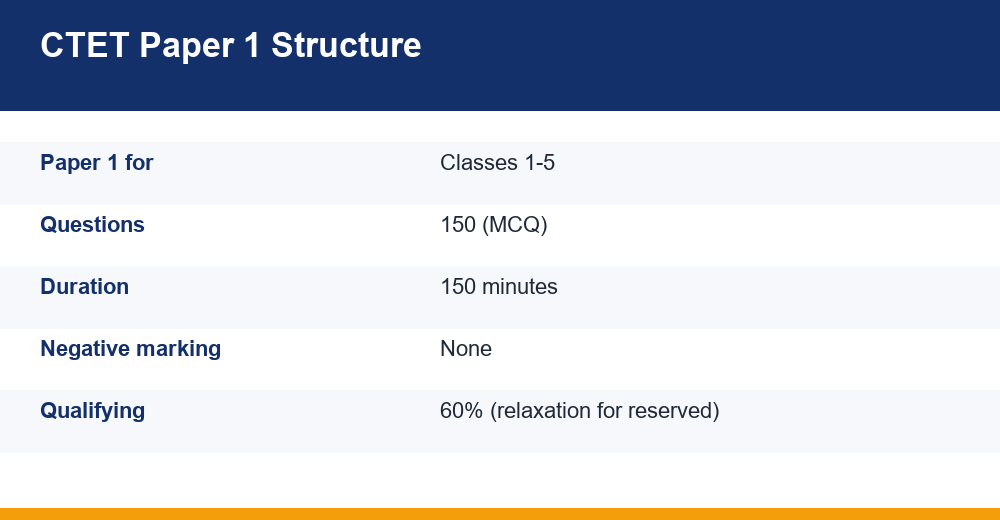
Paper 1 has 150 multiple-choice questions for 150 marks, to be answered in 150 minutes. There is no negative marking, so every question should be attempted. The five subjects are equally weighted:
| Subject | Questions | Marks |
|---|---|---|
| Child Development & Pedagogy | 30 | 30 |
| Language I | 30 | 30 |
| Language II | 30 | 30 |
| Mathematics | 30 | 30 |
| Environmental Studies (EVS) | 30 | 30 |
| Total | 150 | 150 |
Child Development and Pedagogy is compulsory and, in many ways, the most decisive section, because its concepts also underpin the pedagogy sub-sections of Mathematics and EVS. Language I is the medium of instruction chosen by the candidate, tested for proficiency and the pedagogy of language; Language II is a different language, tested similarly. Understanding this structure helps you allocate preparation time sensibly.
Child Development & Pedagogy (CDP)
Child Development and Pedagogy is the heart of CTET Paper 1. It is broadly divided into three parts: child development (roughly 15 questions), the concept of inclusive education and understanding children with special needs (around 5 questions), and learning and pedagogy (around 5 questions). Mastering CDP lifts your score not only in this section but across the pedagogy portions of the other subjects too.
The most important theorists to understand are Jean Piaget, whose theory of cognitive development describes distinct stages through which children pass; Lev Vygotsky, who emphasised the social context of learning and the “zone of proximal development”; Lawrence Kohlberg, known for the stages of moral development; and Howard Gardner, whose theory of multiple intelligences argues that intelligence is not a single ability. Questions rarely ask for a bare definition; instead they present a classroom scenario and ask which principle applies, so aim for genuine understanding rather than rote learning.
Other high-frequency CDP topics include the difference between growth and development, the roles of heredity and environment, principles of development, theories of learning and motivation, individual differences, assessment and evaluation (including the shift towards continuous and comprehensive evaluation), and the ideas behind inclusive education. Contemporary policy references such as the National Education Policy also appear, so keep an eye on current developments in school education.
Language, Mathematics & EVS
Language I and II each combine a reading-comprehension component with a pedagogy-of-language component. The comprehension part tests unseen prose or poetry passages; the pedagogy part covers language acquisition, the principles of teaching language, listening and speaking skills, the role of grammar, remedial teaching and evaluation. You do not need advanced literature — you need solid proficiency in your chosen languages and a clear grasp of how children learn a language.
Mathematics for Paper 1 is pitched at the primary level and covers numbers, addition and subtraction, multiplication and division, measurement, weight, time, money, geometry, data handling and patterns — plus, crucially, the pedagogy of mathematics: the nature of mathematics, place of maths in the curriculum, language of mathematics, evaluation, remedial teaching and common errors children make. The content is simple; the pedagogy is where marks are won or lost.
Environmental Studies (EVS) covers themes such as family and friends, food, shelter, water, travel and things we make and do, along with the pedagogy of EVS — its concept and scope, significance, integrated approach, activities, experimentation, discussion, and continuous and comprehensive evaluation. Because EVS integrates science and social studies at the primary level, questions often test the ability to connect everyday experience with concepts.
CTET Paper 1 preparation strategy
The most effective strategy is to make Child Development and Pedagogy your anchor, because it influences nearly half the paper once you count the pedagogy sub-sections of Maths and EVS. Study the major theorists deeply enough to apply them to scenarios, not just to recall their names. For the content subjects, revise the primary-level syllabus (an NCERT-based foundation works well) and pair every content topic with its pedagogy. Solve previous-year CTET papers extensively, because the exam reuses question patterns and even themes year after year.
- Anchor your preparation in Child Development & Pedagogy.
- Learn theorists by application, using classroom scenarios.
- Pair every content topic (Maths, EVS) with its pedagogy.
- Choose your two languages early and build steady proficiency.
- Solve at least five to ten years of previous CTET papers.
- Since there is no negative marking, plan to attempt all 150 questions.
For the general-awareness and language foundations that support this paper, our GK one-liner questions and Hindi grammar notes on Sandhi are useful companions, and you can confirm official details on the CTET official website.
Key theorists you must know
Because scenario questions dominate Child Development and Pedagogy, it pays to know each major theorist a little more deeply. Piaget proposed four stages of cognitive development — sensorimotor, pre-operational, concrete operational and formal operational — and ideas such as assimilation, accommodation and schema. Vygotsky stressed that learning is social and introduced the zone of proximal development and the idea of scaffolding. Kohlberg described three levels of moral reasoning (pre-conventional, conventional and post-conventional). Gardner argued for multiple intelligences, challenging the idea of a single IQ. A question might describe a child solving a puzzle by trial and error and ask which stage it illustrates; knowing theorists by application lets you answer confidently.
It also helps to understand the shift the CTET expects: from teaching as transmission of facts to learning as active construction of knowledge by the child. This constructivist view underlies the correct option in many pedagogy questions. When two options both look reasonable, the one that puts the child’s active participation, curiosity and individual pace at the centre is usually the intended answer.
Use previous-year papers
Previous-year CTET papers are the most valuable resource for this exam. The CTET reuses question patterns and even repeats themes year after year. Solving several years of papers familiarises you with the style of scenario questions, reveals which pedagogy topics are asked most, and builds the time management you need for 150 questions in 150 minutes. Treat each solved paper as a diagnostic and revise the specific pedagogy ideas you got wrong.
A study plan for CTET Paper 1
A two-to-three month plan works well for most candidates. Spend the first phase building Child Development and Pedagogy thoroughly, since it pays off everywhere. Use the second phase to cover the content and pedagogy of Mathematics, EVS and the two languages, revising the primary syllabus alongside. Reserve the final phase for previous-year papers, full-length mocks and revision. Because CTET rewards understanding over cramming, spaced revision of pedagogy concepts is more valuable than last-minute reading.
Final tips for CTET Paper 1
Approach every question as a teacher, not just as a test-taker: ask what is best for the child’s learning, and the pedagogically sound option is usually the correct answer. Attempt all questions since there is no penalty for wrong answers, manage your 150 minutes so no section is rushed, and keep your language proficiency sharp through regular reading. With Child Development and Pedagogy mastered and previous papers practised, CTET Paper 1 becomes a very achievable qualification.
Frequently Asked Questions
What is CTET Paper 1?
CTET Paper 1 is the paper of the Central Teacher Eligibility Test for candidates who wish to teach classes 1 to 5 (primary level). It has 150 objective questions across five subjects and no negative marking.
What are the subjects in CTET Paper 1?
The five subjects are Child Development and Pedagogy, Language I, Language II, Mathematics and Environmental Studies (EVS), each carrying 30 marks.
What is the qualifying mark for CTET?
The general-category qualifying mark is 60% (90 out of 150); reserved categories get relaxation as per rules. Qualifying makes the CTET certificate valid for teacher recruitment.
Is there negative marking in CTET?
No. CTET has no negative marking, so every question should be attempted.