Physics GK is a dependable scoring area in the general science section of SSC, Railway and Banking exams. Most such questions test finite, factual knowledge — a law, a unit, an instrument or a discovery — rather than problem-solving, which makes them quick marks once revised. This guide brings together the most important laws, SI units, instruments and discoveries, followed by a set of one-liner questions for rapid revision.
Table of Contents
Why physics GK matters
General science usually carries a meaningful share of the general awareness section, and physics is one of its three pillars alongside chemistry and biology. Unlike numerical physics, the physics GK asked in these exams is almost entirely factual: which scientist gave which law, what unit measures what quantity, which instrument does what job. Because the facts are limited and rarely change, a focused revision pays off reliably year after year. Treat this as a memory topic, not a mathematics topic, and it becomes one of the easier parts of general science.
Important laws of physics
A handful of laws and principles are asked repeatedly. Understand the one-line idea behind each rather than only the name:
- Newton’s laws of motion — the foundation of mechanics: inertia, force equals mass times acceleration, and action-reaction.
- Law of gravitation (Newton) — every mass attracts every other mass.
- Archimedes’ principle — a body in a fluid experiences an upthrust equal to the weight of fluid displaced (explains floating).
- Ohm’s law — current is proportional to voltage for a conductor at constant temperature.
- Pascal’s law — pressure applied to an enclosed fluid is transmitted equally in all directions (hydraulic lift).
- Bernoulli’s principle — faster-moving fluid exerts lower pressure (explains aeroplane lift).
SI units to remember
Unit questions are among the most common in physics GK. Learn the quantity and its SI unit together:
| Quantity | SI Unit |
|---|---|
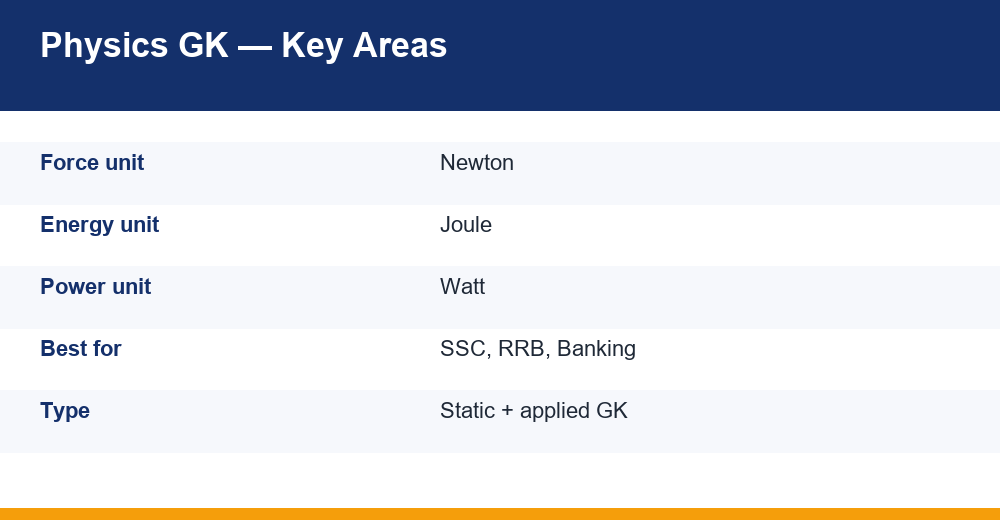
| Force | Newton (N) |
| Work / Energy | Joule (J) |
| Power | Watt (W) |
| Pressure | Pascal (Pa) |
| Electric current | Ampere (A) |
| Frequency | Hertz (Hz) |
| Resistance | Ohm |
| Temperature | Kelvin (K) |
Scientific instruments
Instrument questions pair a device with what it measures. The most-asked pairs are worth memorising as a block:
| Instrument | Measures / Used for |
|---|---|
| Barometer | Atmospheric pressure |
| Thermometer | Temperature |
| Seismograph | Earthquakes |
| Ammeter | Electric current |
| Voltmeter | Voltage / potential difference |
| Hygrometer | Humidity |
| Anemometer | Wind speed |
| Lactometer | Purity of milk |
Discoveries & inventions
Exams also test who discovered or invented what. Key names include Isaac Newton (laws of motion, gravitation), Albert Einstein (theory of relativity, photoelectric effect), C. V. Raman (the Raman effect, for which he won the Nobel Prize in Physics), James Watt (improvements to the steam engine), Alexander Graham Bell (the telephone), Thomas Edison (the practical electric bulb) and Michael Faraday (electromagnetic induction). Linking each discovery to its scientist — and, where relevant, to a national day such as National Science Day on 28 February for the Raman effect — helps the facts stick.
Physics GK one-liner questions
Revise with these quick one-liners, covering the areas above:
| Question | Answer |
|---|---|
| Who formulated the three laws of motion? | Isaac Newton |
| What is the SI unit of electric current? | Ampere |
| Which principle explains why ships float? | Archimedes’ principle |
| What does a seismograph measure? | Earthquakes |
| Who proposed the theory of relativity? | Albert Einstein |
| What is the SI unit of power? | Watt |
| Which instrument measures humidity? | Hygrometer |
| What is the speed of light approximately? | 3 × 10^8 metres per second |
| Which law relates current and voltage? | Ohm’s law |
| What is the unit of frequency? | Hertz |
| Which mirror is used as a rear-view mirror in vehicles? | Convex mirror |
| Why does the sky appear blue? | Scattering of light (Rayleigh scattering) |
For a broader set of quick facts across subjects, combine this with our GK one-liner questions, and cross-check any science fact you are unsure about on a reliable reference such as the National Portal of India.
Everyday physics
Exams increasingly ask physics that explains everyday phenomena, so keep these ready. A rear-view mirror in vehicles is convex because it gives a wider field of view. The sky appears blue because shorter blue wavelengths scatter more than longer red ones. A stick partly in water looks bent because of refraction. We see a flash of lightning before we hear the thunder because light travels far faster than sound. A pressure cooker cooks food faster because higher pressure raises the boiling point of water. Ice floats on water because it is less dense than liquid water. Each of these is a one-line concept that turns into a direct question.
Branches of physics
It also helps to know the main branches, which organise the whole subject: mechanics (motion and force), thermodynamics (heat and energy), optics (light), electromagnetism (electricity and magnetism), acoustics (sound), and modern physics (relativity, quantum theory and nuclear physics). When a question mentions a phenomenon, identifying its branch often points you straight to the relevant law or scientist. This mental map makes even unfamiliar questions easier to place.
Revision tips for physics GK
Because physics GK is factual, spaced repetition works best: revise the laws, units and instruments as small grouped lists rather than in isolation, and test yourself by covering the answer. Pay special attention to the units and instruments tables, which are the highest-frequency question types. A few minutes of revision every couple of days will quietly build a strong general-science score without the time cost of numerical practice.
Frequently Asked Questions
What is the SI unit of force?
The SI unit of force is the newton (N), named after Sir Isaac Newton.
Who gave the three laws of motion?
Sir Isaac Newton gave the three laws of motion, which form the foundation of classical mechanics.
Which instrument measures atmospheric pressure?
The barometer measures atmospheric pressure.
Why is physics GK important for exams?
Physics appears in the general science portion of SSC, Railway and Banking exams, and its facts — units, laws and instruments — are direct, scoring questions.