
The folk dances of India are a favourite art-and-culture topic in SSC, Railway and State PSC exams, usually asked as “which dance belongs to which state”. This guide lists the folk dances of India state by state, and also covers the eight classical dance forms, so you can answer both types of question. Because dances are strongly tied to states and festivals, learning them by region makes them easy to remember.
Table of Contents
Why dances matter in exams
Art and culture questions are common in general awareness, and dances are among the most predictable within that theme. The questions are almost always about matching a dance to its state, so a clear state-wise map is all you need. Dances also connect to festivals (Garba with Navratri, Bihu with the Assamese new year), which lets a single fact answer more than one question. This is low-effort, high-return revision if organised well.
Classical dances of India
India has eight classical dance forms recognised for following codified rules rooted in ancient texts. These are frequently tested, so learn each with its state of origin:
| Classical Dance | State of Origin |
|---|---|
| Bharatanatyam | Tamil Nadu |
| Kathak | Uttar Pradesh / North India |
| Kathakali | Kerala |
| Kuchipudi | Andhra Pradesh |
| Odissi | Odisha |
| Manipuri | Manipur |
| Mohiniyattam | Kerala |
| Sattriya | Assam |
A common exam point is that Kerala is home to two classical forms (Kathakali and Mohiniyattam), and that Sattriya, from Assam, was the most recently added to the list of classical dances.
Folk dances state-wise
Folk dances are community traditions tied to festivals, harvests and seasons. Learn them by state:
| State | Famous Folk Dances |
|---|---|
| Punjab | Bhangra, Giddha |
| Gujarat | Garba, Dandiya Raas |
| Rajasthan | Ghoomar, Kalbelia |
| Assam | Bihu |
| Maharashtra | Lavani |
| Karnataka | Yakshagana, Dollu Kunitha |
| Odisha | Chhau (also Jharkhand & West Bengal) |
| Jammu & Kashmir | Rouf |
| Mizoram | Cheraw (bamboo dance) |
| Himachal Pradesh | Nati |
| Uttar Pradesh | Nautanki, Raslila |
| Tamil Nadu | Karagattam, Kummi |
| Andhra Pradesh | Kolattam |
| Kerala | Theyyam |
| West Bengal | Chhau, Gambhira |
| Goa | Dekhni, Fugdi |
| Nagaland | Chang Lo (Sua Lua) |
| Meghalaya | Nongkrem, Wangala |
| Chhattisgarh | Panthi, Raut Nacha |
| Haryana | Dhamal |
Dances and their festivals
Many folk dances are tied to specific festivals or seasons, and questions often use that link. Garba and Dandiya Raas belong to Navratri in Gujarat; Bihu marks the Assamese new year and harvest; Bhangra is associated with Baisakhi in Punjab; and Chhau is performed around the spring festival in the eastern states. Wangala is the harvest festival dance of the Garo people of Meghalaya, and Nongkrem is a thanksgiving dance of the Khasi community. Learning a dance together with its festival is efficient, because a single association can answer two different questions — the dance-to-state match and the dance-to-festival match.
Classical vs folk dances
Understanding the distinction helps you avoid a common trap. Classical dances follow a codified grammar drawn from ancient treatises such as the Natya Shastra, require years of formal training, and have a recognised guru-shishya tradition. Folk dances grow out of community life, are learned informally, and are performed at festivals, weddings and harvests. So Bharatanatyam is classical while Bhangra is folk, even though both are Indian dances. Questions sometimes mix the two lists deliberately, so keep them separate in your mind. The Kalbelia dance of Rajasthan and Chhau are also recognised by UNESCO as intangible cultural heritage, a detail worth noting.
How to remember folk dances of India
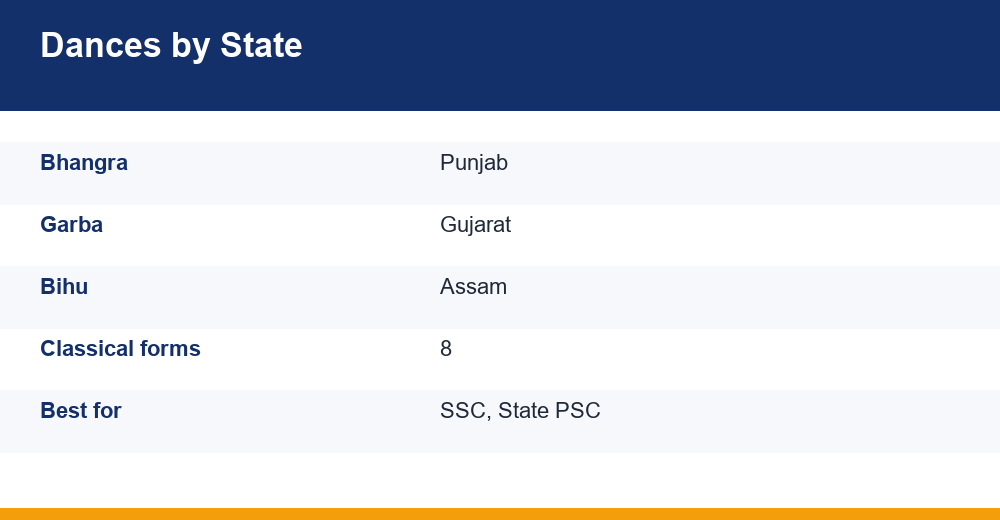
Build a state-wise mental map: picture the map of India and attach one or two dances to each state, starting with the most-asked (Bhangra-Punjab, Garba-Gujarat, Bihu-Assam, Ghoomar-Rajasthan, Lavani-Maharashtra). Keep the eight classical forms as a separate, memorised block. Link dances to festivals where you can, since that reinforces both facts at once. For broader culture and GK revision, combine this with our firsts in India and GK one-liner questions, and verify any detail on the National Portal of India.
Frequently Asked Questions
What is the folk dance of Punjab?
Bhangra (performed by men) and Giddha (performed by women) are the famous folk dances of Punjab.
How many classical dance forms does India have?
India has eight recognised classical dance forms: Bharatanatyam, Kathak, Kathakali, Kuchipudi, Odissi, Manipuri, Mohiniyattam and Sattriya.
What is the difference between folk and classical dance?
Classical dances follow codified rules from ancient texts like the Natya Shastra and are formally trained, while folk dances are community traditions passed down informally and tied to festivals and seasons.
Which is the folk dance of Gujarat?
Garba and Dandiya Raas are the famous folk dances of Gujarat, performed especially during Navratri.