Government schemes are one of the most reliably tested current-affairs and GK topics in SSC, Railway and Banking exams. Questions almost always ask the launch year, the purpose or the ministry behind a scheme, so this guide lists the important government schemes of India in a clear, revision-friendly form and groups them by theme. Because new schemes are announced regularly, keep this list updated with the latest budget and policy announcements.
Table of Contents
Why government schemes matter
Flagship schemes sit at the intersection of current affairs, economy and polity, which is why examiners return to them so often. A single scheme can generate several questions — its year, its ministry, its slogan, its target beneficiaries — so learning each one properly gives a good return. Schemes also connect to the economy section (financial inclusion, employment) and to governance, making them doubly useful. The key is to organise them by theme rather than memorising a random list.
List of important government schemes
Learn each scheme with its launch year and one-line purpose:
| Scheme | Year | Purpose |
|---|---|---|
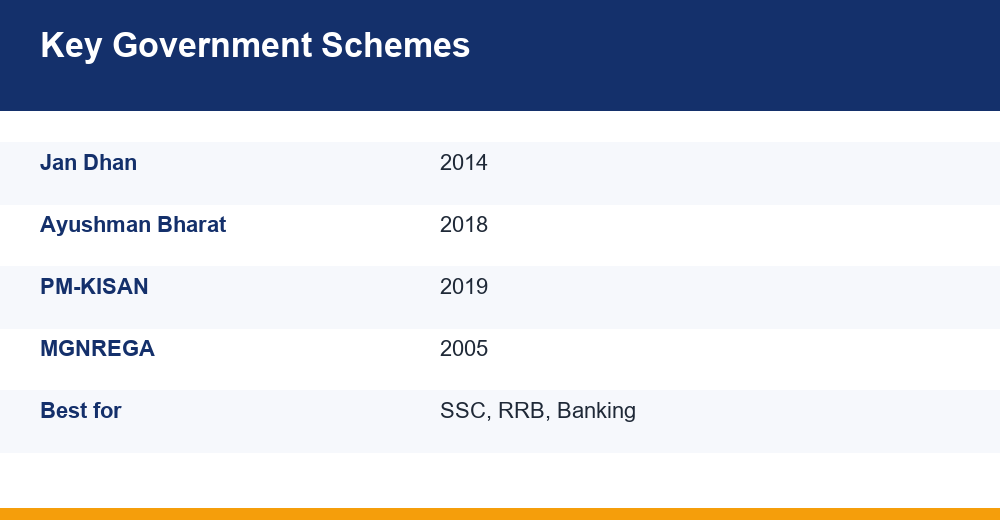
| MGNREGA | 2005 | Guaranteed wage employment in rural areas |
| PM Jan Dhan Yojana | 2014 | Financial inclusion / bank accounts for all |
| Swachh Bharat Mission | 2014 | Sanitation and cleanliness |
| Make in India | 2014 | Boost domestic manufacturing |
| Digital India | 2015 | Digital infrastructure and services |
| Skill India | 2015 | Skill development and training |
| Beti Bachao Beti Padhao | 2015 | Save and educate the girl child |
| Atal Pension Yojana | 2015 | Pension for the unorganised sector |
| PM Mudra Yojana | 2015 | Loans to small and micro enterprises |
| PM Awas Yojana | 2015 | Housing for all |
| Sukanya Samriddhi Yojana | 2015 | Savings scheme for the girl child |
| Startup India | 2016 | Support for startups and entrepreneurs |
| PM Ujjwala Yojana | 2016 | Free LPG connections to poor households |
| PM Fasal Bima Yojana | 2016 | Crop insurance for farmers |
| Saubhagya | 2017 | Household electrification |
| Ayushman Bharat (PM-JAY) | 2018 | Health insurance for poor families |
| PM-KISAN | 2019 | Income support to farmers |
Major welfare & social schemes
Several schemes target social welfare and are especially important. MGNREGA guarantees a set number of days of wage employment per year to rural households and is one of the world’s largest employment programmes. Ayushman Bharat provides health-insurance cover for hospitalisation to crores of vulnerable families, making it one of the largest health-assurance schemes globally. PM Awas Yojana pursues housing for all, while Ujjwala Yojana provides free cooking-gas connections to reduce indoor air pollution. Beti Bachao Beti Padhao addresses the declining child sex ratio and promotes girls’ education. Each of these has a clear target group that is worth remembering.
Financial inclusion & economic schemes
A cluster of schemes drives financial inclusion and entrepreneurship — a favourite area for banking exams. The Jan Dhan Yojana opened bank accounts for the unbanked on a massive scale and underpins direct benefit transfers. Mudra Yojana provides collateral-free loans to micro enterprises in three categories (Shishu, Kishor and Tarun). Atal Pension Yojana and the Jeevan Jyoti and Suraksha Bima schemes extend pension and insurance to the unorganised sector. Stand Up India supports enterprises by women and Scheduled Caste/Scheduled Tribe entrepreneurs. For the economic context behind these, see our Indian economy notes.
Agriculture & farmer schemes
Farmer-focused schemes form an important cluster. PM-KISAN provides direct income support to eligible farmer families in instalments. PM Fasal Bima Yojana offers crop insurance against natural calamities, pests and diseases at a low premium. The Soil Health Card scheme helps farmers use fertilisers efficiently, and the Kisan Credit Card gives farmers timely access to credit. Because agriculture employs a large share of the workforce, these schemes are heavily promoted and frequently tested; remember each one’s specific benefit — income support, insurance, soil testing or credit — to tell them apart.
How to remember government schemes
The most effective way to master schemes is to group them by theme — employment, health, housing, financial inclusion, agriculture, education — and then attach the launch year and ministry to each. Many flagship schemes launched in 2014 and 2015, so clustering by year also helps. Pair each scheme with its one-line purpose and, where relevant, its slogan, since questions often quote the tagline. For related current-affairs practice, combine this with our current affairs preparation strategy and GK one-liner questions.
Revision tips
Keep a running one-page note of schemes grouped by theme and update it whenever a new scheme is announced in the Union Budget or a policy statement. Revise it in short, frequent sessions, and cross-check launch years and details on the National Portal of India. Because scheme questions are direct and unambiguous, this small, well-organised effort converts into steady marks across the general-awareness section.
Frequently Asked Questions
Which government scheme is for financial inclusion?
The Pradhan Mantri Jan Dhan Yojana, launched in 2014, is the flagship financial-inclusion scheme aimed at providing bank accounts to all households.
What is Ayushman Bharat?
Ayushman Bharat (PM-JAY), launched in 2018, is a health-insurance scheme providing cover for hospitalisation to eligible poor and vulnerable families.
When was MGNREGA launched?
The Mahatma Gandhi National Rural Employment Guarantee Act (MGNREGA) was enacted in 2005 to guarantee days of wage employment in rural areas.
Why are government schemes important for exams?
Government schemes are a high-frequency current-affairs and GK topic, and questions typically ask the launch year, the ministry or the purpose of a scheme.