The firsts in India are among the most predictable general-knowledge facts in competitive exams. This categorised list of important firsts in India covers politics, administration, women achievers, science, space, sports and culture — the exact areas SSC, Railway (RRB) and Banking papers draw from. Bookmark it and revise the categories that you forget most.
Table of Contents
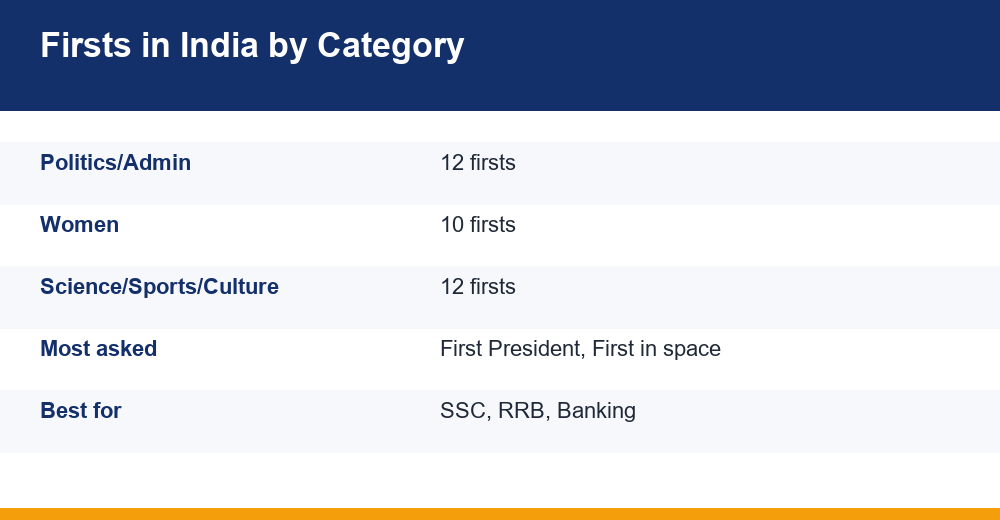
Firsts in politics & administration
These are the most frequently asked firsts in India. The offices of President, Prime Minister and Vice President appear year after year.
| First / Position | Person |
|---|---|
| First President of India | Dr. Rajendra Prasad |
| First Prime Minister of India | Jawaharlal Nehru |
| First Vice President of India | Dr. Sarvepalli Radhakrishnan |
| First Deputy Prime Minister | Sardar Vallabhbhai Patel |
| First woman Prime Minister | Indira Gandhi |
| First woman President | Pratibha Patil |
| First Muslim President | Dr. Zakir Husain |
| First Speaker of the Lok Sabha | G. V. Mavalankar |
| First woman Speaker of the Lok Sabha | Meira Kumar |
| First Chief Justice of India | H. J. Kania |
| First Chief Election Commissioner | Sukumar Sen |
| First Indian to join the ICS | Satyendranath Tagore |
Women firsts in India
“Firsts by women” is often a sub-section of its own. Learn these together, as examiners like to group them in match-the-following questions.
| First (Women) | Person |
|---|---|
| First woman IPS officer | Kiran Bedi |
| First woman IAS officer | Anna Rajam Malhotra |
| First woman Governor of an Indian state | Sarojini Naidu |
| First woman Chief Minister | Sucheta Kripalani |
| First woman judge of the Supreme Court | Justice Fathima Beevi |
| First Indian woman in space | Kalpana Chawla |
| First Indian woman to win an Olympic medal | Karnam Malleswari |
| First Indian woman to climb Mount Everest | Bachendri Pal |
| First Indian woman to win a Nobel Prize | Mother Teresa |
| First Indian to be crowned Miss World | Reita Faria |
Science, sports & culture firsts
This group blends space, cinema, sports and literature. Pair each fact with its year where possible, as the year is sometimes asked too. For related sports facts, see our GK one-liner questions.
| First (Science, Sports & Culture) | Answer |
|---|---|
| First Indian in space | Rakesh Sharma (1984) |
| First Indian satellite | Aryabhata (1975) |
| First Indian to win a Nobel Prize | Rabindranath Tagore (Literature, 1913) |
| First Indian to win an individual Olympic gold | Abhinav Bindra (2008) |
| First Indian chess Grandmaster | Viswanathan Anand |
| First Indian to win the Booker Prize | Arundhati Roy (1997) |
| First Indian to win an Oscar | Bhanu Athaiya (Costume Design, 1983) |
| First feature film of India | Raja Harishchandra (1913) |
| First talkie (sound) film of India | Alam Ara (1931) |
| First Indian city to get a Metro rail | Kolkata |
| First field marshal of the Indian Army | Sam Manekshaw |
| First Indian to swim across the English Channel | Mihir Sen |
Notable firsts in India explained
Some firsts come up so often that it helps to know the story behind them, not just the name. Rabindranath Tagore became the first Indian — and the first Asian — to win a Nobel Prize when he received the 1913 Prize in Literature for Gitanjali, a collection of devotional poems he translated into English himself. This single fact is asked in many forms: first Indian Nobel laureate, first Asian Nobel laureate, and the work for which it was awarded.
Rakesh Sharma, an Indian Air Force pilot, became the first Indian to travel to space in 1984 aboard the Soviet Soyuz T-11 mission, spending about eight days in orbit. When asked by Prime Minister Indira Gandhi how India looked from space, his reply — “Saare Jahan Se Achha” — became famous. Do not confuse him with Kalpana Chawla, the first woman of Indian origin to go to space, who flew on NASA’s Space Shuttle Columbia.
In sport, Abhinav Bindra won India’s first individual Olympic gold medal in the 10m air rifle event at the 2008 Beijing Olympics, while Karnam Malleswari had already become the first Indian woman to win any Olympic medal, taking bronze in weightlifting at the 2000 Sydney Games. In administration, Kiran Bedi became the first woman to join the Indian Police Service (IPS) in 1972, and Bachendri Pal became the first Indian woman to summit Mount Everest in 1984.
Grouping firsts by the person’s field — space, sport, administration, cinema — makes them far easier to recall than a flat alphabetical list, because each field has its own short, memorable story.
Recent firsts you should not miss
Examiners increasingly mix classic firsts with recent achievements, so keep this group current. In cinema, India celebrated two landmark Oscars in 2023: the song Naatu Naatu from the film RRR won Best Original Song — the first song from an Indian film to do so — and The Elephant Whisperers won Best Documentary Short Film. These sit alongside the older fact that Bhanu Athaiya was the first Indian to win an Oscar, for costume design in Gandhi (1983).
In literature, Arundhati Roy was the first Indian woman to win the Booker Prize, for The God of Small Things (1997), and in 2022 Geetanjali Shree’s Tomb of Sand became the first Hindi novel to win the International Booker Prize. In chess, Viswanathan Anand was India’s first Grandmaster, and the tradition he began continues with a new generation of young Indian Grandmasters now among the best in the world. In pageantry, Reita Faria was the first Indian to be crowned Miss World (1966), while Sushmita Sen became the first Indian to win Miss Universe (1994).
The lesson is to treat “firsts” as a living topic: the classic firsts never change, but each year adds a few new ones from sport, cinema and science that examiners love to slip in as current affairs.
Firsts in the world (bonus)
Alongside Indian firsts, general-knowledge papers often include a handful of world firsts. The most commonly asked are worth keeping on the same page:
| First in the World | Person |
|---|---|
| First person to walk on the Moon | Neil Armstrong (1969) |
| First human in space | Yuri Gagarin (1961) |
| First woman in space | Valentina Tereshkova (1963) |
| First person to reach the summit of Everest | Edmund Hillary & Tenzing Norgay (1953) |
| First Secretary-General of the United Nations | Trygve Lie |
Note that Tenzing Norgay, who summited Everest with Edmund Hillary in 1953, links a world first to the subcontinent, and is a frequent crossover question.
State and administrative firsts worth knowing
Beyond national firsts, exams also test administrative and regional firsts: the first Indian to join the ICS (Satyendranath Tagore), the first woman Governor of an Indian state (Sarojini Naidu, in Uttar Pradesh), and the first woman Chief Minister (Sucheta Kripalani, also of Uttar Pradesh). Other administrative firsts worth memorising include the first Chief Justice of India (H. J. Kania), the first Chief Election Commissioner (Sukumar Sen) and the first Field Marshal of the Indian Army (Sam Manekshaw). For State PSC exams, always add your own state’s firsts — first Chief Minister, first Governor, first High Court — to the national set above, because state papers weight local firsts heavily and these are easy marks that many candidates overlook.
Firsts in education, science & economy
Another cluster of firsts covers India’s institutions and infrastructure. These are especially common in Railway and State exams:
| First / Institution | Answer |
|---|---|
| First university of modern India | University of Calcutta, Bombay & Madras (1857) |
| First IIT established | IIT Kharagpur (1951) |
| First nuclear reactor in India | Apsara (1956) |
| First Indian to receive the Jnanpith Award | G. Sankara Kurup (1965) |
| First newspaper of India | Bengal Gazette (1780), by James Augustus Hicky |
| First fully Indian-owned bank | Punjab National Bank (1894) |
| First Indian to win the Nobel Prize in Physics | Sir C. V. Raman (1930) |
| First Indian to win the Nobel Prize in Economics | Amartya Sen (1998) |
The Nobel laureates are worth grouping: Rabindranath Tagore (Literature, 1913), C. V. Raman (Physics, 1930), Mother Teresa (Peace, 1979), Amartya Sen (Economics, 1998) and later Kailash Satyarthi (Peace, 2014) form the core list of India-linked Nobel Prizes that examiners test again and again.
How firsts in India are asked
Questions usually take a direct form (“Who was the first…?”) or a match-the-following pairing a person with their achievement. Because the facts are unambiguous, they are pure-memory marks — there is no reasoning shortcut, only recall. That is exactly why they are worth revising repeatedly. Cross-check any office-holder you are unsure of against the National Portal of India, and connect these firsts with the fuller list of Presidents of India and list of Prime Ministers.
Revision tips for firsts in India
- Group the firsts by category (as above) rather than learning them in a random list.
- Attach a year to each fact where one exists — it doubles the value of the same line.
- Separate look-alikes carefully: first President vs first Prime Minister, first woman IPS vs first woman IAS.
- Self-test weekly by covering the answer column; recall beats re-reading every time.
Treat firsts in India as guaranteed marks: a compact, closed set of facts that rewards steady revision far more than last-minute cramming.
Frequently Asked Questions
Who was the first President of India?
Dr. Rajendra Prasad was the first President of India, serving from 1950 to 1962.
Who was the first Indian in space?
Rakesh Sharma became the first Indian to travel to space in 1984 aboard a Soviet mission.
Who was the first woman Prime Minister of India?
Indira Gandhi was the first woman Prime Minister of India.
Why is the “firsts in India” topic important for exams?
It is a self-contained, high-frequency chapter in SSC, Railway and Banking exams, where facts are asked directly with little scope for confusion once memorised.