The difference between SI and CI is one of the most predictable question types in SSC CHSL, CGL, Railway and banking arithmetic papers, and it can usually be solved in a single line once you know the right formula. This guide covers the 2-year and 3-year shortcuts, the half-yearly and quarterly traps, and reverse questions where the difference is given and you must find the principal or the rate.
Table of Contents
Why Is Compound Interest More Than Simple Interest?
Simple interest is calculated only on the original principal. If you lend ₹10,000 at 10% per annum, you earn ₹1,000 every year, no matter how many years pass. The formula is SI = P × R × T / 100.
Compound interest adds each year’s interest to the principal, so the next year’s interest is calculated on a bigger amount. The amount formula is A = P(1 + R/100)^T, and CI = A − P.
So the gap between the two is nothing but interest earned on interest. In year one there is no earlier interest to grow, which is why the two are equal for 1 year when compounding is annual. From year two onward, CI pulls ahead and the gap widens every year.
| Year | SI earned that year | CI earned that year | Extra from compounding |
|---|---|---|---|
| 1 | ₹1,000 | ₹1,000 | ₹0 |
| 2 | ₹1,000 | ₹1,100 | ₹100 |
| 3 | ₹1,000 | ₹1,210 | ₹210 |
The table uses ₹10,000 at 10% per annum. Add up the last column and you get ₹100 after 2 years and ₹310 after 3 years. Those two numbers are exactly what the shortcut formulas below produce, which is an easy way to remember that they are correct.
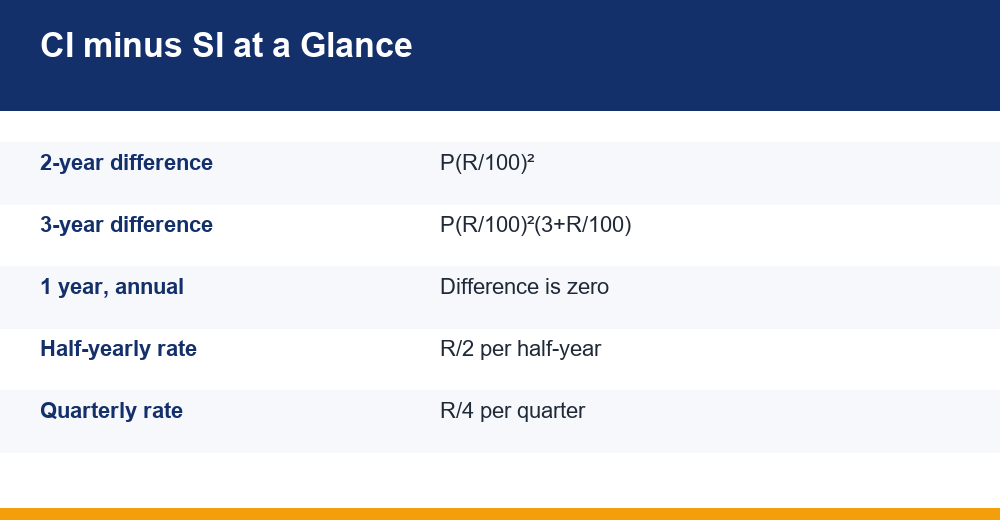
- Year 1 (annual compounding): CI = SI, difference is zero.
- Year 2: CI earns extra interest on year-1 interest.
- Year 3: CI earns extra interest on the interest of years 1 and 2, plus interest on that interest.
Because the whole topic rests on percentage change, it helps to be fluent with successive percentages first. Our page on percentage questions for competitive exams covers the base skills that make these calculations quick.
Difference Between SI and CI Formula for 2 Years
For a principal P at R% per annum compounded annually, the 2-year formula is:
CI − SI (2 years) = P × (R/100)²
Here is why it works. SI for 2 years is 2PR/100. CI for 2 years is P[(1 + R/100)² − 1] = 2PR/100 + P(R/100)². Subtract SI and only P(R/100)² remains. That leftover term is the interest earned in year two on the year-one interest.
Solved example 1
Find the difference between compound interest and simple interest on ₹12,000 for 2 years at 5% per annum.
- Write r = 5/100 = 0.05.
- Square it: r² = 0.0025.
- Multiply: 12,000 × 0.0025 = ₹30.
Answer: ₹30. There is no need to compute CI and SI separately, which saves valuable time in a timed paper.
A second way to see it
The 2-year difference also equals one year’s simple interest × R/100. On ₹12,000 at 5%, one year’s SI is ₹600, and 5% of ₹600 is ₹30. This version is handy when the question already gives you the SI.
Some papers state the 2-year SI instead of the 1-year SI. Halve it first to get one year’s SI, then take R% of that. For example, if the 2-year SI at 8% is ₹1,600, one year’s SI is ₹800 and the gap is 8% of ₹800, which is ₹64.
What Is the Difference Between CI and SI for 3 Years?
For 3 years with annual compounding, the formula becomes:
CI − SI (3 years) = P × (R/100)² × (3 + R/100)
An equivalent form is P[(R/100)³ + 3(R/100)²]. Expanding (1 + r)³ gives 1 + 3r + 3r² + r³. The 3r part is the simple interest, so the gap is P(3r² + r³). The 3r² term is first-level interest on interest, and r³ is interest on interest on interest.
Solved example 2
Find the difference between CI and SI on ₹10,000 for 3 years at 10% per annum.
- r = 0.10, so r² = 0.01.
- 3 + r = 3.1.
- Difference = 10,000 × 0.01 × 3.1 = ₹310.
Check by the long method: amount = 10,000 × 1.331 = ₹13,310, so CI = ₹3,310. SI = ₹3,000. The gap is ₹310, which matches.
Linking the 2-year and 3-year results
Notice that the 3-year difference is the 2-year difference multiplied by (3 + r). On the same sum and rate, D3 / D2 = 3 + R/100. This ratio is the basis of a popular reverse question, covered in the tricks section.
Quick Reference Table: CI minus SI by Duration
The table below uses P = ₹10,000 and R = 10% per annum, compounded annually, so you can see how fast the difference between SI and CI grows. Memorise the formula column, not the numbers.
| Time | CI − SI formula (r = R/100) | Value at ₹10,000, 10% |
|---|---|---|
| 1 year | 0 | ₹0 |
| 2 years | P r² | ₹100 |
| 3 years | P r² (3 + r) | ₹310 |
| 4 years | P r² (6 + 4r + r²) | ₹641 |
The 4-year row rarely appears in CHSL papers, but it shows the pattern: the gap is not linear. It rises from ₹100 to ₹310 to ₹641 because each year’s interest on interest feeds the next.
The same idea explains why lenders state how often interest is compounded, and why a small change in rate matters over long loans and deposits. Our Indian economy notes explain how interest rates and monetary policy connect to these ideas.
How Half-Yearly and Quarterly Compounding Change the Answer
This is where most marks are lost. When interest is compounded more often than once a year, you must convert both the rate and the time into periods before using any formula.
| Compounding | Rate per period | Number of periods |
|---|---|---|
| Annual | R% | T |
| Half-yearly | R/2 % | 2T |
| Quarterly | R/4 % | 4T |
Solved example 3: half-yearly, 1 year
Find the difference between CI (compounded half-yearly) and SI on ₹8,000 for 1 year at 10% per annum.
- Rate per half-year = 5%; periods = 2.
- Use the 2-period formula: 8,000 × (0.05)² = 8,000 × 0.0025.
- Difference = ₹20.
Check: CI = 8,000 × (1.05² − 1) = ₹820; SI = ₹800. Gap = ₹20. Notice that even for one year the difference is no longer zero, because there are two compounding periods.
Solved example 4: quarterly, 6 months
Find CI − SI on ₹16,000 for 6 months at 20% per annum, compounded quarterly.
- Rate per quarter = 5%; periods in 6 months = 2.
- Difference = 16,000 × (0.05)² = ₹40.
Check: CI = 16,000 × (1.1025 − 1) = ₹1,640, and SI for half a year at 20% is ₹1,600. The gap is ₹40.
Solved example 5: half-yearly, 2 years
₹10,000 at 10% per annum for 2 years, compounded half-yearly. Now there are 4 periods at 5%, so the 2-year shortcut does not apply directly. Compute: CI = 10,000 × (1.05⁴ − 1) = 10,000 × 0.21550625 ≈ ₹2,155.06. SI = ₹2,000. Difference ≈ ₹155.06.
The trap is to apply P(R/100)² with R = 10, which gives ₹100 and is wrong. Always count periods first, then choose the 2-period, 3-period or full formula. In short, the difference between SI and CI depends on the number of compounding periods, not simply on the number of years.
Finding the Principal or Rate When the Difference Is Given
Reverse questions simply rearrange the same formulas. If D is the given difference and r = R/100:
- 2 years: P = D / r²
- 3 years: P = D / [r² (3 + r)]
- Rate from 2-year difference: r = √(D / P)
Solved example 6: principal, 2 years
The difference between CI and SI on a sum for 2 years at 8% per annum is ₹64. Find the sum.
r² = 0.0064, so P = 64 / 0.0064 = ₹10,000.
Solved example 7: principal, 3 years
The difference between CI and SI on a sum for 3 years at 10% per annum is ₹93. Find the sum.
r²(3 + r) = 0.01 × 3.1 = 0.031. P = 93 / 0.031 = ₹3,000.
Solved example 8: principal, 3 years at 20%
The gap for 3 years at 20% per annum is ₹192. Here r² = 0.04 and 3 + r = 3.2, so the multiplier is 0.128. P = 192 / 0.128 = ₹1,500.
Solved example 9: rate from the difference
On ₹25,000 the difference between CI and SI for 2 years is ₹40. Find the rate.
r² = 40 / 25,000 = 0.0016, so r = 0.04, giving R = 4% per annum.
A useful habit: when you get the answer, plug it back into the forward formula. It takes five seconds and catches decimal slips.
10 Smart Formula Tricks for Exams
These shortcuts cover nearly every variation of the difference between SI and CI that appears at the CHSL level.
- 2-year shortcut: D = P(R/100)². Square the rate, divide by 10,000, multiply by P.
- 3-year shortcut: D = P(R/100)²(3 + R/100).
- Ratio trick: on the same sum and rate, D3 / D2 = 3 + R/100. If D2 = ₹50 and D3 = ₹155, then 3 + r = 3.1 and R = 10%.
- SI-based trick: D2 = (one year’s SI) × R/100. If yearly SI is ₹600 at 5%, D2 = ₹30.
- One-year rule: with annual compounding, CI and SI are equal for 1 year.
- Period conversion: half-yearly means R/2 and 2T; quarterly means R/4 and 4T. Do this before anything else.
- Fraction rates: convert rates to fractions where possible. 10% = 1/10, 12.5% = 1/8, 20% = 1/5. Then D2 = P/100 for 10%, P/64 for 12.5%, and P/25 for 20%.
- Reverse principal: P = D × (100/R)² for 2 years. At 5%, P = 400D; at 10%, P = 100D.
- Rate from difference: R = 100 × √(D/P) for 2 years.
- Option elimination: the 3-year difference must be slightly more than three times the 2-year difference on the same sum. Discard options that break this.
Trick 7 is worth practising until it is automatic. For a 2-year question at 20%, the difference is simply P/25, so ₹5,000 gives ₹200 without any decimals.
Trick 3 also works in reverse. If a question gives D2 and D3 and asks for the sum, find r from the ratio, then use P = D2 / r². With D2 = ₹50 and R = 10%, P = 50 / 0.01 = ₹5,000.
Simple and compound interest sit in the arithmetic part of the quantitative syllabus. Always confirm the current scheme and syllabus in the latest notice on the Staff Selection Commission’s official website before you plan your revision.
Common Traps and a CHSL-Level Practice Set
Even strong students drop marks on this topic for avoidable reasons. Watch for these:
- Using the annual rate in the 2-year formula when compounding is half-yearly or quarterly.
- Forgetting that the 2-year and 3-year shortcuts assume annual compounding.
- Squaring R instead of R/100, which inflates the answer by 10,000 times.
- Mixing up which value is given: the difference, the CI, or the total amount.
- Rounding too early in multi-period questions; keep at least four decimals until the final step.
Practice questions
- Find CI − SI on ₹20,000 for 2 years at 6% per annum. (Answer: ₹72)
- Find CI − SI on ₹5,000 for 3 years at 10% per annum. (Answer: ₹155)
- The 2-year difference at 12.5% per annum is ₹125. Find the sum. (Answer: ₹8,000)
- On ₹40,000 the 2-year difference is ₹100. Find the rate. (Answer: 5%)
- Find CI − SI on ₹6,400 for 1 year at 10% per annum, compounded half-yearly. (Answer: ₹16)
Work through each one using the shortcut first, then check it with the long method. Once both approaches agree every time, this topic becomes a reliable source of quick marks in the quantitative section.
To see where arithmetic topics like this fit within your overall study plan, read our SSC CHSL preparation strategy. Revisiting the difference between SI and CI once a week, with five timed questions, is usually enough to keep the formulas fresh.
Frequently Asked Questions
What is the formula for difference between CI and SI for 2 years?
For annual compounding, the 2-year difference equals P × (R/100)², where P is the principal and R is the annual rate. For example, ₹12,000 at 5% gives 12,000 × 0.0025 = ₹30. You can also multiply one year’s simple interest by R/100 to get the same result.
What is the difference between CI and SI for 3 years?
For 3 years with annual compounding, the difference is P × (R/100)² × (3 + R/100). On ₹10,000 at 10%, this is 10,000 × 0.01 × 3.1 = ₹310. The 3-year gap is always slightly more than three times the 2-year gap on the same sum and rate.
How do you find the principal when the difference of CI and SI is given?
Rearrange the formula. For 2 years, P = D ÷ (R/100)²; for 3 years, P = D ÷ [(R/100)² × (3 + R/100)]. If the 2-year difference at 8% is ₹64, then P = 64 ÷ 0.0064 = ₹10,000. Always verify by plugging the answer back.
How does half-yearly compounding change the answer?
Halve the annual rate and double the number of periods. So 10% for 1 year compounded half-yearly becomes 5% for 2 periods, and the difference on ₹8,000 is 8,000 × 0.0025 = ₹20. Unlike annual compounding, CI and SI are no longer equal for one year.