
The national parks in India are a favourite GK and environment topic, usually asked as “which park is in which state” or “which animal is this park famous for”. This list of national parks in India pairs each park with its state and signature wildlife, and highlights the record-holders that appear again and again.
Table of Contents
List of national parks in India
Learn each park with its state and the species it is best known for:
| National Park | State | Famous for |
|---|---|---|
| Jim Corbett | Uttarakhand | Tigers (first national park) |
| Kaziranga | Assam | One-horned rhinoceros |
| Gir | Gujarat | Asiatic lion |
| Ranthambore | Rajasthan | Tigers |
| Sundarbans | West Bengal | Royal Bengal tiger (mangroves) |
| Bandhavgarh | Madhya Pradesh | Tigers |
| Kanha | Madhya Pradesh | Tigers, barasingha |
| Periyar | Kerala | Elephants, tigers |
| Sariska | Rajasthan | Tigers |
| Bandipur | Karnataka | Elephants, tigers |
| Hemis | Ladakh | Snow leopard (largest park) |
| Silent Valley | Kerala | Lion-tailed macaque |
| Keibul Lamjao | Manipur | Sangai deer (only floating park) |
| Great Himalayan | Himachal Pradesh | Alpine wildlife (UNESCO site) |
| Nanda Devi | Uttarakhand | High-altitude fauna (UNESCO site) |
More parks that appear frequently in state and railway papers are worth adding to your list:
| National Park | State | Famous for |
|---|---|---|
| Pench | Madhya Pradesh | Tigers (inspiration for The Jungle Book) |
| Satpura | Madhya Pradesh | Tigers, leopards |
| Nagarhole | Karnataka | Elephants, tigers |
| Dudhwa | Uttar Pradesh | Tigers, swamp deer |
| Namdapha | Arunachal Pradesh | Biodiversity (four big cats) |
| Manas | Assam | Tigers (UNESCO site) |
| Simlipal | Odisha | Tigers, elephants |
| Dachigam | Jammu & Kashmir | Hangul (Kashmir stag) |
| Velavadar | Gujarat | Blackbuck |
| Valley of Flowers | Uttarakhand | Alpine flowers (UNESCO site) |
Record-holding & famous parks
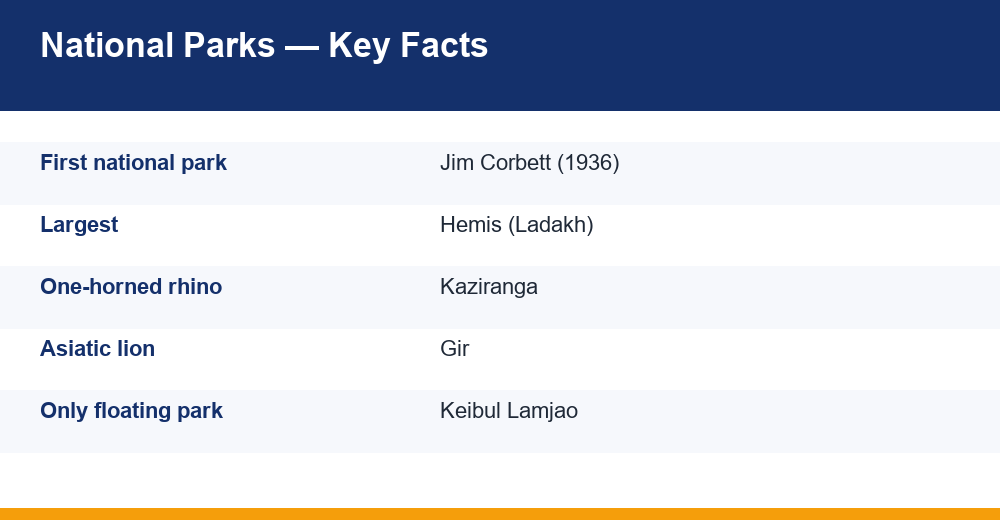
The record-holders are the highest-yield facts. Jim Corbett (Uttarakhand, 1936) is the first national park in India and the birthplace of Project Tiger. Hemis in Ladakh is the largest national park in India and is known for the snow leopard. Kaziranga in Assam, a UNESCO World Heritage Site, protects two-thirds of the world’s one-horned rhinos. Gir in Gujarat is the last home of the Asiatic lion. Keibul Lamjao in Manipur, on Loktak Lake, is the only floating national park in the world and shelters the endangered sangai deer.
Parks grouped by state
Grouping by state answers “which parks are in this state” questions and helps with map-based items. Madhya Pradesh is especially rich, with Bandhavgarh, Kanha, Pench and Satpura; Rajasthan has Ranthambore and Sariska; Kerala has Periyar and Silent Valley; Uttarakhand has Jim Corbett and Nanda Devi; and Karnataka has Bandipur and Nagarhole. For the physical geography behind these habitats, see our major rivers of India guide.
Project Tiger and tiger reserves
Launched in 1973 from Jim Corbett National Park, Project Tiger is India’s flagship conservation programme and a heavily tested topic. It created a network of tiger reserves managed by the National Tiger Conservation Authority (NTCA). Many famous national parks — Corbett, Ranthambore, Kanha, Bandhavgarh, Sundarbans and Periyar — are core areas of tiger reserves. A common exam trap is the difference between a national park and a tiger reserve: a tiger reserve is a larger conservation unit that usually includes a national park or sanctuary as its core, plus a buffer zone.
Protected areas: parks, sanctuaries & biosphere reserves
India’s protected areas come in a hierarchy that examiners like to compare. A national park has the highest level of protection, where no human activity is generally allowed. A wildlife sanctuary offers protection but permits some regulated activity. A biosphere reserve is a much larger area that conserves whole ecosystems and may contain several national parks and sanctuaries within it — the Nilgiri, Nanda Devi and Sundarbans biosphere reserves are examples. Knowing this hierarchy answers a whole class of environment questions.
UNESCO World Heritage natural sites
Several national parks are inscribed as UNESCO World Heritage Sites for their natural value, and these are asked directly. Kaziranga (Assam), Sundarbans (West Bengal), Nanda Devi and Valley of Flowers (Uttarakhand), Manas (Assam), Keoladeo (Rajasthan, famous for birds) and the Western Ghats cluster all hold this status. Grouping the UNESCO natural sites together is an efficient way to lock in several high-probability facts at once.
Why national parks matter in exams
National parks link geography, environment and current affairs — Project Tiger, UNESCO World Heritage listings, and conservation news all draw on them. Questions test the state, the signature species and the records, and increasingly appear in environment and ecology sections of exams like SSC, Railway and State PSC. You can verify designations and details through official sources such as the National Portal of India.
Famous bird sanctuaries
Bird sanctuaries often appear alongside national parks in the environment section, so keep a short list ready. The Keoladeo National Park (formerly Bharatpur Bird Sanctuary) in Rajasthan is a UNESCO site famous for migratory birds. Other frequently asked sanctuaries include Salim Ali (Goa), Ranganathittu (Karnataka), Vedanthangal (Tamil Nadu, one of the oldest), Nal Sarovar (Gujarat) and Chilika Lake (Odisha), a brackish-water lagoon that draws huge flocks of migratory birds each winter. Pairing these with the national parks list gives you complete coverage of the “protected areas” theme.
Quick facts about national parks in India
Some standout facts recur across exams. Jim Corbett, established in 1936, was originally named Hailey National Park and later renamed after the conservationist Jim Corbett. Kaziranga holds the largest population of the one-horned rhinoceros in the world. Gir is the only natural home of the Asiatic lion outside Africa. Keibul Lamjao is the only floating national park on earth, formed on the phumdis (floating vegetation) of Loktak Lake. Hemis, the largest national park in India, is renowned for the elusive snow leopard. Facts like these are exactly what examiners turn into direct questions.
How to remember national parks in India
- Learn each park as a trio: park → state → famous species.
- Fix the records first: Jim Corbett (first), Hemis (largest), Keibul Lamjao (only floating).
- Group parks by state, especially Madhya Pradesh and Rajasthan which have many.
- Link parks to conservation programmes (Project Tiger) for current-affairs crossover.
Revised as park-state-species trios, the national parks in India turn into easy, repeatable marks across the GK and environment sections.
Frequently Asked Questions
Which is the first national park in India?
Jim Corbett National Park in Uttarakhand, established in 1936, is the first national park in India.
Which national park is famous for the one-horned rhinoceros?
Kaziranga National Park in Assam is famous for the one-horned rhinoceros and is a UNESCO World Heritage Site.
Where can the Asiatic lion be found in India?
The Asiatic lion is found only in the Gir National Park (Gir Forest) in Gujarat.
Which is the only floating national park in India?
Keibul Lamjao National Park in Manipur, on Loktak Lake, is the only floating national park in the world.