Serious SSC CGL preparation is less about studying harder and more about studying the right things in the right order. This SSC CGL preparation guide for 2026 lays out the exam pattern, the section-wise syllabus, a realistic 90-day study plan and a subject-wise strategy so you always know what to do next. Always confirm the latest pattern with the official notification before you start.
Table of Contents
What is SSC CGL
The Combined Graduate Level (CGL) examination is conducted by the Staff Selection Commission to recruit graduates into Group B and Group C posts across government ministries and departments — roles such as Income Tax Inspector, Assistant Section Officer, Auditor and Statistical Investigator. It is one of India’s most competitive exams, and selection is based on performance across multiple tiers.
SSC CGL exam pattern
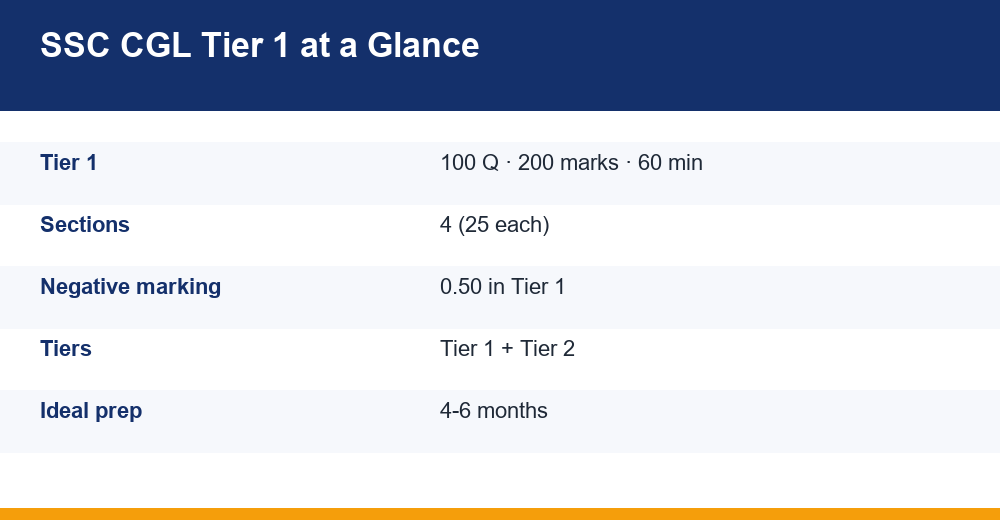
The exam is conducted in two main tiers. Tier 1 is a screening test common to all posts; Tier 2 marks count towards the final merit. The Tier 1 structure is:
| Section | Questions | Marks |
|---|---|---|
| General Intelligence & Reasoning | 25 | 50 |
| General Awareness | 25 | 50 |
| Quantitative Aptitude | 25 | 50 |
| English Comprehension | 25 | 50 |
| Total | 100 | 200 |
Tier 1 lasts 60 minutes with 0.50 negative marking per wrong answer. Tier 2 consists of a compulsory Paper 1 (Mathematics, Reasoning, English, General Awareness and Computer modules) plus specialised papers for certain posts, generally with 1 mark negative marking. Because the exact Tier 2 structure is revised periodically, check the current notification.
Section-wise syllabus
Reasoning: analogies, classification, series, coding-decoding, blood relations, syllogism, non-verbal reasoning. Quantitative Aptitude: number system, percentage, ratio, average, profit & loss, time-speed-distance, algebra, geometry, trigonometry, data interpretation. English: grammar, vocabulary, synonyms/antonyms, error spotting, fill in the blanks, comprehension. General Awareness: static GK, history, polity, geography, economics, general science and current affairs.
For the General Awareness section, our reference sets are directly useful — start with GK one-liner questions, the Indian polity notes and major rivers of India.
SSC CGL preparation strategy
Study all four sections every day rather than one section per week — rotation keeps every subject fresh and prevents last-minute panic. Build concepts first, then move to previous-year questions, then to full mock tests. Reasoning and Quant reward daily practice; English rewards steady vocabulary and grammar work; General Awareness rewards short, frequent revision. Track accuracy, not just attempts, because negative marking punishes careless guessing.
- Phase 1 (concepts): learn every topic in each section with basic practice.
- Phase 2 (practice): solve previous-year questions topic by topic.
- Phase 3 (mocks): full-length tests with detailed analysis of every mistake.
Reasoning strategy: this is the most scoring and time-efficient section. Master the recurring types — analogy, classification, series, coding-decoding, blood relations and syllogism — and practise until you can identify the pattern in seconds. Non-verbal reasoning (mirror images, paper folding) is pure practice and should not be skipped, as it offers quick marks.
Quantitative Aptitude strategy: Quant decides most final selections because it separates candidates. Build arithmetic first (percentage, ratio, profit & loss, time-speed-distance, averages), then advanced topics (algebra, geometry, trigonometry, mensuration) and finally data interpretation. Learn tables up to 20, squares up to 30 and common fractions as percentages to save precious seconds. Accuracy under time pressure only comes from solving hundreds of previous-year problems.
English strategy: English is scoring for those who read regularly. Split preparation into grammar (error spotting, sentence improvement, fill in the blanks), vocabulary (synonyms, antonyms, idioms, one-word substitutions) and comprehension. A daily habit of reading and noting new words compounds over months into a strong vocabulary base.
General Awareness strategy: GA is the fastest section to attempt in the exam but the slowest to build, so start early and revise in short daily doses. Static GK (history, polity, geography, science) is finite and repeats; current affairs needs a running note by category. Our current affairs preparation strategy pairs well with this section.
Detailed section-wise syllabus
It helps to see the full topic list for each section so nothing is missed. General Intelligence & Reasoning covers analogies, similarities and differences, space visualisation, problem-solving, judgement, decision-making, visual memory, discrimination, observation, relationship concepts, arithmetical reasoning, verbal and figure classification, arithmetic number series, and non-verbal series, along with coding-decoding and statement-conclusion questions.
Quantitative Aptitude covers the whole number, decimal and fraction system, relationships between numbers, percentage, ratio and proportion, square roots, averages, interest (simple and compound), profit and loss, discount, partnership, mixture and alligation, time and distance, time and work, and the whole of elementary algebra, geometry, mensuration, trigonometry, and data interpretation through bar graphs, pie charts and tables.
English Comprehension tests error recognition, fill in the blanks, vocabulary (synonyms, antonyms, spellings), grammar, sentence structure, one-word substitutions, idioms and phrases, sentence improvement, active and passive voice, direct and indirect speech, and reading comprehension passages. General Awareness spans history, culture, geography, economic scene, general polity, the Constitution, scientific research and current affairs of national and international importance.
Tier 2 in detail
Tier 2 is where the final merit is largely decided, so it deserves focused attention once Tier 1 is cleared. In the current pattern, Tier 2 has a compulsory Paper 1 taken by all candidates, plus additional papers for specific posts (Paper 2 for Junior Statistical Officer and Paper 3 for Assistant Audit/Accounts Officer). Paper 1 is divided into modules covering Mathematical Abilities and Reasoning, English Language and Comprehension, General Awareness, Computer Knowledge and a Data Entry Speed Test (DEST). The Computer Knowledge module is qualifying, and the DEST is a skill check. Because Tier 2 carries higher marks and generally has 1 mark negative marking, the depth of preparation must go a level beyond Tier 1. Always confirm the current module structure in the official notification, as SSC has revised it in recent years.
Posts, salary & career growth
SSC CGL recruits for Group B and Group C posts across ministries. Popular posts include Assistant Section Officer (in ministries such as External Affairs and Railway), Income Tax Inspector and Inspector (Central Excise) under the CBDT and CBIC, Assistant Audit Officer and Assistant Accounts Officer (the highest-paid, Group B gazetted posts) under the CAG, and Statistical Investigator. Pay is structured according to the 7th Pay Commission pay levels (roughly Level 4 to Level 8 depending on the post), with the total in-hand salary varying by city and allowances. Career growth comes through departmental promotions and departmental examinations, and several posts offer a clear path to senior gazetted ranks over time.
Eligibility & posts
SSC CGL is open to Indian citizens who hold a bachelor’s degree from a recognised university, with the age limit varying by post (generally within the 18-32 band, with relaxations for reserved categories). The exam recruits for a wide range of posts — Assistant Section Officer, Income Tax Inspector, Inspector (Central Excise), Assistant Audit Officer, Statistical Investigator and more — each with its own pay level and department. Because eligibility and age limits are revised in each cycle, confirm the exact criteria in the official notification before applying.
Myths vs reality
A few myths hold candidates back. “You need coaching to clear SSC CGL” — untrue; many toppers are self-study candidates who used free resources, previous-year papers and mocks. “English is impossible without an English-medium background” — untrue; English is the most improvable section with daily grammar and vocabulary work. “You must attempt all 100 questions” — false and dangerous under negative marking; high accuracy on 90 beats careless attempts on 100. Seeing the exam clearly, without these myths, is itself a competitive advantage.
A 90-day SSC CGL study plan
A focused three-month plan divides neatly into three phases of 30 days each:
| Phase | Days | Focus |
|---|---|---|
| Concept building | Day 1-30 | Cover full syllabus of all four sections with basic practice |
| Application | Day 31-60 | Previous-year questions, sectional tests, speed building |
| Test & revise | Day 61-90 | Full mocks, error analysis, current affairs and revision |
Working professionals can follow the same plan with 3-4 focused hours on weekdays and longer weekend sessions. The phases matter more than the exact hours.
How to attempt the paper on exam day
Strategy inside the exam hall is as important as months of study, because Tier 1 is only 60 minutes for 100 questions. A reliable order is to start with General Awareness (fast, either you know it or you do not — spend no more than 7-8 minutes), then Reasoning (quick, high accuracy), then English, and finally Quantitative Aptitude, which is the most time-consuming. Aim to give each of the four sections a roughly fixed time budget so that a hard Quant question never eats the minutes that easy marks elsewhere deserve.
Because of the 0.50 negative marking, accuracy is everything. Attempt a question only when you can eliminate at least two options; leave a question blank rather than guessing blindly. Most toppers attempt 90-95 questions with very high accuracy rather than all 100 with careless errors. Practising this exact rhythm in full-length mocks is what turns knowledge into a score.
Cut-off and normalisation
SSC releases category-wise cut-offs after each tier, and because the exam runs in multiple shifts, scores are normalised to account for differences in difficulty between shifts. You cannot control normalisation, so focus on maximising accuracy in your own shift. As a rough guide, aim comfortably above the previous year’s cut-off for your category and target post, and remember that Tier 2 marks ultimately decide the final merit for most posts.
Best books & resources
- Reasoning: a standard verbal & non-verbal reasoning book plus daily practice sets.
- Quantitative Aptitude: one concept book plus a large question bank of previous-year problems.
- English: a grammar reference plus regular reading to build vocabulary.
- General Awareness: concise static-GK notes and a monthly current-affairs compilation.
- Above all: previous-year papers and full-length mock tests — the single highest-return resource.
You can confirm official dates, vacancies and the syllabus on the Staff Selection Commission website.
A sample daily timetable
A workable daily routine during full-time preparation keeps all four sections in rotation while leaving room for revision and testing:
| Slot | Activity |
|---|---|
| Morning (1.5 hrs) | Quantitative Aptitude — concept + practice |
| Late morning (1 hr) | Reasoning — practice sets |
| Afternoon (1 hr) | English — grammar or vocabulary + reading |
| Evening (1 hr) | General Awareness + current affairs notes |
| Night (30 min) | Revision of the day + short self-test |
Two or three times a week, replace part of this routine with a full-length mock test followed by detailed analysis. The analysis matters more than the test: for every wrong answer, identify whether it was a concept gap, a silly mistake or a time-pressure error, and target that cause. Candidates who analyse mocks improve far faster than those who simply take more of them.
Common mistakes to avoid
- Studying only strong sections and avoiding weak ones — the weak section decides your rank.
- Reading without testing — mocks and PYQs reveal what reading hides.
- Ignoring negative marking — accuracy is as important as attempts.
- Leaving current affairs to the end — a little every day beats a last-week rush.
- Taking mocks without analysing them — the analysis is where the improvement happens.
- Chasing too many books — one good resource per section, revised well, beats ten skimmed.
Consistent, analysed practice is the whole game in SSC CGL preparation. Follow the phases, respect accuracy, and revise General Awareness in small daily doses to build a score that clears the cut-off comfortably.
Frequently Asked Questions
What is the SSC CGL exam pattern?
SSC CGL Tier 1 has 100 questions for 200 marks in 60 minutes across four sections — Reasoning, General Awareness, Quantitative Aptitude and English — with 0.50 negative marking. Qualifiers then sit Tier 2.
How many months are needed for SSC CGL preparation?
Most aspirants need four to six months of consistent study, though a focused candidate with a strong base can prepare in three months.
Which section is most scoring in SSC CGL?
Quantitative Aptitude and Reasoning are the most scoring because answers are objective and improve sharply with practice; General Awareness is the fastest to attempt.
Is there negative marking in SSC CGL?
Yes. Tier 1 has 0.50 marks deducted per wrong answer, so intelligent guessing and accuracy matter as much as speed.