Questions on tribes of India state wise appear in almost every SSC, Railway, Banking and state TET paper, usually as a simple tribe-and-state match or a question about which group is the largest. This guide puts about 40 major tribes into one revision table, gives the Census 2011 figures behind the common “largest” and “highest” questions, and covers PVTGs along with the tribal festivals and dances that are often asked in the same breath.
Table of Contents
Scheduled Tribes: The Basics Examiners Test
Before you memorise any list, get the constitutional framework straight, because one-mark questions often come from it. The Constitution gives no fixed definition of a tribe. Instead, Article 342 lets the President notify, for each state or Union Territory, the communities that count as Scheduled Tribes (STs). Parliament can then add or remove groups from that list by law.
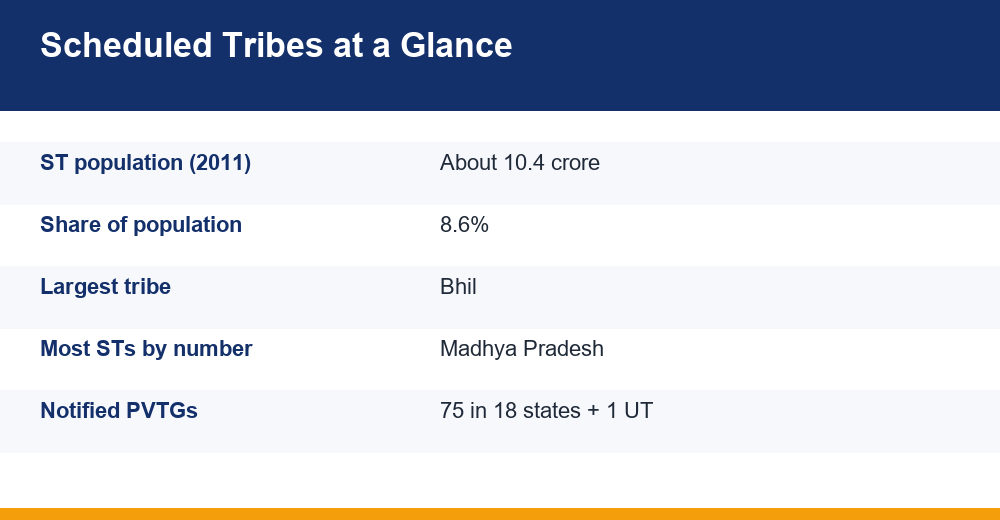
Census 2011 counted roughly 10.4 crore ST people, about 8.6% of India’s population, and close to 90% of them live in rural areas. Because the list is notified state by state, a community can be an ST in one state and not in the next. That is exactly why examiners frame questions on tribes of India state wise rather than as one national list.
- Fifth Schedule: covers the administration of Scheduled Areas in states such as Jharkhand, Odisha, Chhattisgarh and Madhya Pradesh.
- Sixth Schedule: sets up autonomous district councils for tribal areas in Assam, Meghalaya, Tripura and Mizoram.
- Article 338A: creates the National Commission for Scheduled Tribes (added by the 89th Amendment, 2003).
- Ministry of Tribal Affairs: set up in October 1999 as the nodal ministry for tribal welfare.
Punjab, Haryana, Delhi, Chandigarh and Puducherry have no notified Scheduled Tribes. That makes them the right answers to a “which state or UT has no ST population” question.
Tribes of India State Wise: Master Table
The table below is the core of this page. For each state or UT it lists the tribe most often treated as the largest or most prominent, then other tribes that commonly appear in exam options. If you find it hard to place a state on the map, revise the Indian states and their capitals first. Tribe names stick far better once the geography is clear.
| State / UT | Largest or most prominent tribe | Other important tribes |
|---|---|---|
| Madhya Pradesh | Bhil | Gond, Baiga, Korku, Sahariya |
| Rajasthan | Meena | Bhil, Garasia, Sahariya, Damor |
| Gujarat | Bhil | Dubla, Dhodia, Warli, Siddi |
| Maharashtra | Bhil | Gond, Warli, Kokna, Katkari |
| Chhattisgarh | Gond | Oraon, Kanwar, Baiga, Abujh Maria |
| Jharkhand | Santhal | Oraon, Munda, Ho, Birhor |
| Odisha | Khond (Kandha) | Gond, Santhal, Bonda, Juang, Saora |
| West Bengal | Santhal | Oraon, Munda, Lodha, Toto |
| Bihar | Santhal | Oraon, Gond, Tharu |
| Andhra Pradesh | Sugali (Lambada) | Koya, Yanadi, Yerukula, Chenchu |
| Telangana | Lambada | Gond, Koya, Chenchu, Kolam |
| Karnataka | Naikda | Soliga, Jenu Kuruba, Koraga |
| Kerala | Paniyan | Kurichiya, Irula, Kurumba, Kadar |
| Tamil Nadu | Malayali | Toda, Kota, Irula, Kurumba |
| Uttar Pradesh | Gond | Tharu, Kharwar, Buksa |
| Uttarakhand | Jaunsari | Tharu, Bhotia, Buksa, Raji |
| Himachal Pradesh | Gaddi | Gujjar, Kinnaura, Lahaula |
| Jammu and Kashmir | Gujjar | Bakarwal, Gaddi, Sippi |
| Ladakh | Bot (Boto) | Changpa, Brokpa, Balti |
| Sikkim | Bhutia | Lepcha, Limboo, Tamang |
| Assam | Bodo | Mishing, Karbi, Rabha, Dimasa |
| Arunachal Pradesh | Nyishi / Adi | Apatani, Monpa, Mishmi |
| Nagaland | Konyak | Angami, Ao, Sema, Lotha |
| Manipur | Thadou (Kuki) | Tangkhul, Mao, Kabui |
| Mizoram | Mizo (Lushai) | Chakma, Hmar, Lai |
| Meghalaya | Khasi | Garo, Jaintia (Pnar) |
| Tripura | Tripuri | Reang (Bru), Jamatia, Chakma |
| Goa | Gawda | Kunbi, Velip |
| Andaman and Nicobar | Nicobarese | Jarawa, Onge, Shompen, Sentinelese |
| Lakshadweep | Island communities | Almost the whole population is ST |
Some groups appear in several states. The Bhil are found in Madhya Pradesh, Rajasthan, Gujarat and Maharashtra. The Gond stretch across central India and the Santhal across eastern India. When an option lists one of these three, check whether the question asks about a single state or a whole region.
Note: the “largest” ranking at state level is based on Census 2011 figures and can differ slightly by source for smaller states such as Sikkim and Arunachal Pradesh. For exams, learn the pairings shown above, because they match standard question banks.
Which Is the Largest Tribe in India?
By population, the Bhil are the largest tribe in India. Census 2011 counted about 1.7 crore Bhils (approximate). Most live in western and central India, mainly in Madhya Pradesh, Rajasthan, Gujarat and Maharashtra. The name is often linked to a Dravidian word for bow, a reminder of their old reputation as skilled archers.
The Gond come second, at roughly 1.3 crore (approximate). They live across Madhya Pradesh, Chhattisgarh, Maharashtra, Telangana and Odisha, and the historic Gondwana region is named after them. The Santhal are placed third and are the largest tribe in eastern India.
| Position | Tribe | Main states |
|---|---|---|
| 1st | Bhil | MP, Rajasthan, Gujarat, Maharashtra |
| 2nd | Gond | MP, Chhattisgarh, Maharashtra, Telangana |
| 3rd | Santhal | Jharkhand, West Bengal, Odisha, Bihar |
| Other large tribe | Meena | Rajasthan, MP |
| Other large tribe | Oraon | Jharkhand, Chhattisgarh, Odisha, WB |
Watch for a trap. The Santhal are the largest tribe in Jharkhand and West Bengal, but not in India as a whole. If a question says “largest tribe of eastern India”, answer Santhal. If it says “largest tribe of India”, answer Bhil.
Smallest and most isolated groups
At the other end, several Andaman groups have only a few dozen to a few hundred members. The Sentinelese of North Sentinel Island have refused contact with outsiders and their island is protected by law. Their exact population is not known.
Which State Has the Highest Tribal Population?
There are two correct answers, and the wording of the question tells you which one to pick. In absolute numbers, Madhya Pradesh has the most tribal people: about 1.53 crore in Census 2011, or roughly 14.7% of India’s entire ST population. Even so, STs make up only about 21% of the state’s own population.
By percentage of the population, Lakshadweep (about 94.8%) and Mizoram (about 94.4%) rank highest. Among states alone, Mizoram comes first.
| Measure | Top states / UTs (Census 2011, approx.) |
|---|---|
| Largest ST population (numbers) | Madhya Pradesh, Maharashtra, Odisha |
| Share of India’s STs | MP 14.7%, Maharashtra 10.1%, Odisha 9.2% |
| Highest ST share (UT) | Lakshadweep, about 94.8% |
| Highest ST share (state) | Mizoram, about 94.4% |
| Next highest share | Nagaland, Meghalaya (around 86%) |
| No notified STs | Punjab, Haryana, Delhi, Chandigarh, Puducherry |
After Madhya Pradesh, the next states by absolute ST population are Maharashtra, Odisha, Rajasthan, Gujarat, Jharkhand and Chhattisgarh. A quick memory hook for the top three is “MMO”: Madhya Pradesh, Maharashtra, Odisha.
Odisha appears in another common question. It has one of the longest ST lists of any state, with 62 notified communities, and the highest number of PVTGs, at 13.
What Are PVTGs?
Particularly Vulnerable Tribal Groups (PVTGs) are the most marginalised communities within the ST category. The Dhebar Commission (1960-61) first flagged the wide inequality among tribes. From the Fifth Five-Year Plan onwards the government identified such groups as Primitive Tribal Groups, and the name was changed to PVTG in 2006.
There are 75 PVTGs across 18 states and the Union Territory of Andaman and Nicobar Islands. The state-wise list and the related schemes are published on the official Ministry of Tribal Affairs website. Four criteria are used to identify them:
- A pre-agricultural level of technology
- A stagnant or declining population
- An extremely low literacy rate
- A subsistence-level economy
On 15 November 2023 the government launched the PM-JANMAN mission (Pradhan Mantri Janjati Adivasi Nyaya Maha Abhiyan) to bring housing, roads, water, electricity, health and education to PVTG habitations. It was launched in Khunti, Jharkhand, on Janjatiya Gaurav Divas.
| State / UT | Examples of PVTGs |
|---|---|
| Odisha (13, highest) | Bonda, Juang, Dongria Khond, Lanjia Saora, Birhor |
| Andhra Pradesh and Telangana | Chenchu, Kolam, Konda Reddi, Thoti |
| Jharkhand | Asur, Birhor, Korwa, Mal Paharia, Savar |
| Madhya Pradesh / Chhattisgarh | Baiga, Bharia, Sahariya, Abujh Maria |
| Tamil Nadu | Toda, Kota, Irula, Kurumba, Paniyan |
| Andaman and Nicobar | Great Andamanese, Jarawa, Onge, Sentinelese, Shompen |
| Tripura | Reang (Bru) |
| Gujarat | Siddi, Kolgha, Kathodi, Kotwalia |
Keep in mind that the Nicobarese are a Scheduled Tribe but not a PVTG. Options sometimes try to catch students on exactly that point.
Tribes of the Andaman Islands and Jharkhand
These two regions often get a full question to themselves in papers on tribes of India state wise, so it helps to know them in more detail than the master table gives.
Which tribes are found in the Andaman and Nicobar Islands?
The islands have six indigenous groups. Four live in the Andamans and are generally described as Negrito people: the Great Andamanese, Onge, Jarawa and Sentinelese. Two live in the Nicobars and are of Mongoloid stock: the Nicobarese and the Shompen.
- Great Andamanese: once many separate groups, now a very small population resettled on Strait Island.
- Onge: settled at Dugong Creek and South Bay on Little Andaman.
- Jarawa: live in the forests of South and Middle Andaman, near the Andaman Trunk Road.
- Sentinelese: live on North Sentinel Island and reject all outside contact.
- Shompen: forest-dwelling hunter-gatherers of Great Nicobar.
- Nicobarese: the largest group, mostly horticulturists who grow coconut.
Great Nicobar comes up in current affairs because of the proposed international transshipment port at Galathea Bay, which has raised concerns about Shompen lands. For the shipping side of that story, see our list of major ports of India.
Which tribes live in Jharkhand?
Jharkhand has 32 notified Scheduled Tribes. The Santhal are the largest, followed by the Oraon, Munda and Ho. The Santhal speak Santali, which is written in the Ol Chiki script and was added to the Eighth Schedule in 2003.
- Santhal: Santhal Parganas region; remembered for the Santhal Hul (rebellion) of 1855-56 led by Sidhu and Kanhu Murmu.
- Munda: Ranchi and Khunti area; Birsa Munda led the Ulgulan, and his birth anniversary on 15 November is observed as Janjatiya Gaurav Divas.
- Oraon: speak Kurukh, a Dravidian language, and are central to the Sarhul festival.
- Ho: mainly in the Kolhan region of West Singhbhum.
- PVTGs: Asur, Birhor, Birjia, Korwa, Mal Paharia, Sauria Paharia, Savar and others.
Tribal Festivals and Dances Asked With Tribes
Many papers combine a tribe, its state and its festival into one question. Once you know the tribes of India state wise, adding the cultural links takes only one more short list. For the wider list of regional dances, read our page on folk dances of India.
| Festival / Dance | Tribe | State |
|---|---|---|
| Sarhul (spring, sal blossoms) | Oraon, Munda, Ho | Jharkhand |
| Karma festival and dance | Oraon, Munda, Gond | Jharkhand, Chhattisgarh |
| Bhagoria Haat (before Holi) | Bhil, Bhilala | Madhya Pradesh |
| Hornbill Festival (1-10 Dec) | All Naga tribes | Nagaland |
| Wangala (harvest) | Garo | Meghalaya |
| Nongkrem dance | Khasi | Meghalaya |
| Chapchar Kut, Cheraw (bamboo dance) | Mizo | Mizoram |
| Myoko, Dree | Apatani | Arunachal Pradesh |
| Medaram Jatara (Sammakka Saralamma) | Koya | Telangana |
| Bastar Dussehra | Gond, Maria and others | Chhattisgarh |
| Dhimsa dance | Desia Kondh, Gadaba | Odisha, Andhra Pradesh |
| Bison Horn (Gaur) dance | Bison Horn Maria | Chhattisgarh |
Sarhul and Karma are the two festivals most often asked about for Jharkhand. Bhagoria comes up in Madhya Pradesh questions because of its link with the Bhil. The Hornbill Festival takes place at Kisama Heritage Village near Kohima.
Tribal art also shows up in these combined questions. Warli painting belongs to the Warli of Maharashtra, Pithora to the Rathwa and Bhil of Gujarat, and Gond art to the Gond of Madhya Pradesh.
How to Revise Tribes of India State Wise for Exams
This topic is learned best in short, repeated sessions. Census 2011 lists 705 individual ethnic groups as Scheduled Tribes, so don’t try to memorise them all. Focus on the roughly 40 names in the master table and the five common questions answered above.
- Learn the three big belts first: western (Bhil, Meena), central (Gond, Baiga), eastern (Santhal, Oraon, Munda).
- Treat the North-East as its own group: Khasi, Garo, Mizo, Naga, Bodo, Apatani, Tripuri.
- Memorise the island groups as a set of six, and mark which five are PVTGs.
- Learn the two meanings of “highest tribal population”: MP by numbers, Mizoram or Lakshadweep by share.
- Pair every major tribe with one festival, dance or art form.
Self-test: cover the second column of the master table and say the largest tribe for each state out loud. Then do the reverse, naming the state for Toda, Bonda, Chenchu, Warli and Siddi. If you can do both in under five minutes, you are ready for most questions on tribes of India state wise in SSC CGL, CHSL, RRB NTPC and state TET papers.
Figures in this guide come from Census 2011, which remains the latest published census data on Scheduled Tribes. The next census is now under way, so update your notes once its tribe-wise tables are released.
Frequently Asked Questions
Which is the largest tribe in India?
The Bhil are the largest tribe in India, at roughly 1.7 crore people according to Census 2011 (approximate). They live mainly in Madhya Pradesh, Rajasthan, Gujarat and Maharashtra. The Gond rank second and the Santhal third. The Santhal are the largest tribe in eastern India, which makes them a common wrong option.
Which state has the highest tribal population?
Madhya Pradesh has the highest tribal population by numbers, about 1.53 crore in Census 2011, or roughly 14.7% of India’s ST population. By percentage, Lakshadweep (about 94.8%) and Mizoram (about 94.4%) rank highest. Read the question carefully to see whether it asks about numbers or share.
What are PVTGs?
PVTGs, or Particularly Vulnerable Tribal Groups, are the most marginalised tribal communities. They are marked by pre-agricultural technology, very low literacy, a subsistence economy and a stagnant or declining population. There are 75 PVTGs in 18 states and the Andaman and Nicobar Islands. Odisha has the most, with 13.
Which tribes are found in the Andaman and Nicobar Islands?
Six indigenous groups live there. The Great Andamanese, Onge, Jarawa and Sentinelese live in the Andamans, while the Nicobarese and Shompen live in the Nicobars. All except the Nicobarese are classified as PVTGs. The Sentinelese of North Sentinel Island still refuse contact with outsiders and are protected by law.