SSC CHSL preparation works best when every week has a clear job: build basics first, then speed, then exam temperament. This guide gives you a 90-day plan mapped to the actual Tier 1 and Tier 2 pattern, with section-wise score targets, a simple way to analyse mocks and a ranked list of topics you can follow as written or compress if your exam date is closer.
Table of Contents
What Is the SSC CHSL Exam Pattern?
The Combined Higher Secondary Level (10+2) Examination is conducted by the Staff Selection Commission for posts such as Lower Division Clerk/Junior Secretariat Assistant (LDC/JSA) and Data Entry Operator (DEO). Selection runs through two computer-based stages: Tier 1, which only screens you, and Tier 2, which decides the final merit along with a skill or typing test.
Application windows, exam dates and vacancy numbers change every cycle, and SSC often revises its tentative calendar. Before you lock your timetable, read the current notice, schedule and admit card updates on the official Staff Selection Commission website, and count your 90 days backwards from the announced Tier 1 window.
Tier 1 at a glance
| Section | Questions | Marks |
|---|---|---|
| General Intelligence (Reasoning) | 25 | 50 |
| General Awareness | 25 | 50 |
| Quantitative Aptitude (Basic Arithmetic) | 25 | 50 |
| English Language (Basic Knowledge) | 25 | 50 |
| Total (60 minutes) | 100 | 200 |
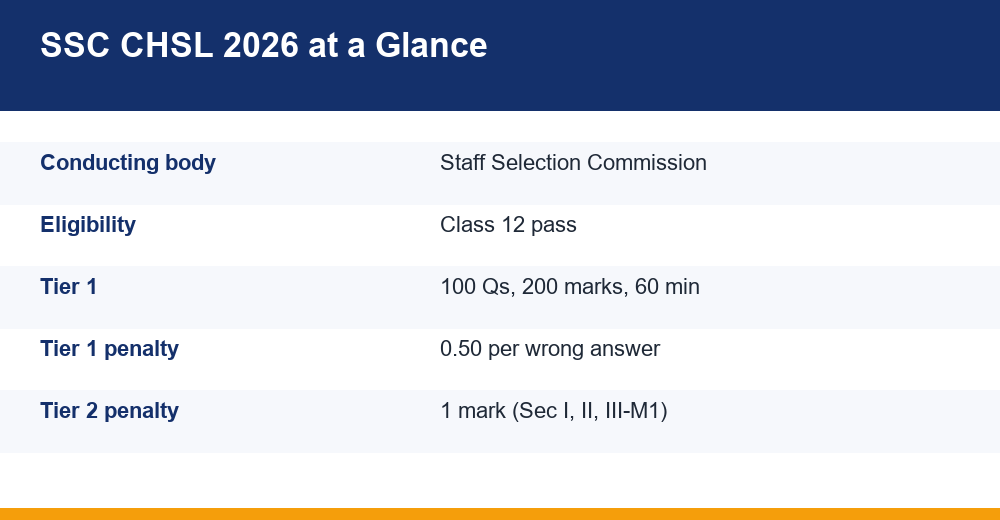
Each wrong answer in Tier 1 costs 0.50 marks. Tier 1 is qualifying, so its marks do not count in the final merit list, but you still need a score well above the cut-off to be shortlisted for Tier 2.
Tier 2 at a glance
| Section / Module | Questions | Marks | Time |
|---|---|---|---|
| Section I: Mathematical Abilities | 30 | 90 | 1 hour (both modules) |
| Section I: Reasoning and General Intelligence | 30 | 90 | |
| Section II: English Language and Comprehension | 40 | 120 | 1 hour (both modules) |
| Section II: General Awareness | 20 | 60 | |
| Section III: Computer Knowledge (qualifying) | 15 | 45 | 15 minutes |
| Section III: Skill Test / Typing Test (qualifying) | – | – | 15 minutes |
Every Tier 2 question carries 3 marks. A wrong answer costs 1 mark in Section I, Section II and the Computer Knowledge module. Sections I and II decide your rank, while Computer Knowledge and the typing or skill test only need to be cleared. Confirm the final module details in the notification for your cycle, since SSC can revise them.
For LDC/JSA posts the typing test has long been set at about 35 words per minute in English or 30 words per minute in Hindi, while DEO posts use a data entry speed test measured in key depressions per hour. Check the exact speed and post-wise rules in your notification.
Before Day 1: Baseline Test and Timetable
Do not start with a book. Start with one full Tier 1 previous year paper, attempted honestly in 60 minutes. This baseline score tells you which sections need foundation work and which only need speed.
- Record your score in each section, plus how many questions you attempted and how many were wrong.
- Note the time you spent per section. Many beginners lose 20 minutes or more in Quant.
- Mark every question you got wrong because of a concept gap (you did not know the method) versus a speed or silly mistake.
- Keep a single notebook for formulas, vocabulary and static GK facts. You will revise from it in the last two weeks.
Then fix your timetable. Split each study day into two deep blocks for weak sections and one lighter block for General Awareness and vocabulary. From Week 9 onwards, study at the same time as your likely exam shift at least three days a week, so you are alert at that hour.
Finally, gather a small, fixed set of resources: one book or course per subject, a source of previous year papers and one mock test series. Switching material every week is one of the most common reasons SSC CHSL preparation stalls halfway.
SSC CHSL Preparation: The 90-Day Week-by-Week Plan
This plan covers about 13 weeks, which is roughly what a serious beginner needs to cover both tiers. The weeks are grouped into four phases, each with a clear outcome.
| Weeks | Phase | Main focus | Mocks |
|---|---|---|---|
| 1-4 | Foundation | Concepts in Quant, grammar rules, reasoning types, static GK | 2 sectional tests per week |
| 5-8 | Practice and speed | Mixed topic practice, previous year questions, current affairs | 1 full Tier 1 mock per week + sectionals |
| 9-11 | Exam simulation | Full mocks, error log, weak-topic repair | 3-4 full Tier 1 mocks per week |
| 12-13 | Tier 1 revision + Tier 2 start | Notebook revision, Tier 2 English and Computer, typing | Alternate-day full mocks |
How to prepare for SSC CHSL in 3 months: phase details
Weeks 1-2: In Quant, finish number system, simplification, percentage, ratio and average. In English, revise parts of speech, subject-verb agreement and tenses. In Reasoning, cover analogy, classification, series and coding-decoding. Read 15-20 minutes of static GK daily, starting with polity and history.
Weeks 3-4: Move to profit and loss, discount, interest, time and work, and speed and distance. A short guide on the difference between simple and compound interest will help here, since SSC papers regularly ask two-year and three-year SI-CI difference questions. In Reasoning, add blood relations, direction and distance problems, and mirror and water images.
Weeks 5-8: Complete geometry, mensuration, trigonometry, algebra and data interpretation. In English, practise cloze test, error spotting, fill in the blanks, idioms and one-word substitution every day. Start a monthly current affairs routine covering appointments, awards, sports, government schemes and important days.
Weeks 9-11: Shift your weight to full mocks. Spend more time analysing each mock than taking it. Repair two weak topics per week using previous year questions only.
Weeks 12-13: Revise your notebook twice. Begin Tier 2 work: longer reading comprehension passages, 20 minutes of typing daily and the basics of computer knowledge such as MS Office, internet, memory and shortcut keys.
Short on time? A compressed version
If you have only five or six weeks before Tier 1, merge Weeks 1-8 into three weeks by skipping low-frequency chapters such as advanced data interpretation, then follow Weeks 9-11 as written. Keep at least one full mock every two days in the final fortnight.
Section-Wise Targets and Strategy
Tier 1 cut-offs change every year with difficulty, category and normalisation, so aim for a safe margin rather than a fixed number. The targets below are approximate goals for a strong attempt, not official figures.
| Section | Target attempts (of 25) | Target accuracy | Time budget |
|---|---|---|---|
| English | 22-25 | 90%+ | 10-12 min |
| General Intelligence | 22-25 | 90%+ | 12-14 min |
| General Awareness | 18-22 | 80%+ | 6-8 min |
| Quantitative Aptitude | 18-23 | 85%+ | 22-26 min |
- English: Attempt it first if it is your strongest area. Quick, accurate marks here create a time cushion for Quant.
- Reasoning: Non-verbal questions like paper folding and embedded figures are fast once practised. Do not skip them.
- General Awareness: Answer only what you know. With a 0.50 penalty, blind guessing rarely helps.
- Quant: Do one pass for easy questions, then a second pass for lengthy ones. Leave anything that takes more than 90 seconds.
Tier 2 strategy
In Tier 2, English carries 120 marks and is often the biggest scoring opportunity. Reading speed, vocabulary and grammar accuracy matter more here than in Tier 1, so start long-passage practice early. Because the penalty rises to 1 mark per wrong answer, accuracy over attempts becomes the rule: each wrong answer wipes out a third of a correct one.
Mathematical Abilities in Tier 2 goes a level deeper than Tier 1 arithmetic, with more algebra, geometry and trigonometry. Revise those chapters once more in the gap between the two tiers rather than starting Tier 2 from scratch.
Most Important Topics for SSC CHSL
Not every chapter deserves equal time. The priority list below reflects topics that appear repeatedly in recent previous year papers. Spend the most hours on high-priority topics before touching the rest.
| Subject | High priority | Medium priority |
|---|---|---|
| Quantitative Aptitude | Percentage, profit and loss, ratio, average, SI and CI, geometry, mensuration, trigonometry | Algebra identities, time and work, speed and distance, DI |
| Reasoning | Analogy, classification, series, coding-decoding, missing number | Blood relations, direction, Venn diagrams, syllogism, mirror and water images |
| English | Error spotting, sentence improvement, synonyms and antonyms, idioms, one-word substitution, cloze test | Active-passive, narration, spelling, comprehension |
| General Awareness | Polity, history, geography, static GK, current affairs | Economics, general science, computer basics |
How to use the list
- Take topic-wise previous year questions for each high-priority chapter.
- Solve 40-50 questions per topic until your accuracy crosses 85%.
- Write the shortcut or rule you used in your notebook in one line.
- Return to the topic once a week until the exam.
General Awareness deserves a note of its own. Static topics such as the Constitution, Indian history, rivers and national parks repeat in new wordings, while current affairs questions usually come from the six to eight months before the exam. Short daily reading beats a last-week cramming marathon.
How Many Hours Should You Study Daily?
There is no official number, but many full-time aspirants manage 6-8 focused hours a day, and working candidates or college students can follow this plan with 3-4 hours. Consistency counts more than one long weekend session.
| Block | Full-time aspirant | Working or student |
|---|---|---|
| Quantitative Aptitude | 2 hours | 1 hour |
| English | 1.5 hours | 45 minutes |
| Reasoning | 1.5 hours | 45 minutes |
| General Awareness | 1 hour | 30 minutes |
| Mock or revision | 1-2 hours | 30-60 minutes |
From Week 9, swap your topic blocks for mocks and analysis on mock days. Add 20 minutes of typing practice daily from Week 10 if you are targeting LDC/JSA, since the typing test is qualifying but cannot be crammed at the last minute.
- Study in 50-minute blocks with a 10-minute break.
- Keep one day a week lighter for revision and rest.
- Protect your sleep: tired practice produces the silly mistakes that later show up in mocks.
The Mock Analysis Method That Raises Scores
Taking 50 mocks without analysis is a common mistake. A focused review after each test is what turns mocks into marks. Use this error log after every full test:
| Error type | What it means | Fix |
|---|---|---|
| Concept gap | You did not know the method | Re-study the chapter, solve 30 PYQs |
| Silly mistake | Calculation or reading error | Slow down by 10%, underline key words |
| Time trap | You knew it but spent over 2 minutes | Add it to a skip-first list |
| Guess gone wrong | Random attempt cost 0.50 marks | Stop guessing below 50% certainty |
- Compare your section scores with your previous three mocks, not with toppers.
- Re-attempt every wrong and skipped question without a timer the same day.
- Count how many marks each error type cost you. Fix the largest bucket first.
- Note your attempt order and decide whether to change it for the next mock.
After two weeks, your error log will show patterns. If silly mistakes keep costing 8-10 marks, the fix is accuracy drills, not more chapters. This is the single habit that separates effective SSC CHSL preparation from routine practice.
Is SSC CHSL Tougher Than SSC CGL?
Generally, no. CHSL is open to Class 12 pass candidates, while CGL is a graduate-level exam with a deeper Quant and English syllabus and more demanding Tier 2 papers. CHSL questions are usually more direct, though competition is intense because of the large number of applicants per vacancy.
The good news is that the two exams overlap heavily. Topics in arithmetic, reasoning, grammar and static GK are common, so your SSC CHSL preparation also builds a base for CGL later. If you plan to attempt both, our guide to SSC CGL preparation explains the extra advanced maths and Tier 2 topics you will need to add.
| Point | SSC CHSL | SSC CGL |
|---|---|---|
| Minimum qualification | Class 12 pass | Graduation |
| Tier 1 structure | 100 Qs, 200 marks, 60 min | 100 Qs, 200 marks, 60 min |
| Maths depth | Basic arithmetic focus | More advanced maths |
| Typical posts | LDC/JSA, DEO | Group B and C posts |
- Similar: Tier 1 structure, sections, and core arithmetic and reasoning topics.
- Different: CGL goes deeper in advanced maths and has a wider Tier 2 syllabus.
- Strategy: Clear CHSL-level basics first, then layer CGL topics on top.
Whichever exam you aim for, a disciplined SSC CHSL preparation routine works the same way: follow the plan phase by phase, keep your error log honest and check the official SSC notices for date changes before each phase ends.
Frequently Asked Questions
How to prepare for SSC CHSL in 3 months?
Spend weeks 1-4 on concepts in Quant, grammar and reasoning, weeks 5-8 on mixed practice and previous year questions with one weekly full mock, and weeks 9-11 on three or four full mocks a week with strict error analysis. Use the final two weeks for notebook revision and Tier 2 English, computer knowledge and typing.
What is the SSC CHSL exam pattern?
Tier 1 has 100 questions for 200 marks in 60 minutes across Reasoning, General Awareness, Quant and English, with a 0.50 penalty per wrong answer and qualifying status. Tier 2 has Maths, Reasoning, English and General Awareness at 3 marks each with a 1-mark penalty, plus qualifying Computer Knowledge and a skill or typing test.
How many hours should I study for SSC CHSL?
There is no fixed rule, but full-time aspirants often study 6-8 focused hours a day, while working candidates or students can follow a structured plan with 3-4 hours. Give Quant the largest share, keep daily English and GK blocks, and replace topic study with mocks and analysis in the final weeks.
What are the most important topics for SSC CHSL?
High-priority topics include percentage, profit and loss, ratio, SI and CI, geometry and trigonometry in Quant; analogy, series and coding-decoding in Reasoning; error spotting, idioms and one-word substitution in English; and polity, history, geography, static GK and current affairs in General Awareness.